

Financial markets were mostly volatile after the US and Iran announced their deal over the weekend. At Polymarket, traders are still debating whether the incident happened at all.
The prediction market platform processed more than $345 million in trading volume for contracts related to the U.S.-Iran peace deal. Although the two countries have announced an agreement, the market remains in limbo as users disagree over whether the development meets the requirements of a contractual “permanent peace agreement.”
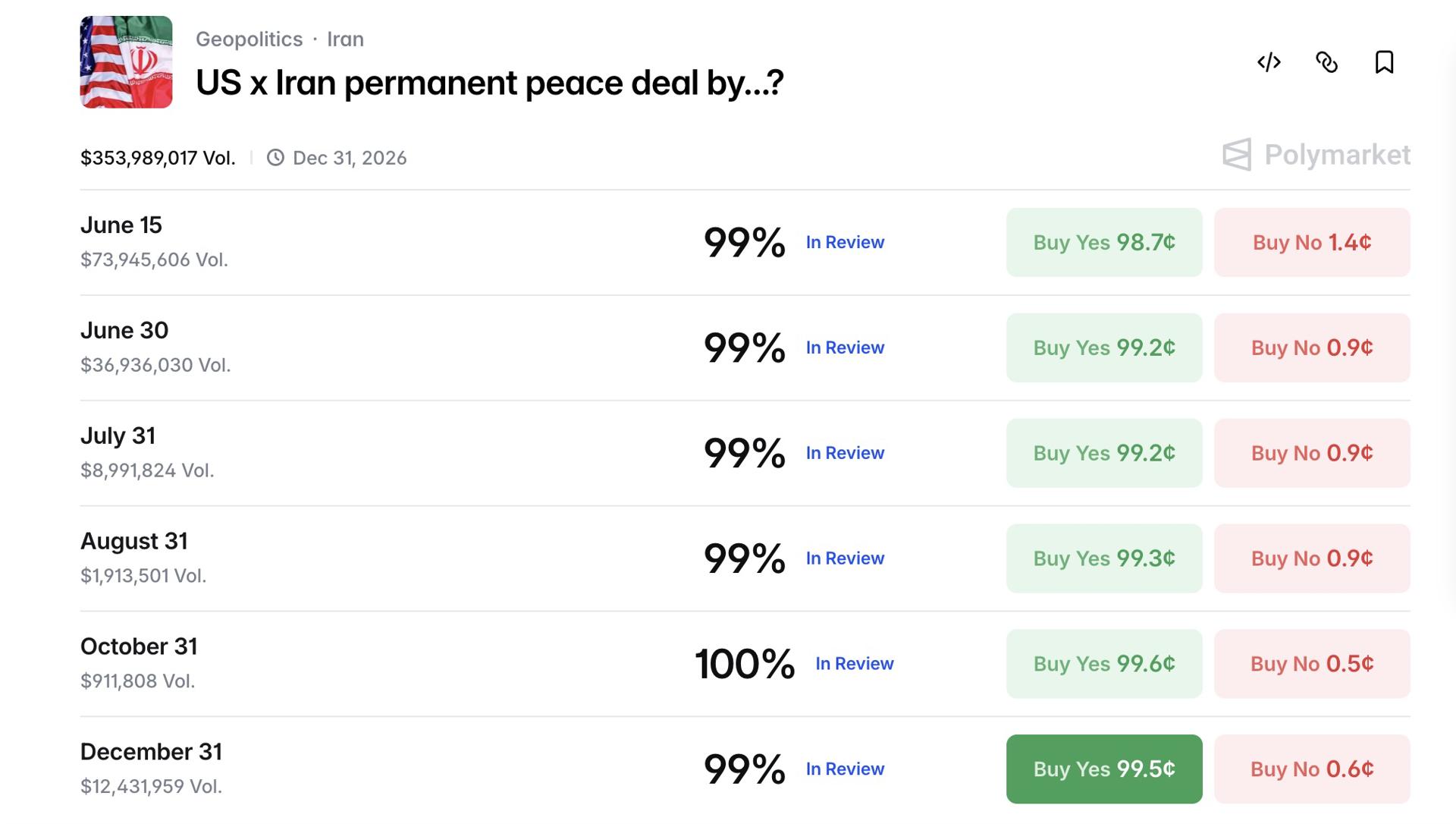
Polymarket’s bet on Iran peace deal challenged. Source: Polymarket
When are peace agreements important?
This conflict overturns Polymarket’s definition of a “permanent peace agreement.” According to contract provisions, a qualifying agreement must explicitly state that military hostilities between the two countries have ended or permanently ceased. Temporary agreements or agreements that do not clearly provide for a permanent cessation of hostilities are not eligible.
This wording divided opinions among traders. Supporters of the “yes” resolution point to official statements describing the agreement as a permanent end to military operations.
Opponents argue that negotiations are still ongoing, that no final document has been signed and that some of the arrangements remain provisional, including the reported 60-day reopening of the Strait of Hormuz.
Traders are now arguing over contract language and official documents, rather than the underlying events themselves.
Who has the final say?
As with other disputed polymarket markets, the final decision is currently $A token holder. They discuss contested results before voting on resolutions.
This process has faced criticism in the past. Bloomberg recently reported that nine wallets control more than half of the tokens used in contested votes. This concentration has raised concerns that a small number of participants could influence outcomes involving hundreds of millions of dollars.
The outcome depends on what happens next. $A Voters will read the contract language and available public statements. Contracts remain negotiable during the dispute process, allowing users to effectively trade how the arbitrator is likely to resolve the dispute.
Beyond one market
The Iran conflict highlights broader challenges for prediction markets as they move into increasingly complex topics such as geopolitics, regulation and public policy.
Prediction markets have become very effective at aggregating expectations. Reconciliation remains difficult when outcomes depend on interpretation rather than clearly verifiable events.
Platforms have adopted a variety of approaches. Polymarket relies on the governance of external token holders to resolve disputed outcomes. In contrast, Calsi settles markets based on a predefined CFTC regulatory rulebook.
Both approaches ultimately face the same challenges. In other words, how should binary markets resolve events that do not neatly fit into a yes or no outcome?


