

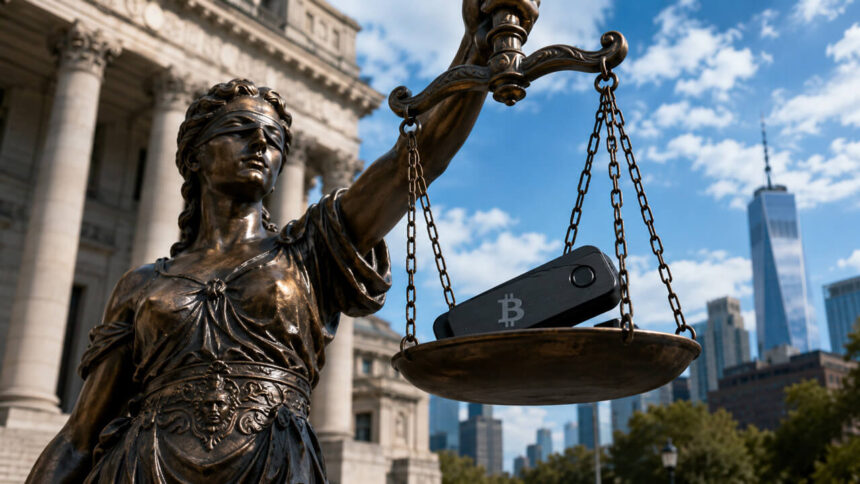
A New York court has suspended a lawsuit seeking to transfer ownership of 39,069 Bitcoin wallets.
The June 5 show-cause order suspended further proceedings on the plaintiffs’ declaratory judgment requests, including coroner’s hearings and default judgment requests, pending a July 14 hearing on draft court briefs by attorney Ian R. Cohen.
This procedural pause comes just days after blockchain posed an even more difficult issue for the case. According to transaction data on mempool.space, on June 2, Bitcoin address 1LwWtSs7tMCwcRczQd5kVMv3xpWw6w4Sxe, an old address associated with the dispute, spent approximately 35.55 BTC after years of inactivity.
The campaign has not identified the owner, explained his motives, or resolved whether his address is in a particular location on the plaintiff’s list of defendants. The simpler reason this is important is that while the address shows a June 2 outgoing transaction, the court record describes a theory built around dormancy, notice, and lost property.
That’s the clash that just happened in front of the courtroom. Plaintiffs are seeking a legal declaration. Bitcoin requires a private key.
Litigation seeks ownership, not keys
The lawsuit, filed by Noah Doe, ABC Company, and XYZ Company against John Doe 1-39,069, asks the New York County Supreme Court to declare that the plaintiffs own thousands of wallets allegedly abandoned. The amended complaint constitutes a request under Section 7B of the New York Personal Property Law, New York’s lost property law.

igcurrencynews’s previous coverage explains the original theory. The plaintiffs stated that the wallets were abandoned property and each had a value of less than $10 for purposes of legal proceedings, and that they attempted to notify the pseudonym address holders via on-chain OP_RETURN messages.
Previously, igcurrencynews’s report on fake legal notices targeting dormant wallets showed why that kind of on-chain notification channel already existed in questionable corners of Bitcoin culture.

The complaint also notes issues that make it difficult to translate the case from courtroom jargon to protocol reality. A private key is required to authorize withdrawals from a Bitcoin wallet, and without the private key, it is impossible to withdraw cryptocurrency.
igcurrencynews’s private key description clearly explains the same mechanism. A key is what allows the owner to sign transactions.
Therefore, the case also raises the question of whether the court can transfer title to real property that the receiver cannot yet move. A ruling can change legal relationships between people or organizations, but it does not become a signature on the Bitcoin network.
June 2 spending changed de facto pressure
The June 2 spending further heightened that tension, as dormancy looked like a weak shortcut to abandonment. mempool.space shows confirmed transactions starting with b90755… that spent 35.546714 BTC from 1LwWt… address on June 2, 2026.
The exact identity behind the expenditure is not established in current records. The useful fact is that someone was able to move coins from an address that appeared unused for years.
Legally, the plaintiffs’ theory depends on whether courts treat inactivity as evidence of loss or abandonment of the wallet. Technically, the only test of a blockchain was whether a transaction met the network’s rules. Culturally, long periods of silence are normal with Bitcoin.
Owners can keep coins for years, estates can leave keys untouched, old miners can ride out the cycle, and wallets can remain silent for reasons unrelated to abandonment.
The court’s hold did not decide any of these issues. However, it blocked the path to default relief.
It is unlikely that a defendant with an assumed address will appear in court in the normal manner, meaning that a friend of the court application may be the first significant adversarial test of the title theory before the court considers an application for default.
Mr. Cohen’s Brief Attacks the Lost and Found Mechanism
Cohen’s court brief argues that Article 7B was written to cover tangible property that the finder could physically take into custody and turn over to police. The brief claims that those who scanned the public blockchain did not discover anything within the meaning of the statute and do not own the coins or their keys.
This argument is different from saying Bitcoin is outside the law. Courts can adjudicate ownership disputes over digital assets, compel parties to litigate, and issue orders to enforce enforcement on the financial system.
Cohen’s point is more specific. Seeing a speech is not the same as taking possession of the asset behind it, and silence of a speech is not the same as the owner giving up the asset.
New York State also has specific virtual currency abandonment property laws. Section 1319 of the Abandoned Property Act addresses virtual currency held or owed by a covered entity and sends what is certified as abandoned property to the state comptroller after a five-year dormancy period.
The State Comptroller’s Guidance describes the reporting and filing obligations under the system.
Therefore, how courts should treat self-custodial Bitcoin addresses remains an open question. This shows why the Noah-Doe theory is not a routine lost property claim.
The plaintiffs are not asking the custodian to hand over the account. They are asking the court to declare ownership of the addresses where only those who control the keys can use the coins.
Galaxy Research converted the request size into BTC and calculated that a set of 39,069 addresses held 3,799,629 BTC. Using igcurrencynews’s June 8 Bitcoin price of $63,060.28, that balance would be worth approximately $239.6 billion.
This magnitude explains why procedural failures against dormant addresses have consequences far beyond a single unusual lawsuit filing.
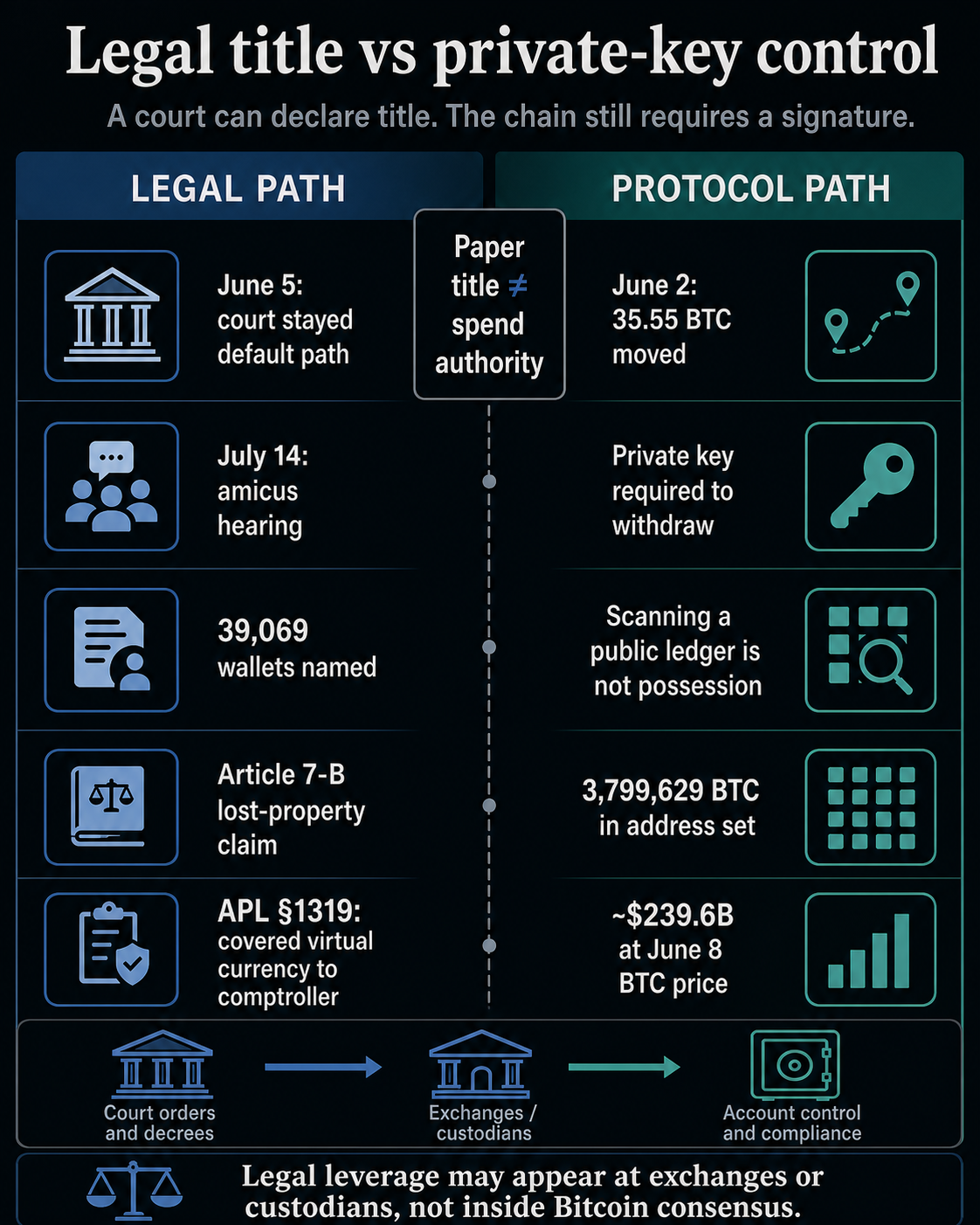
The title of the paper is also important off-chain.
The case is now a substantive point of contention. Courts can determine legal ownership as a matter of law. Self-custodial Bitcoin cannot be moved without a signature.
A more limited implication is that declarations can still create off-chain leverage. If the coins are later transferred to an exchange, custodian, or another institution, the party holding the New York judgment may assert competing claims and attempt to force the dispute in a venue that responds to court orders rather than private keys.
This is a practical consequence of legal ownership, not protocol-level control.
The June 2nd movement does not answer all factual questions, but it is important. This shows the gap between legal description and protocol management.
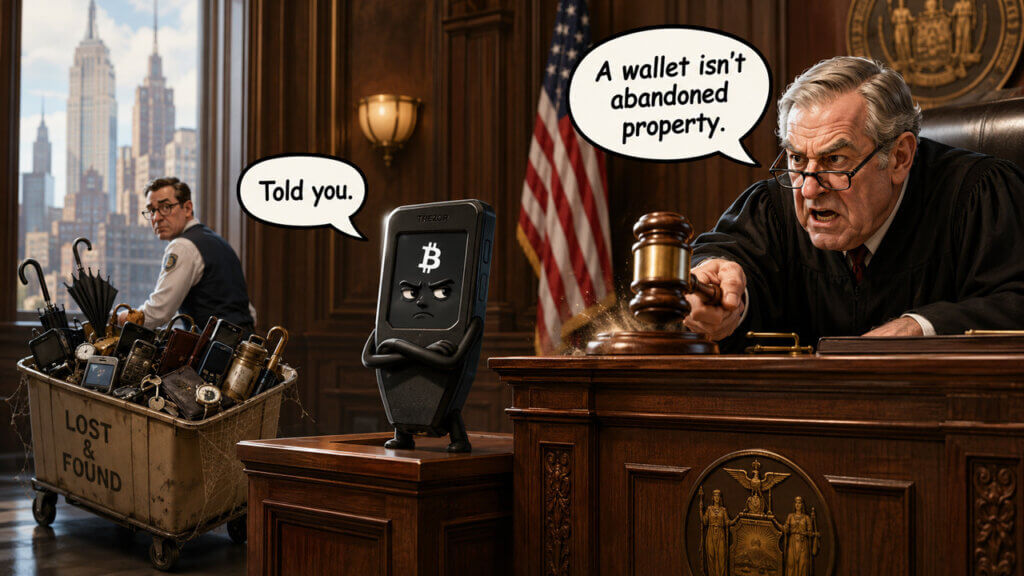
The court can only call the wallet abandoned within the legal framework. By design, Bitcoin treats a valid signature as an event that changes the ledger.
Therefore, the July 14 hearing is not just a procedural date. This is the next step for the court to decide whether to proceed with the case as a mostly uncontroversial default claim or to face a more complete challenge to its core premise.
Until then, the most powerful facts on record are also the simplest. At least one old address was moved because someone had the ability to sign.
A legal theory built on dormancy must explain why it is not sufficient to defeat the idea that silence is tantamount to abandonment.
(Tag translation) Bitcoin


