

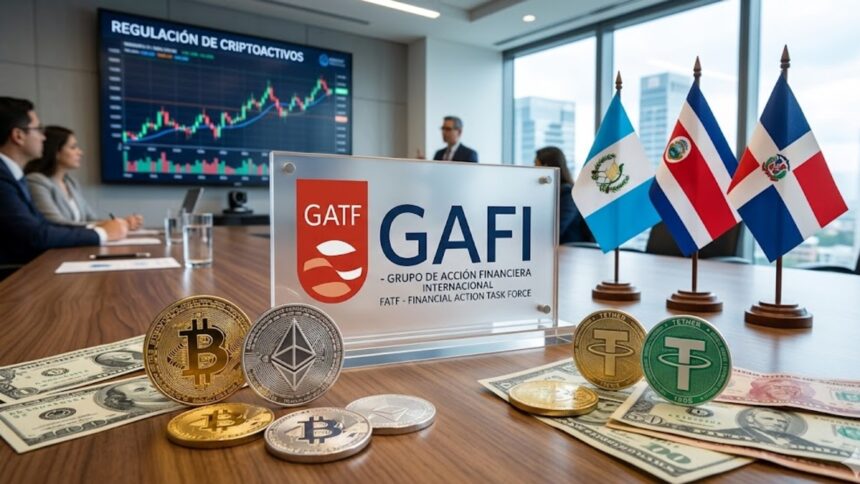
Central America and the Caribbean are increasingly interested in adopting Bitcoin (BTC) and cryptocurrencies due to the urgent need to comply with global financial standards.
The governments of Guatemala, Costa Rica, and the Dominican Republic are in the process of approving regulatory frameworks for digital asset ecosystems. However, the primary purpose of these laws, which are strongly aligned with international guidelines, is financial control and prevention of money laundering, prioritizing state oversight over developing the inherent strengths that Bitcoin technology offers.
This legislative election is a direct response to pressure and impending assessments from the Financial Action Task Force (FATF) and its regional arm Gaffirat. Authorities in these countries are trying to close regulatory gaps surrounding companies dealing with digital currencies. I’m afraid of receiving a negative review by living things.
And in reality, an unfavorable assessment due to regulatory deficiencies means a risk of being placed on the FATF’s dreaded “grey list,” which could lead to increased international credit costs. and loss of confidence in global markets.
In general, the impact of low international ratings poses an economic suffocation threat for regional countries. Increased external regulation typically results in reduced foreign direct investment, disruption of family remittance flows, and loss of relationships with foreign correspondent banks.
For this reason, the members of the three countries Emphasis on supervision and inspection This is to ensure the link between the traditional financial system and the world’s major economic powers.
New regulations, either approved or under discussion, formally classify virtual asset service providers (PSAVs) such as exchange platforms, custodians and intermediaries as subject to the mandate. This places them under direct state supervision. and force all operations to be reported. In front of financial intelligence agencies in each country.
Let’s take a look at the current situation:
Decree 15-2026 and inspections in Guatemala
As reported by CriptoNoticias, this week in Guatemala, the Congress of the Republic approved Decree 15-2026, which corresponds to Initiative 6593, with a total of 160 members and 147 votes in favor.
The Regulations constitute comprehensive legislation for the prevention and suppression of money laundering and other assets, as well as terrorist financing. The new legal text updates the 25-year-old legal framework and explicitly includes a digital currency sector for the first time in the Central American country’s history. It is under the direct supervision of state agencies.
The law provides that exchange platforms, custody companies, and virtual asset service providers, regardless of whether their operations are domestically or internationally managed, will be considered mandatory subjects before an Special Verification Investigation (IVE).
Guatemalan authorities justified the urgency of this action by pointing to previous regulatory deficiencies. put the country in a vulnerable position Facing international technical analysis can impact relationships with correspondent banks and increase the cost of external financing.
Guatemala’s national system is currently preparing to conduct an in-person assessment by Gafilat experts in February 2027, according to the country’s parliament.
To adjust this process, Direct interviews with public and private institutions are being consideredto measure the actual effectiveness of the entire prevention system.
In this order, the recently approved legal framework also introduces a strict chapter on compliance with UN Security Council resolutions, allowing for precautionary restrictions on funds. Expanding international cooperation capacity IVE’s.
Amendments to Law 7786 in Costa Rica
Meanwhile, Costa Rica’s Legislative Assembly unanimously approved major amendments to Law 7786 during its second reading. The bill, processed under file 25,340, establishes certain obligations for providers of virtual asset services with a view to preventing money laundering and terrorist financing.
This initiative, like the Guatemalan initiative, came as a direct response to an opinion made in 2024 by the organization FATF, which had suggested the need to correct existing regulatory gaps. Focused on companies specializing in the exchange of digital assets.
Costa Rican authorities accelerated the legislative process after being warned of inaction. The country could be added to an international organization’s gray list. This is no small thing, as a negative rating of this kind could make international loans more expensive and create general mistrust within the Costa Rican banking system.
Therefore, this reform will help companies in this sector Operated by the same compliance rules than traditional banking organizations.
To ensure the correct implementation of the new guidelines, a high-level delegation from Gafilat made an official visit to Costa Rican territory in early March 2026. The purposes of these meetings are: Formalize the peer review process and strengthen the involvement of the highest national authorities.
In addition, the regional organization coordinated intensive technical training in collaboration with experts from the Kingdom of Spain, with the aim of strengthening the knowledge of competent authorities on methodologies for measuring the effectiveness of international standards.
Legislative proposals and fiscal forecasts in the Dominican Republic
In the Dominican Republic, debate on regulation moved to the House of Representatives after a project called the Cryptocurrency Prevention, Control and Regulation Act was formally deposited.
As reported by CriptoNoticias, the legislative proposal was formally submitted at the Legislative Secretariat in March this year, led by Deputy Carlos de Pérez.
The law’s proponents claim that the measure is based on an estimated 52% increase in the use of virtual currencies in the domestic market last year. This requires a clear inspection system.
Unlike a purely precautionary approach, the Dominican bill Explicitly define Bitcoin and other digital assets as goods subject to ordinary commercial taxation. This means that the economic profits generated by its exchange, intermediation or sale must be taxed in the same way as financial assets in the traditional system.
However, the proposed document has technical similarities to regulatory models implemented in other countries in the Latin American region, such as Mexico and Colombia. This last point led to questions from the Dominican Bitcoin community and was incorporated into the discussions leading up to the final formulation of the regulatory document.
In terms of institutional deadlines, the Dominican Republic has broader deadlines compared to Guatemala and Costa Rica. The final calendar for mutual evaluation will start from 2027 onwards. Preliminary estimates for the 2028 or 2029 period.
This gap is due to the country’s transition from the Caribbean Financial Action Task Force to the Gafilat bloc as a full member. Currently, the Financial Analysis Department and the Regional Bankers Association are using this slack to conduct supervisory training and internal preparedness workshops based on the new global effectiveness methodology.
Although a FATF mutual evaluation is not urgent for Quisqueya’s country, it is pressuring countries like Guatemala and Costa Rica to push for a FATF mutual evaluation. Enforcement of regulations for the virtual currency sectorPedro Vital, head of Bitcoin Dominicana, told CriptoNoticias.
The reason is fear, not innovation.
The scenario described shows the following: Regional priority is not promoting financial innovation based on Bitcoinrather, it is the implementation of technical control tasks to protect the bank’s reputation. In fact, this does not stem from an interest in updating and profiting from digital assets, but rather from the state’s fear of economic exclusion.
As a result, governments are forced to impose strict controls to limit the flexibility of the digital environment and protect the reputation of the traditional banking system. and ensure connections with international financial powers.
This is despite the fact that the crypto ecosystem has proven to be a clear and sometimes quick way to optimize financial processes and improve the lives of users and businesses in Latin America and the world.
(Tag Translation)Bitcoin (BTC)


