

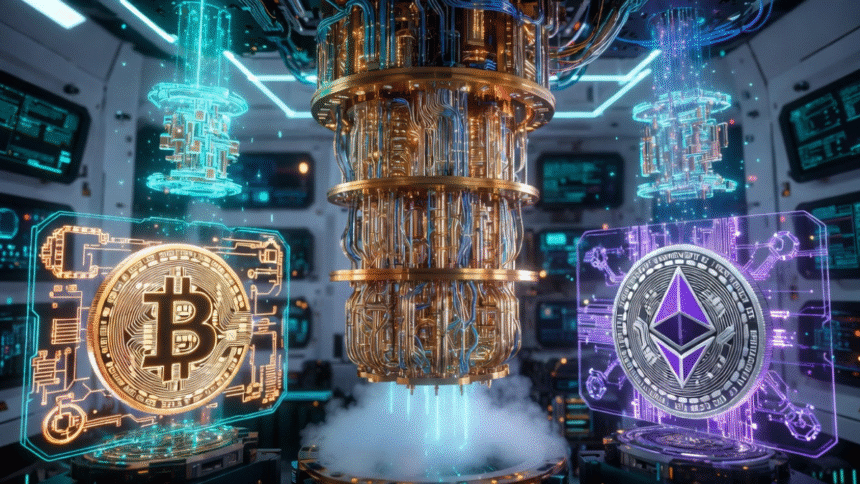
According to Eli Ben Sasson, CEO of StarkWare, a company specializing in zero-knowledge (ZK) proofs and the creator of StarkNet, Ethereum’s second layer (L2) network, Israeli mathematician Gil Karai claims that quantum computers will never be able to break the code.
Ben Sasson made it clear that while he doesn’t agree with that position, he thinks it’s worthwhile to expose it: “Quantum computers will never be able to break encryption…That’s not my opinion, but it’s important to bring it up, so I’ll explain.”
Karai, a mathematician at the Hebrew University of Jerusalem and an adjunct professor at Yale University in the US, is skeptical of globally scalable quantum computing. According to Ben Sasson, his argument revolves around noise: Small disturbances (vibrations, temperature changes, even electromagnetic radiation from the environment) can change the state of a qubit (quantum computing unit), giving erroneous results.
The cubit resembles the castle of Nipes. Any interference from the environment can bring it “down”It will fail and return wrong results. In this framework, quantum error correction techniques aim to stabilize qubits by grouping several qubits together to “monitor” each other. If one fails, the other qubits will rebuild the correct value.
The problem raised by Karai is Quantum computer itself shakes the table: The more qubits there are, the more disturbances the system itself generates.
According to Ben Sasson, That noise is not random and may be correlated with the calculation itself.. “This noise may not be random ‘oops, I was wrong’ noise that can be averaged out. It may be noise that is correlated with the computation. In other words, the more qubits you have, the more noise you have. Bad noise can ruin your computation,” StarkWare’s CEO wrote.
If Kalai’s premise is correct, error correction would be ineffective on a large scale. Therefore, it is impossible for a quantum computer to destroy the system. These include RSA (used by banks), Elliptic Curves (ECC, used in networks such as Bitcoin and Ethereum), and SNARK schemes (cryptographic proofs that allow calculations to be verified without revealing the data supporting them).
Recent advances complicate assumptions.
Two recent experiments by Quantinuum reported by CriptoNoticias directly contradict Professor Kalai’s ideas.
The first paper, published last February, showed that quantum error correction goes beyond so-called error correction. “break even”: The point where shielding the qubit improves rather than degrades the results. This could not be achieved with existing technology.
The second, published in March, extracted 48 logical qubits (functional qubits capable of reliable computation) from just 98 physical qubits in a 2:1 ratio. Most accepted industry standards estimate that building a logical qubit requires between 100 and 1,000 physicists; This second line of research could narrow the scope for building scalable quantum hardware..
Similarly, Ethereum Foundation (EF) cryptologist Thomas Kolatger assured that this ratio would improve by 10:1 with a neutral atom processor that improves the connectivity between qubits.
Quantum computing and ecosystem estimation
Justin Drake, one of the main developers of Ethereum; paper Increased Google Quantum AI estimates Probability of crypto breakout will increase from 1% to 50% by 2032. Ethereum co-founder Vitalik Buterin predicts that by 2028, quantum computers could compromise ECDSA, the digital signature system that secures Bitcoin and Ethereum transactions.
Along similar lines, Mikhail Lukin, a Harvard professor and co-founder of the Harvard Quantum Initiative, believes fault-tolerant quantum computers could be available “at least in some form” by the end of the century. companies like Google, Cloudflare, and Grayscale scheduled for 2029 as a horizon for completing the post-quantum transition.
At the other end of the spectrum is Blockstream co-founder Adam Back. “It will take at least 10 years.”JAN3 CEO Samson Mo extended the period from 10 to 20 years.
As Ben Sasson reported, Karai’s argument does not belong to the deadline argument. He did not say when the threat might arrive, warning that given the physical feasibility of quantum hardware, the technology does not pose a real threat to current cryptographic systems.
(Tag Translation)Bitcoin (BTC)


