


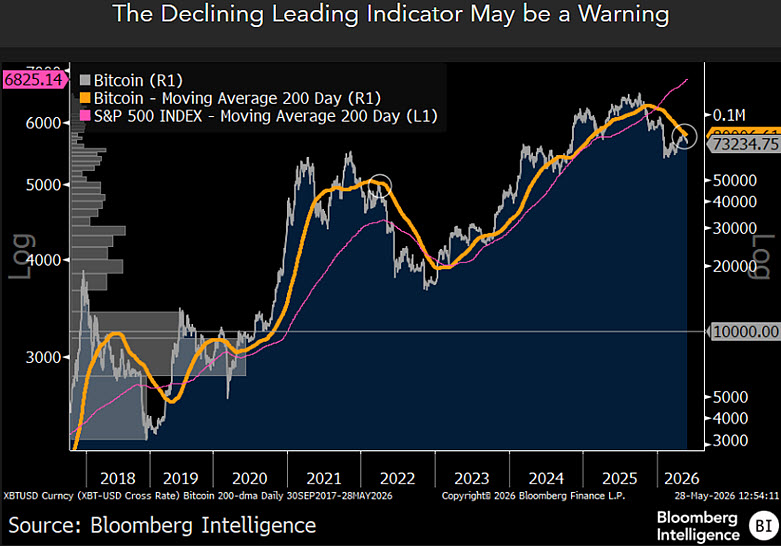
At the end of May 2026, while the US S&P 500 index soared to historic highs, the cryptocurrency sector rapidly lost ground, creating a dangerous anomaly in financial markets. The price difference forced Mike McGlone, senior commodity strategist at Bloomberg Intelligence, to strengthen his technical sell signal.
In his view, the industry has begun a broader bubble-deflation process that risks pushing Bitcoin back to its long-term historical average of around $10,000. The core of Bloomberg’s bearish forecast is that multi-year correlations are breaking down.
Why the S&P 500’s record rally won’t save Bitcoin
Previously, Bitcoin rose as a classic high-beta asset, obediently following the global liquidity and equity waves, but now this mechanism is turned off. The situation worsened further on May 29, when the industry benchmark Bloomberg Galaxy Crypto Index (BGCI) officially fell below the psychological mark of 2,000 points, losing half its value from its 2025 peak.
McGlone draws a direct parallel to the 2018 cycle, when Bitcoin “lost zero” and stalled just around $3,000 after a long period of sharp decline. But even if the first cryptocurrencies were exclusive assets in 2009, by 2026 they will be forced to compete with millions of capital-diluting tokens, leaving only the dollar stablecoin with any real utility.
However, Bloomberg’s insistence on pure mathematical symmetry has traditionally caused skepticism in the professional cryptocurrency community. McGlone’s opponents remind the market that his past predictions of a drop to $20,000 at the height of the bull market never materialized because analysts tend to ignore changes in capital structure.
The main argument against the “$10,000 Bitcoin” scenario is the strong institutional framework created by BlackRock and Fidelity’s Spot ETF. In the 2018 and 2022 cycles, these multibillion-dollar funds did not exist, but now they form a strong price floor that is nearly impossible to break through without a complete collapse of the U.S. financial system.
Furthermore, while BGCI’s decline is more reflective of the death of speculative altcoins, Bitcoin’s own dominance typically strengthens during times of crisis.
McGlone himself still sees a chance for redemption in the market, calling the $75,000 level a “line in the sand.” Only a return above this mark and a confident consolidation invalidates the bearish scenario and proves the S&P 500’s asynchrony to be temporary noise.


