


Bitcoin was trading at $75,860 as of May 23rd, falling below $76,000 as the U.S. House of Representatives introduces Bill Lock Government. $BTC Over 20 years, the ETF has recorded six consecutive days of outflows, with longs absorbing more than $350 million in liquidations in a 24-hour window.
Bitcoin daily chart: Channel break, $73,500 downside
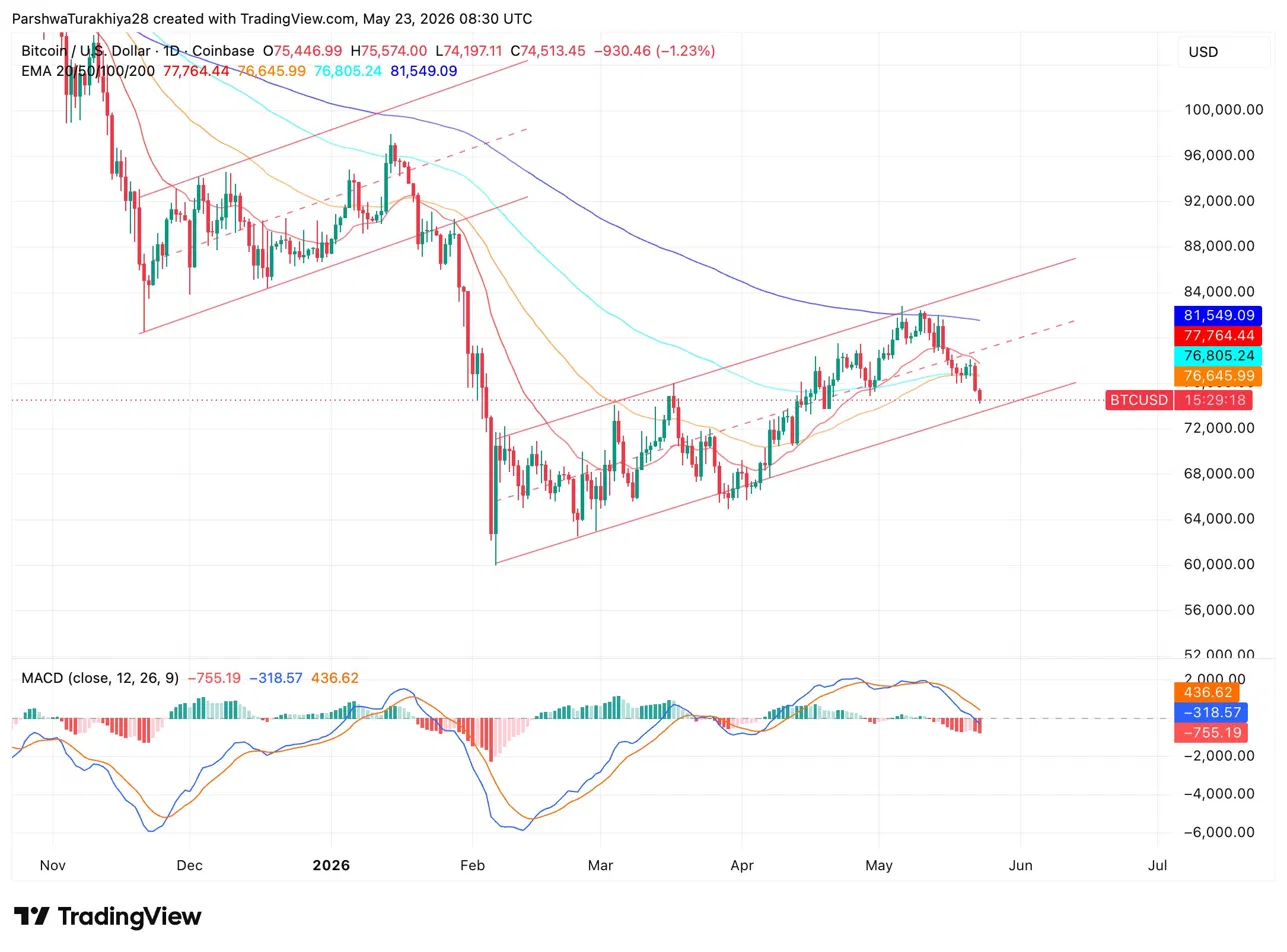
$BTC It broke out of the ascending channel from the April lows and then reversed sharply. The price is $75,860, below all four EMAs. The 200 EMA at $81,549 is the macro ceiling. The MACD is in a bearish cross with the first line at -755 and the signal at -318, but the histogram is compressed, meaning the sell momentum is slowing without reversing.
The horizontal support at $73,500 is where the broken channel base and previous dotted support converge. Daily closing prices below this start at $68,000. A retrieval of $76,500 to $77,800 along with volume is an important first signal for the upside.
$BTC Key levels for May 24th:
- resistance: $76,500 to $77,800, $81,549 (200 EMA)
- support: $73,500 horizontal support, $68,000 FVG zone
- MACD: Bearish cross, histogram compresses towards zero
The ARMA bill: The real role of the Strategic Bitcoin Reserve
Representatives Nick Begich and Jared Golden introduced the American Reserve Modernization Act on Thursday. This bill requires the entire government $BTC Reserves shall be maintained for a minimum of 20 years and shall not be sold, exchanged or disposed of of any kind during that period. After the lock-up, the Treasury can recommend selling up to 10% of its holdings in any two years.
1 million $BTC The purchase goals of the previous BITCOIN law are gone. Instead, ARMA directs the Treasury Department and the Department of Commerce to consider budget-neutral acquisition options, including conversion of non-Bitcoin government cryptocurrencies, revaluation of gold certificates, forfeiture revenue, customs revenue, and state partnerships. Quarterly reserve attestation reports and independent audits are required. Arkham Intelligence estimates that the current U.S. government’s total cryptocurrency holdings are approximately $26 billion. $BTCETH, USDT.
The bill would lock up seized government assets for 20 years, eliminating any potential sales pressure. While no purchase obligation means there is no direct demand injection, a formal reserve framework signals a long-term commitment by the government at the legislative level.
Assets drop below $100 billion due to six consecutive days of ETF outflows
On May 22, it recorded an outflow of $105.19 million. BlackRock’s IBIT topped the list with $68.89 million, followed by Fidelity’s FBTC, which added $36.29 million. Total net worth fell to $98.87 billion, falling below $100 billion for the first time since April. The cumulative inflow amount has reached $57.08 billion.
Outflows for the six consecutive days since May 15 totaled approximately $1.55 billion, the most sustained institutional outflow since the launch of these products. The weeks in April that averaged $600 million to $900 million in weekly inflows are now a distant memory.
$BTC Derivative: Long takes all damage
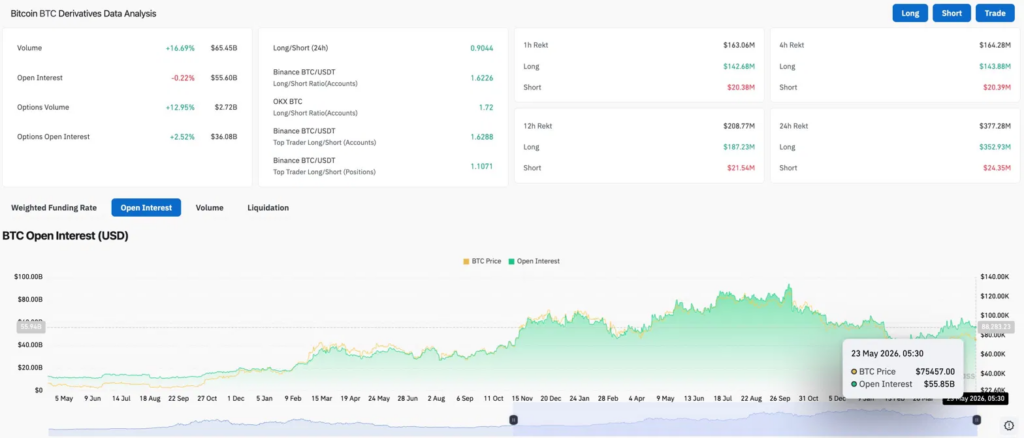
Volume increased 16.69% to $65.45 billion, while open interest was nearly flat at $55.6 billion. Options trading volume increased by 12.95% to $2.72 billion, and option OI increased by 2.52% to $36.08 billion, indicating that hedging demand remains strong. Binance Retail holds a long ratio of 1.6226. Top traders are in a near-neutral position at 1.1071 per position.
Over the course of 24 hours, longs absorbed $352.93 million in liquidations, while shorts totaled $24.35 million. Long required 14 times more pain. All bounce attempts to resistance are fading and leveraged longs are paying the price.
Bitcoin price prediction for May 24th
- Upwards: The trigger is a return of volume from $76,500 to $77,800. If the ETF’s outflows slow below $50 million each day and the MACD histogram rises above zero, it will indicate a completed sell. Developments in the ARMA passage committee and the CLARITY Act Senate floor are macro catalysts that could move prices quickly.
- Disadvantages: If the daily closing price is less than $73,500, the opening price will be $68,000. Six consecutive days of outflows, daily long-term liquidations of $352 million, and yields above 4.60% are unlikely to reverse without a catalyst. Until it arrives, all bounces may be sold.


