


With Ethereum trading near $2,000, BitMine purchased an additional 60,000 ETH worth approximately $126 million, expanding one of the largest corporate accumulation strategies tied to the second-largest digital asset.
The acquisition comes at a time when the company has been added to the reserve list of the Russell 1000 index, meaning crypto holders stand to gain a slice of the $12.2 trillion in assets that benchmark the Russell U.S. index.
Why BitMine Adds Ethereum Holdings During Current Stock Price Drop
On May 23, blockchain analyst EmberCN reported that BitMine’s latest ETH purchases were executed through BitGo and Kraken.
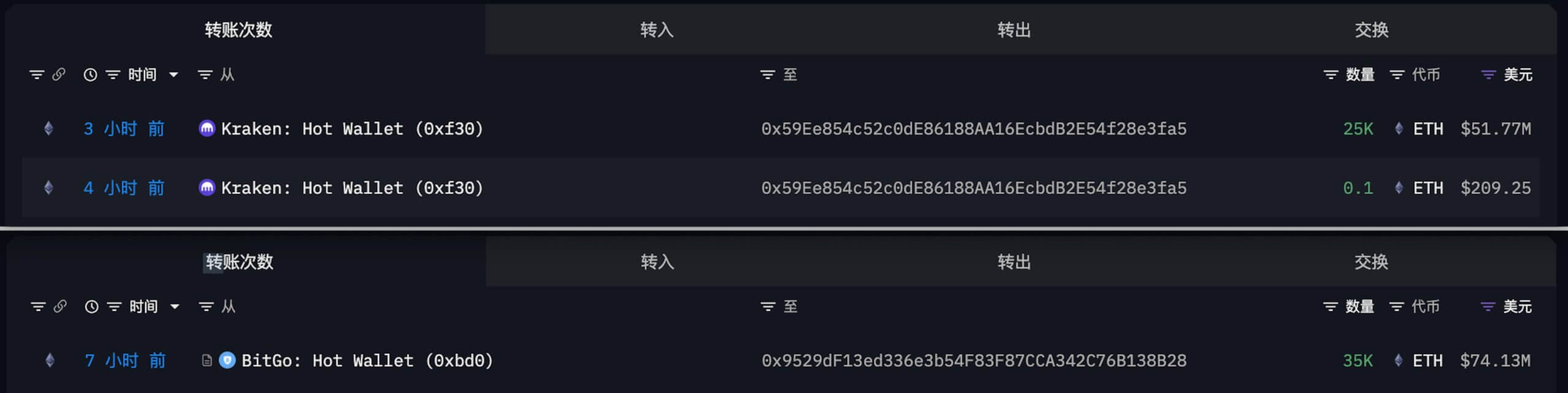
The acquisition increases BitMine’s Ethereum holdings to over 5.2 million ETH, equivalent to approximately $11.1 billion at current market value. The company continues to accumulate despite ETH trading near $2,000, which is about 60% below its all-time high of $4,953 in August 2025.
Notably, this latest purchase comes about two weeks after the company indicated its intention to slow down the pace of ETH accumulation.
However, BitMine Chairman Thomas Lee previously stated that ETH’s recent drop below $2,200 is an attractive entry point.
According to him, the decline was an opportunity to increase ETH exposure ahead of a possible recovery in the digital asset. Lee said recent regulatory developments around the CLARITY Act could foster growth in emerging industries.
As a result, his company continued to increase its exposure to cryptocurrencies in anticipation of growth.
BitMine’s strategy, on the other hand, mirrors the corporate finance model popularized by Strategy (formerly MicroStrategy), but shifts its focus from Bitcoin to Ethereum.
This distinction gives BitMine’s balance sheet a different profile, as Ethereum’s proof-of-stake system allows holders to generate staking rewards rather than relying solely on price appreciation.
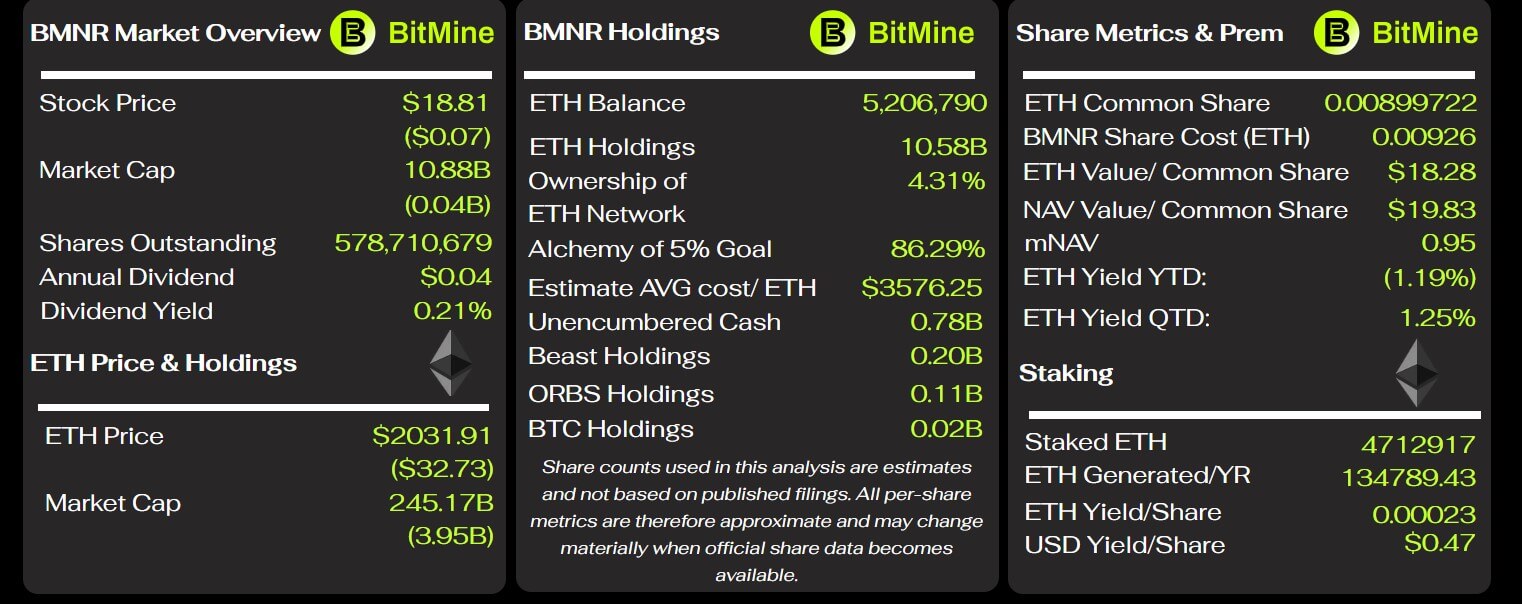
BitMine operates MAVAN, an Ethereum staking platform that adds a yield component to the financial approach. The company has invested more than $10 billion of its Ethereum holdings and ties a portion of its balance sheet proceeds to the ETH network economy.
This structure gives investors a clearer way to evaluate BitMine’s strategy. The company is looking to buy into ETH’s weakness, stake a large portion of its holdings, and turn that exposure into a stock market vehicle available to traditional investors.
Another channel added to Russell’s tentative list
In addition to its financial expansion, BitMine has been added to the preliminary list of the Russell 3000 Index for 2026.
FTSE Russell will release the first reconstitution data on May 22nd, with the final index composition expected to take effect at the end of June.
Lee said Bitmine’s market capitalization could lead to BMNR being included in the Russell 1000 index, the large-cap segment of the broader Russell 3000 index, rather than the Russell 2000 index.
This distinction is important to the company’s investor base. The Russell 3000 tracks approximately 3,000 of the largest companies in America, representing nearly the entire investable U.S. stock market. The Russell 1000 covers the largest companies within that group, while the Russell 2000 covers the smaller companies.
While funds that benchmark Russell indexes often adjust their portfolios around index reconfigurations, some active managers use these benchmarks to define a pool of eligible holdings, so inclusion in the index could potentially change ownership of BitMine stock.
Lee also argued that many active managers focus on the Russell 1000, and that passive funds and ETFs could account for a significant share of a company’s market capitalization if included in a major benchmark.
Cryptocurrency government bond stocks will be further included in public indexes
BitMine’s Russell path comes as more crypto-related companies enter mainstream stock benchmarks.
Sharplink Gaming, another publicly traded company with an Ethereum financial strategy, is also said to be involved in the Russell index inclusion.
Sharplink CEO Joseph Chalom said the company plans to join the Russell 2000 and Russell 3000 indexes on June 29, calling the move an important milestone because of its capital tied to these benchmarks.
According to him:
“Approximately $12.2 trillion of assets are benchmarked against the Russell U.S. Index, with approximately 16% using the Russell 2000 as a reference point. Inclusion places SBET among the passive and active flows that track these benchmarks.”
Russell’s preliminary materials include Gemini Space Station (GEMI) and Galaxy Digital (GLXY), as well as other crypto companies such as Iris Energy and Soluna.
This group reflects a broader shift in which exposure to cryptocurrencies is no longer limited to tokens, private funds, and spot ETFs.
Meanwhile, tThese additions follow the precedent established by Strategy’s MSTR. The company, led by Michael Saylor, joined the Russell 1000 in June 2024 and subsequently entered the Top 200 Value Index in 2025.
(Tag translation) Featured


