




Bitcoin ETF outflows have just absorbed the first severe macro shock in seven weeks, and last week’s Bitcoin ETF outflows could be a temporary capital retreat or the start of a broader cycle of institutional risk aversion.
CoinShares reported that outflows from its digital asset investment products exceeded $1 billion, marking the first negative week in seven weeks and the third largest weekly outflow of 2026.
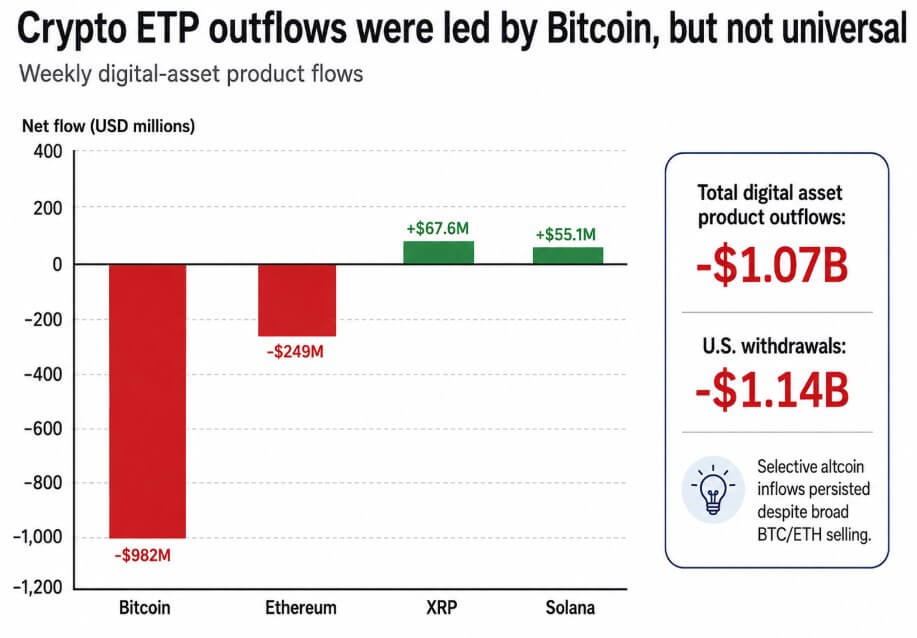
Of this amount, Bitcoin products accounted for $982 million, Ethereum products accounted for $249 million, and the total assets under management of virtual currency ETPs decreased from $159 billion to $157 billion. Overall, Bitcoin ETF flows have shifted from steady demand to a stress test of institutional investors’ risk appetite.
CoinShares clearly linked the reversal to Iran-related risk-offs and positioned it as the end of a six-week positive streak, while Bitfinex said Bitcoin faces declining Bitcoin ETF demand, rising oil prices, and a prolonged high interest rate environment.
Withdrawals by US investors amounted to $1.14 billion, exceeding the global total. Can Luka Koymen, investment strategist at Signum Bank, said in a note:
“The picture changes when you remove the US. Switzerland, Germany, the Netherlands, and Canada all recorded net inflows. XRP gained $67.6 million globally, Solana gained $55.1 million, and 11 individual assets attracted meaningful inflows.”
BTC is up significantly compared to April, and Koymen reads some of last week’s outflows as prudent profit-taking for moments of stress, capital that could take profits and return at a lower entry point.
The progress of the CLARITY Act has also softened the broader tone on the fringes and kept the crypto regulatory context constructive even in the midst of a deteriorating macro environment, he added.
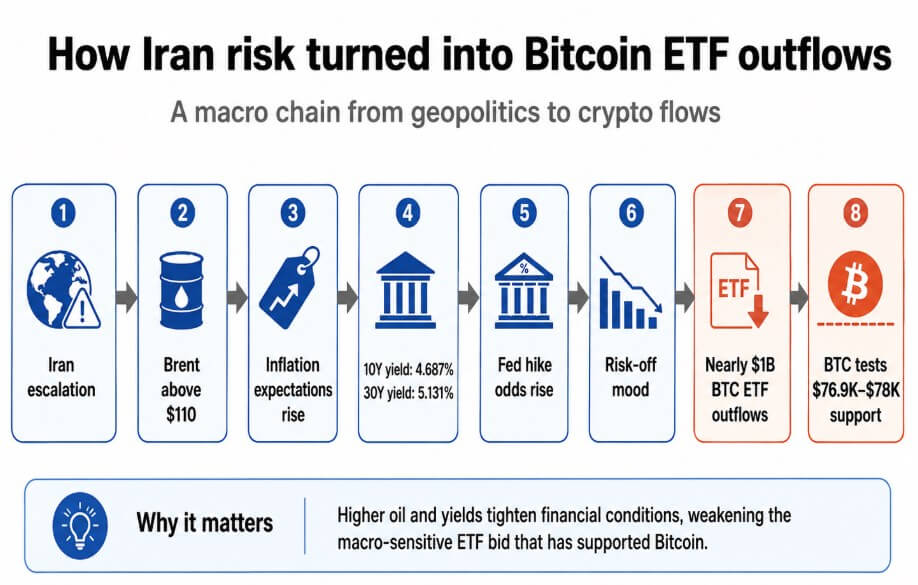
Macrochain changed the course of Bitcoin ETFs
Iran’s escalation pushed Brent crude prices above $110 as traders monitored disruption risks around the Strait of Hormuz, with the 10-year rising to 4.687% before settling around 4.65%, while the 30-year hit 5.131%, with oil at that level resetting inflation expectations upward.
As yields rise, the market’s implied probability of a Fed rate hike increases, with nearly 40% pricing in a 25 basis point (bp) hike and 14% pricing in a 50 basis point (bp) hike in December. This combination resulted in negative risk appetite across liquid assets, with Bitcoin absorbing the selloff first.
Bitfinex noted that the $80,000 to $83,000 resistance zone saw sellers return, with Bitcoin ending the week 4.6% lower, and the US Spot Bitcoin ETF’s weekly net outflows reaching nearly $1 billion.
Institutional certainty has not been sufficient to absorb macroshocks and interest rate fluctuations at current flow levels. ETF bids that exit when yields spike or oil prices soar are treated by allocators as discretionary risk allocation.
Glassnode identified near-term support for Bitcoin around $76,900 on a 30-day cost basis and near-term resistance around $86,900 based on the cumulative range from November to February.
As BTC rose above $80,000, the realized 30-day net position change returned to $2.8 billion per month, but that number remained well below the $10 billion-plus level associated with the bull market expansion.
Bitcoin was trading within its stress zone around $77,000 on May 19th, and Bitfinex’s short-term framework placed BTC in the $72,000-$80,000 corridor until it regained its previous rejection zone near $80,000-$83,000 short-term holder realized price and true market average territory.
Koymen pointed out that the perpetual funding rates of some altcoins turned positive during the decline, even though the funding rates of Bitcoin and Ethereum remained negative, but both are showing signs of recovery.
While Bitcoin responded to geopolitical risks, a strong dollar, and rising yields, some altcoins and crypto sectors operated on separate catalysts, insulating them from the BTC-specific macro factors that drove US Bitcoin ETF redemptions.
Where crude oil and yields determine
If tensions in Iran ease, oil prices retreat above $110, and the price of Fed rate hikes wears off, the same allocators that cut back last week could quickly rebuild their exposures, as six weeks of inflow momentum has built a baseline strong enough to withstand a single shock.
ETF inflows will resume within a week or two, BTC will regain the $80,000-$83,000 recovery zone, and outflows of over $1 billion will be a one-week macro air pocket.
Glassnode’s $86,900 resistance zone will be the next target once the repair zone is cleared, but Koimen’s profit-taking framework reinforces the view that the outflow was partially caused by rational position management, which has its own ceiling.
| scenario | macro condition | ETF/ETP Flow Signals | BTC technical signals | market interpretation | what would confirm that? |
|---|---|---|---|---|---|
| macro air pocket | Tensions in Iran ease. brent withdraws over $110; 10-year yield is moving away 4.687% Peak; Fed rate hike price fades | Outflow slows or reverses to domestic inflow 1-2 weeks | BTC holdings $76,900 – $78,000 Support and collection $80,000 – $83,000 | of More than $1 billion leaked It was not a structural system regression, but tactical profit-taking and macro shock absorption. | The following CoinShares report shows a steady flow. US Spot BTC ETF Daily Data Stops Bleeding. BTC target $86,900 resistance |
| Institutional risk avoidance cycle | oil stays on top $110; 10-year yield pushed back towards higher 4.687%;real rate pressure persists; Risk appetite remains weak | Large-scale ETF/ETP redemptions will continue this week, especially in US Bitcoin products. | bitcoin loses $76,900 – $78,000 Trade deeper inside Bitfinex $72,000 – $80,000 corridor | Financial institutions are not abandoning crypto, but are extending Bitcoin risk budget cuts beyond the shock week | CoinShares shows continued BTC-led outflows. US ETF redemptions will continue. glass node $2.8 billion/month Capital inflow rate worsens |
If oil prices remain above $110 and the 10-year Treasury yield is pushed back toward its peak of 4.687%, the decline in Bitcoin real interest rates will persist without a macro trigger for reversal.
Allocators who trimmed last week have no reason to rebuild, and a fall in BTC below $76,900 could trigger additional ETF redemptions by investors managing mark-to-market exposure.
Another week of large ETF outflows would confirm that institutional risk aversion extends beyond a single shock reaction, pushing BTC into Bitfinex’s lower trading range of $72,000 to $80,000.
The monthly inflow rate of $2.8 billion that Glassnode recorded before last week’s outflows would worsen if redemptions continued at a rate of more than $1 billion per week, stripping the structural demand narrative of its anchor of fact.
If BTC holds the $76,900 support at Glassnode while outflows are slow, it would confirm that allocators are done trimming, but continued redemption and BTC losing it would confirm that there is more runway in the de-risking cycle.
Bitcoin ETF forward test
Next week’s CoinShares flow data and US Spot Bitcoin ETF flows provide the most accurate reading of what path is unfolding.
If outflows slow while BTC holds between $76,900 and $78,000, last week’s support will be considered to have absorbed the shock, and if outflows continue while BTC loses the high $70,000s, six consecutive weeks of inflows will be the gateway to broader institutional risk budget cuts.
Koymen said that despite the sell-off of US products in the same week, European capital inflows, altcoin inflows, and recovery derivatives positioning remained intact, and that short-term Bitcoin ETF flows constitute a single data point within a larger allocation picture.
Bitcoin ETF bidding is macro-sensitive, and the next CoinShares report will determine whether that sensitivity created a spike or a cycle.
(Tag translation) Bitcoin


