

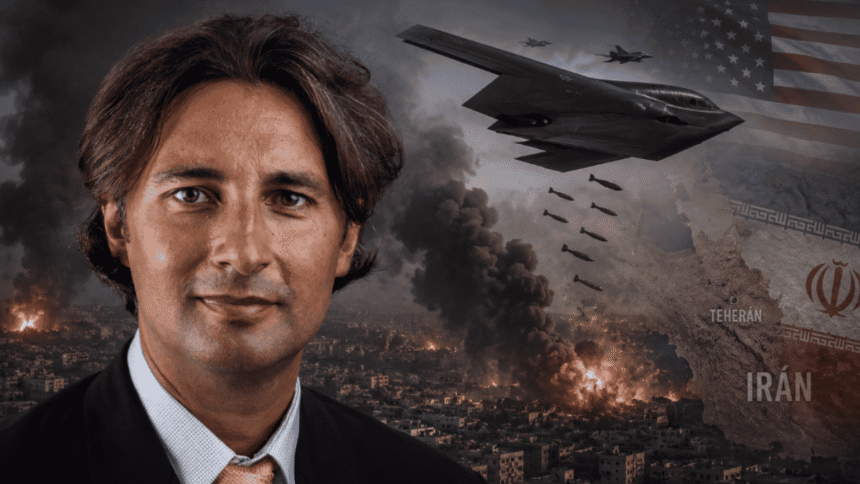
The United States and the Iranian government are in talks to contain the conflict, which has been ongoing since February 28, 2026.
Tensions between the two countries worsened between last weekend and yesterday, Tuesday, May 19th. First, US President Donald Trump warned Tehran: Time is running out to reach a negotiated exit. The president then announced yesterday the cancellation of a military attack on Iranian territory that was scheduled for the same day.
Against this backdrop, researcher and financial advisor Damir Tokić offers a worrying outlook for the geopolitical future. “This could be the most difficult geopolitical situation in history. There is no solution or basis for reaching an agreement, but escalation could be catastrophic,” experts warned of stalled peace talks.
The core of the crisis lies in the strategic and military sphere of the region. “Iran appears determined to maintain its nuclear program, but this should not be tolerated if the time required to develop a nuclear weapon is actually in the order of weeks,” Tokic said. Analysts directly linked this technological advance to the immediate position adopted by the White House.
“In my opinion, the time it will take for Iran to develop a nuclear weapon will probably be measured in weeks.” “There is no other reason for President Trump to get so involved in a Middle East war,” the expert argued. Possibility of Asian country completing weapons calls for vigilance in international community.
It is worth clarifying that in Tokic’s argument he follows the official line of the United States and its allies, which justifies strikes to thwart what is said to be an ongoing nuclear program. Iran denies that these are the real reasons. “If they only focus on the economy, oil theft, tourism or electoral prestige, what we are left with is war,” Reza Zabib, Iran’s ambassador to Spain, said in an interview.
Both sides refuse to concede
Diplomatic paralysis is a response to the conflicting goals of those involved in the conflict. “We are at a stalemate and it is very unlikely that we will reach an agreement unless one side weakens significantly,” the researcher said. This condition reduces the scope for agreeing to an effective ceasefire in the short term..
On the other hand, US strategy focuses on directly destroying enemy infrastructure. “The US can weaken Iran’s position through new military actions. That is the escalation option. The US is also trying to weaken Iran through a naval blockade, but this requires time and patience, which the US lacks,” Tokic explained.
Meanwhile, the Iranian government has responded through economic pressure on Western countries. “Iran can only weaken the United States by imposing high economic costs through soaring oil prices and an inflationary crisis, and by closing the Strait of Hormuz,” the expert said, pointing to the dynamics of mutual retaliation.
The hostilities closed the Strait of Hormuz, a vital shipping route through which 20% of the world’s oil passes. The logistics disruption has pushed the price of Brent crude, which accounts for 70% of the global market, to more than $100 per barrel, a record value not seen since 2022.
moreover, The conflict threatens to spread to other shipping routes vital to international trade.. If the conflict escalates, Iran could try to take control of the Bab el-Mandeb Strait, which connects the Red Sea and the Gulf of Aden and through which one-tenth of global merchandise trade flows.
This maritime maneuver corresponds to a clear strategic plan to disperse Western military resources. The intention of controlling that second phase is to “focus the United States on two maritime fronts instead of one,” said Mehdi Karatian, an Iranian analyst and director of the Institute for Political Reconstruction.
The impact of war on the economy and markets
The macroeconomic impact of this energy blockade is already impacting financial indicators around the world. In the US, the Producer Price Index (PPI) rose to 6% year-on-year in April 2026, after 4.3% year-on-year in March. Similarly, the Consumer Price Index (CPI), which measures national retail inflation, rose to 3.8%. Both data are the highest since 2023.
As a direct result of energy-driven inflation, 30-year Treasury yields have increased. Yesterday, May 19, CriptoNoticias reported that interest rates had reached 5.19%, the highest level since July 2007. this movement It reflects the demand for higher returns by investors in the face of inflation risk.
This situation is putting pressure on the actions of the US central bank, the Federal Reserve (FED). “The impact of a war between the United States and Iran could also have a devastating impact on financial markets, primarily through a sudden increase in interest rates,” Tokic predicted, due to the overall acceleration of prices for products and services.
In line with this, investment analyst Ed Yardeni commented that the Fed will keep monetary policy unchanged at its June meeting. However, experts warned: We believe interest rates are likely to rise by one-quarter of a percentage point During a call next year in July 2026.
For the Bitcoin market, this war conflict development is very important. Because government bonds offer attractive and safe returns, a high interest rate environment adversely affects prices, reduces incentives for assets deemed “risky” and causes a movement of capital into bonds.
Bitcoin has fallen 4% over the past seven days, dropping from $81,000 to $76,900 today. This price is the lowest recorded by the crypto asset since May 1 of last year and is 38% below the historic high of $126,000 recorded on October 6, 2025.
In the short and medium term, the future of global financial markets and the price of Bitcoin will largely depend on the resolution of this geopolitical impasse. “Thus, based on these observations, even the last attempt to avoid escalation is likely to fail, because both sides still feel they have the ability to reach a better agreement through escalation,” Tokic elaborated.
According to Tokic, recent peace attempts have little chance of success.
Analysts warned that The next stage of the conflict could exceed the material damage observed so far. “There is great uncertainty as to how a second round of war between the United States and Iran will unfold.
“While the first round was relatively contained and focused primarily on military targets, there was some damage to the region’s energy infrastructure. The next wave could be devastating.”
The consequences of this crisis could force the international community to: Choose between bearing the economic costs of war or accepting a new balance of power.. The expert concluded, “If the United States simply withdraws, Iran will obtain nuclear weapons.The question is whether the international community, led by the United States, will allow Iran to become a nuclear weapons state.”


