



Ethereum is struggling to sustain $2,150 as selling pressure and market uncertainty continue to weigh on the recovery. It has now regained a significant portion of its gains from February’s lows. Prices are under pressure, and analyst MorenoDV has published an exchange flow analysis that pinpoints where that pressure came from and what the data is currently showing in its aftermath.
The findings underlying the analysis are surprising in their focus. On May 10th, 250,000 ETH flowed into all exchanges simultaneously, and Binance absorbed 225,000 ETH. This concentrates 90% of the entire market’s exchange inflows on a single platform in one day. The implications that MorenoDV draws from its concentration are structural rather than accidental. What is happening with Ethereum is increasingly the same as what is happening with Binance. This exchange has become so dominant in the dynamics of ETH flows that its behavior effectively defines market behavior.
This observation alone is significant. However, MorenoDV’s analysis identifies a second development that changes how the current price weakness should be interpreted, and that Binance’s flow data is starting to show what’s to come next: a divergence in the data since May 10th.
There is a more important story at the crossroads.
Binance leads market decline
The differences identified by MorenoDV are accurate and consequential. Binance has transitioned from a net inflow posture that characterized the May 10th event to a net outflow posture, with approximately 12,000 ETH currently leaving the exchange. Meanwhile, the total for all exchanges still shows slightly positive inflows of around 20,000 ETH. This means that the exchanges that led the drawdown are now moving in the opposite direction, while the rest of the market continues to absorb modest deposit pressure.

Ethereum Exchange Netflow on Binance | Source: CryptoQuant
That asymmetry is a signal. The May 10th drawdown was not the product of a broad, uniform wave of currency inflows spread evenly across the market. It’s the result of a single venue absorbing 90% of the day’s flow, a concentration so extreme that it effectively defines the entire event as Binance’s story rather than the overall market’s story.
MorenoDV’s framework for interpreting concentrated Binance inflows identifies four possible motivations. These could be executions of large sales, hedging existing exposures, forced repositioning caused by margin or collateral requirements, or active distributions from large holders reducing their positions. Each motive has different effects on how long selling pressure lasts and how the market recovers from it.
Although the reversal to net outflows does not resolve which motives drove the May 10 concentration, it confirms that power relations have changed. The exchange, which absorbed 225,000 ETH along the way, is now returning the coins to the market rather than accumulating more. For Ethereum, which is struggling to hold $2,150, a change in direction in the most important venue is the data point worth monitoring most closely.
Ethereum falls below major support
Ethereum is trading around $2,115 after losing the important $2,150 support area, and this break would significantly weaken the recovery structure built throughout April. The daily chart shows ETH trading below its 100-day moving average while firmly below its declining 200-day moving average, confirming that the broader trend remains in favor of sellers despite previous attempts at a pullback.
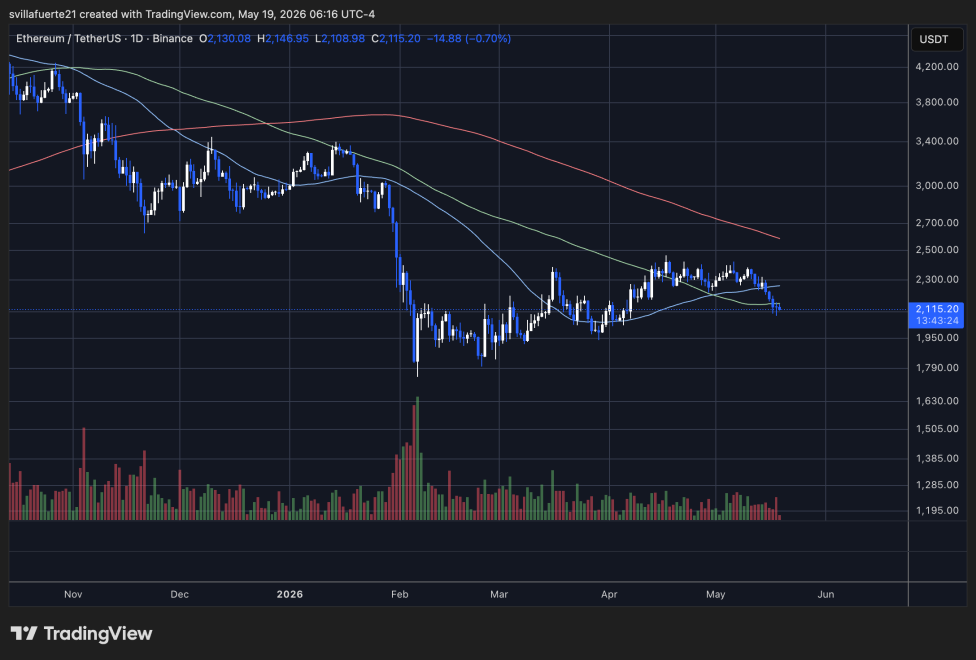
Ethereum consolidates below key MA | Source: ETHUSDT chart on TradingView
The recovery from February’s capitulation lows near $1,800 initially showed constructive momentum and pushed Ethereum back into the $2,300-$2,400 resistance zone. However, the bulls were unable to regain the high levels repeatedly, and the price gradually reversed as buying power weakened under long-term resistance.
The recent decline is highlighted by an apparent increase in supply pressure near local highs. Volume expanded during the rejection from the $2,350 area and remained elevated even as ETH declined, suggesting active distribution rather than passive consolidation. This is consistent with recent Binance flow data showing that a barrage of ETH inflows arrived on the exchange before the collapse accelerated.
Technically, Ethereum is currently approaching a definitive support area between $2,050 and $2,100. Holding this region could help stabilize the market after the recent flash. However, if a breakdown below that is confirmed, Ethereum will likely be exposed to another move towards the broader demand zone around $1,900 to $2,000, where buyers were aggressively defending the price after the February crash.
Featured image from ChatGPT, chart from TradingView.com
editing process for is focused on providing thoroughly researched, accurate, and unbiased content. We adhere to strict sourcing standards, and each page is carefully reviewed by our team of top technology experts and experienced editors. This process ensures the integrity, relevance, and value of your content to your readers.


