

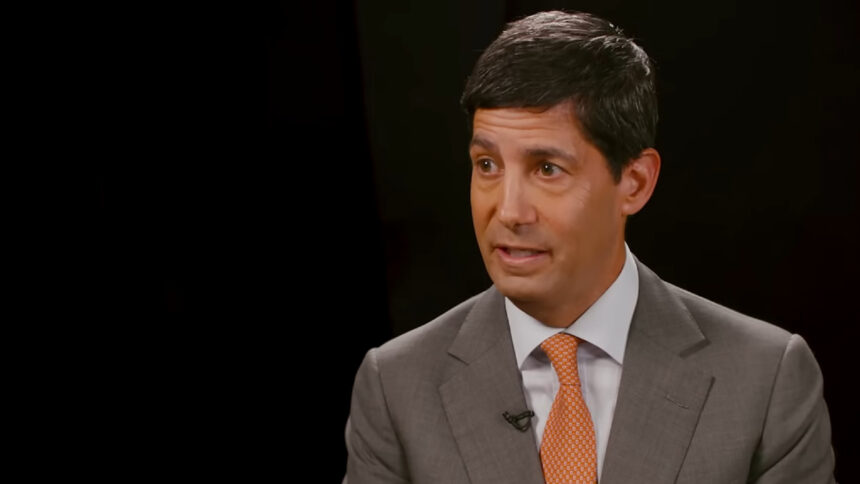
The confirmation of Kevin Warsh as the new head of the Federal Reserve System (FED) begins an important Bitcoin (BTC) debate about the direction of U.S. monetary policy and how it will affect market liquidity.
The U.S. Senate confirmed his appointment on May 13, 2026. There were 54 votes in favor and 45 votes against. Warsh will succeed Jerome Powell after he officially leaves the organization on May 15th.
This is important because BTC has historically performed better in situations of abundant liquidity, low interest rates, and financial expansion.
Current interest rates are between 3.50% and 3.75%. Market expectations indicate policy will remain unchanged at the next Federal Open Market Committee (FOMC) meeting.scheduled for June 17th.
According to market forecasts reflected in CME Group’s FedWatch tool. Traders say there is about a 97% chance the Fed will leave interest rates unchanged at its next meeting.This indicates that expectations for the continuity of current monetary policy prevail widely.
Why does the FED influence Bitcoin?
FED decisions are being closely monitored by the Bitcoin market Because they determine much of the world’s liquidity and cost of money..
Lower interest rates make borrowing cheaper for businesses and investors. Additionally, conservative products (such as government bonds) have low yields, so a portion of your capital is often invested in riskier assets in search of higher returns. these contexts They tend to prefer assets that are considered risky, such as stocks, BTC, and cryptocurrencies.
Conversely, when interest rates rise or the Fed pulls liquidity from the financial system, money becomes more expensive and many investors reduce their exposure to assets considered risky.
Mr. Warsh’s profile divides the market
The debate surrounding Mr. Warsh is not just about monetary policy. The new Fed chief maintains unusual ties to the digital asset ecosystem for someone heading up a major global central bank.
According to a report by CriptoNoticias, he defined Bitcoin as a “vital asset” and argued that Bitcoin acts as a “good policeman” for monetary policy and serves as a warning signal against Fed mistakes and inflationary episodes.
Additionally, documents filed with the U.S. Office of Government Ethics on April 14, 2026 show that he has indirect investments related to the sector, including exposure to Lemon Cash (an exchange of Argentinian origin) and fintech and crypto-related funds (it is important to clarify that he promised to divest all of these investments before accepting his role at the Fed).
For some in the industry, This profile could indicate a favorable change for BTC within the FED..
Juan León, senior investment strategist at Bitwise, said Warsh “will be the first Fed chair to publicly support BTC and describe it as a useful signal for monetary policymakers,” explaining that this represents “a shift in the institutional legitimacy of digital assets.”
Leung also said that although Warsh is considered an “inflation hawk” (an advocate of strict anti-inflation policies), he argued that advances in artificial intelligence (AI) are important. These could encourage enough productivity growth to allow interest rates to be lowered without suppressing inflation. According to the analyst, this “paves a plausible path to more favorable liquidity conditions for digital assets.”
Matt Mena, senior research strategist at 21Shares, was more optimistic, arguing that Warsh’s appointment “will mark a historic shift for the digital asset industry” as he will be “the first Federal Reserve chair whose personal and professional career is deeply tied to the ecosystem.”
A scenario in which Warsh becomes Fed president could lead to “more aggressive interest rate cuts and a lighter balance sheet,” Mena said, which “historically has been a strong tailwind for risk assets like Bitcoin.”
Risks observed by the market
But not everyone interprets the scenario in the same way. Markus Thielen, founder of 10x Research, warned in February 2026: The market also recognizes that Warsh’s influence could be bearish for BTC This is because financial discipline is emphasized, real interest rates are high, and liquidity is low.
According to Thielen, with this approach, digital assets are “no longer seen as a hedge against a decline in currency values, but once again treated as a speculative surplus that loses its strength when the cheap money disappears.”
This point is directly related to one of the big concerns in the market today: liquidity.
Stephen Kress, vice president of quantitative strategy and market data at Seeking Alpha, warns: Following Warsh’s appointment, markets began to temper expectations for aggressive rate cuts.. According to the same analyst, “More than 30% of business operators expect an interest rate hike in December.”
Kress also noted that Warsh has “expressed a desire to shrink the Fed’s balance sheet and engage in more aggressive quantitative tightening.” Quantitative tightening (QT) involves the Fed shrinking its balance sheet and withdrawing liquidity from the financial system. For BTC, this could be negative as less money is available for risk assets, making conservative investments such as bonds more attractive.
In addition to this, there is also the possibility of changing the style. Cress said Warsh “also indicated that he would reduce the Fed’s future guidance” in a move that could create complacency in the market. In that scenario, decisions would be dependent on data from each meeting, potentially increasing volatility.
Analysis shows the market is starting to ignore even the possibility of a rate hike Due to persistent inflation and the economic impact of the Iran war, it will be postponed towards the end of 2026.
Risks are particularly concentrated in the Strait of Hormuz, a key route through which nearly 20% of the world’s oil circulates. Operations in the region are again not fully operational since February 28, when a US attack on Iranian territory was recorded.
This has increased tensions in the energy market, pushed up oil prices and increased inflationary pressures. This scenario could limit the Fed’s room to cut rates.
The market will likely continue to pay close attention to Mr. Warsh’s appointment. Initial decisions regarding interest rates, the Fed’s balance sheet, and financial regulations are variables that could define Bitcoin’s next big move.


