

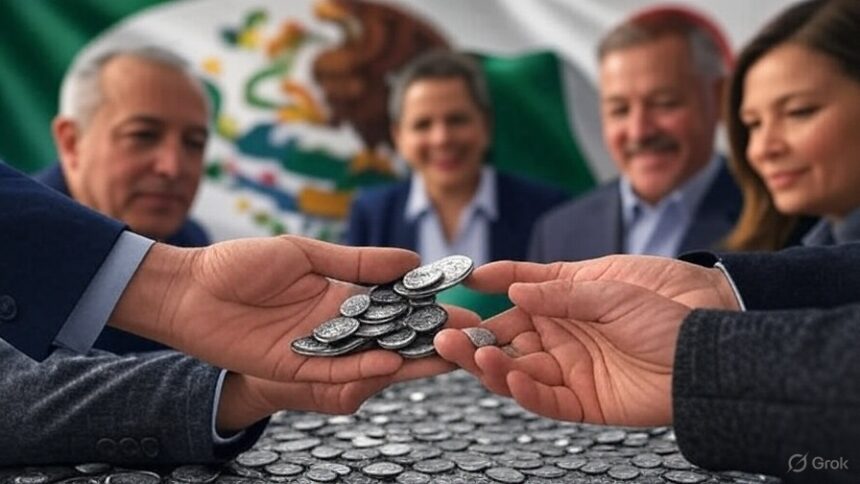
Sen. Alejandro Murat Hinojosa, a member of the Morena Tribunal, submitted a proposal on May 6, 2026 that would provide a legal framework for stablecoins or stable currencies pegged to the Mexican peso.
The project, currently published on the Senate’s website, aims to introduce a stable virtual asset (AVE) figure and regulate private tokens that serve as digital payment instruments in Mexico with strict one-to-one parity.
It is an institutional response to reality. Not covered by the FinTech Act of 2018 For example, the need for clear rules for assets that aim to replicate the value of national currencies in digital asset ecosystems.
User safety is at the heart of this reform, which directly impacts the Credit Institutions Act and the Securities Markets Act. For an asset to be considered AVE, the issuer must demonstrate that it has liquidity reserves equal to 100% of the tokens in circulation. This mechanism aims to avoid liquidity crises and ensure the right to immediate redemption.
According to the initiative statement submitted by Senator Hinojosa: The stable virtual asset “does not confer fiat currency or replace the peso.”
Mexico seeks to align with regional regulatory trends
Initiatives don’t come out of thin air. Mexico is observing an environment where regulation of digital assets has become a strategic priority. The GENIUS Act will be approved in the United States in 2025; As restrictions move forward in Brazil and El Salvador, Mexican lawmakers are trying to avoid delays.
This initiative therefore aims to harmonize innovation in digital payment methods with the maintenance of financial stability through the supervision of the Bank of Mexico and the National Bank and Securities Commission (CNBV).
The urgency of this legal framework can best be understood by looking at the local market context. As CriptoNoticias reported at the time, since 2021 and 2022, private initiatives such as MMXN (Moneta) and MXNT (Tether) tokens have sought to position the “digital peso” as an everyday payment tool and gateway to crypto savings.
However, mass adoption was difficult. Already at the time, sector analysts such as TruBit’s Javier Gamboa said that despite the fact that these assets allow transactions in cities such as Mexico with minimal fees via QR codes, They faced the challenge of a weakening peso against the dollar.
The new legislation introduced in the Senate appears to be the culmination of this experience and seeks to provide the legal certainty that pioneers lacked to engender trust among institutions and retail users.
In any case, the discussion in the digital community has already begun. While some see the law as an opportunity to professionalize local markets, others warn of the risk of creating bureaucratic structures that increase entry costs for new issuers.
The initiative will now be considered by a Senate committee. Given that Morena has a majority in the Senate; The project has a favorable legislative path.
This debate reflects a central challenge for Latin American regulators. It is about finding the right balance between allowing more space for private innovation in digital assets and maintaining exclusive state control over currency creation and financial stability in a world that increasingly demands more decentralization.
(Tag Translation) Latest


