




Despite Michael Saylor pointing out that internal Bitcoin metrics show a continued increase in shareholder exposure, Strategy reported that Bitcoin withdrawals to begin the year outpaced the company’s software revenue, resulting in a huge loss in the first quarter.
The company, formerly known as MicroStrategy, reported a net loss attributable to common stockholders of $12.77 billion, or $38.25 per diluted share, in the first quarter.
Revenues increased 11.9% year over year to $124.3 million, but the result was largely driven by unrealized losses on digital assets of $14.46 billion based on fair value accounting.
This result confirms a central tension surrounding Strategy’s model. The company can show an increase in the Bitcoin per share index while its reported profits are reshaped by the market price of a single volatile asset.
Thaler’s recommendation scorecard shows that companies are accumulating Bitcoin faster than shareholder exposure is eroded by dilution. Traditional accounting shows that a company’s earnings can fluctuate by billions of dollars in a single quarter.
Bitcoin yield becomes Saylor’s main scorecard
Strategy Inc. announced that its BTC yield has reached 9.4% since the beginning of the year. This metric measures the change in Bitcoin holdings per diluted share and provides a way to assess whether a company is increasing its Bitcoin exposure to shareholders even as it issues securities to fund purchases.
BTC Gain takes that percentage and converts it into a Bitcoin number. According to Strategy’s calculations, the increase since the beginning of the year is equivalent to 63,410 BTC.
The company also reported a BTC-Dollar gain of $4.97 billion, a dollar-denominated version of the same internal measure.
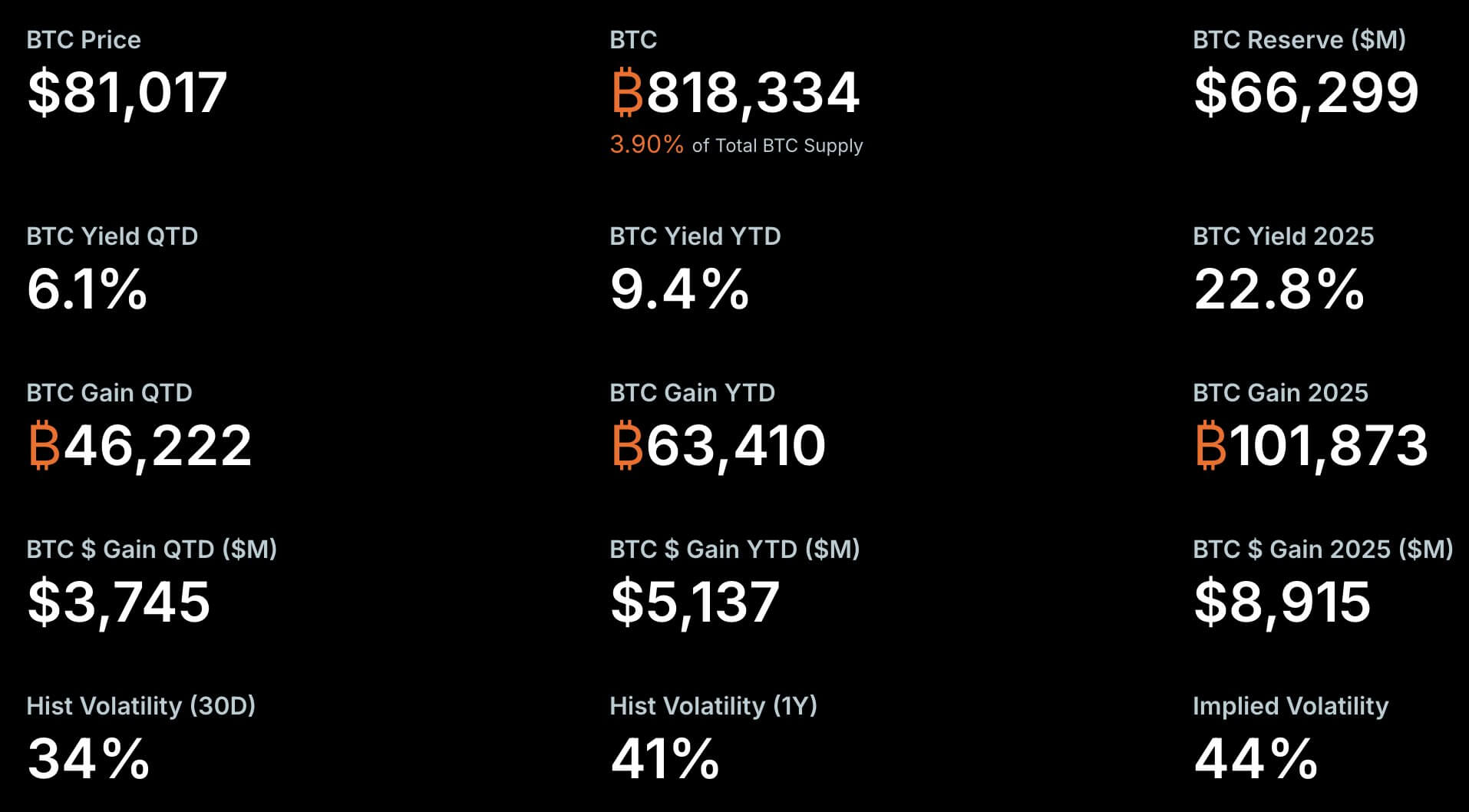
For Saylor and his supporters, the numbers serve as evidence that the company’s capital markets strategy is still generating increased Bitcoin exposure for shareholders.
However, this measure is narrower than profit, cash flow, and net income. There is no indication whether Strategy’s software business is improving, whether it is having difficulty meeting its dividend obligations, or whether the company’s financing costs are rising.
Instead, it answers one specific question: whether a company has increased its Bitcoin per share over a selected period of time.
This difference will shape our first quarter results. Strategy’s revenue was $124.3 million, up from $111.1 million in the year-ago quarter, with its traditional software division taking a backseat.
Revenue came from Bitcoin accounting, not product sales.
Strategy reported an operating loss of $14.47 billion, almost entirely due to unrealized losses on digital assets recorded during the quarter.
This creates a disconnect between economic exposure and reported returns. Although Strategy’s Bitcoin metrics improved, public shareholders absorbed GAAP losses that were well above pre-earnings consensus expectations.
Bitcoin purchases continued even during the drawdown
The first quarter was a stress test for Strategy’s strategy. During the same period, the company continued to buy Bitcoin, even though the price of Bitcoin plummeted.
The strategy ended the period with 818,334 BTC as of May 3, representing a 22% increase in holdings since the beginning of the year.
The company announced that its Bitcoin position had a market value of $64.14 billion as of May 1, based on the Bitcoin price of $78,374. The average purchase price was $75,537 per coin, and the position at that reference price was slightly above cost.
This holding amount is equivalent to approximately 3.9% of Bitcoin’s fixed token supply of 21 million units, making Strategy Inc.’s scale unmatched by other listed companies.
That ability to concentrate is both attractive and at the same time a source of risk.
As Bitcoin rises, Strategy’s balance sheet expands rapidly, potentially causing its stock price to move with more force than the token itself. If Bitcoin falls, that same leverage becomes debt, resulting in accounting losses, putting pressure on stock prices and raising questions about whether companies should continue to raise capital.
If you look at the history of stock prices, you can see the magnitude of their fluctuations. Since Strategy began converting to Bitcoin in 2020, BTC’s rapid rise during this period has seen MSTR stock rise to $500 in 2024, before falling to $100 earlier this year amid price struggles among the top cryptocurrencies.
The post-earnings reaction showed how sensitive the stock remains to that balance. Strategy stock fell after the earnings call, even though the company continued to report an increase in its Bitcoin exposure.
Market reaction is important to Strategy’s models. While rising stock prices make issuing shares more attractive, tight credit markets and falling stock prices can make it more expensive to raise capital.
Saylor’s strategy relies on the long-term price of Bitcoin and the market’s willingness to continue funding the company along the way.
Preferred stock becomes a new financing channel
Strategies’ funding structures are becoming more complex as their Bitcoin holdings expand. Although the company has used convertible debt and common stock for many years, its preferred stock program has become a more important part of its structure.
STRC (Strategy’s Floating Rate Perpetual Preferred Stock) provides the clearest example. This product provides investors with high cash dividends, while also providing another route for Strategy to raise funds for Bitcoin purchases. It also broadens the buyer base beyond investors who want direct exposure to common stocks.
STRC has raised $5.58 billion and has grown 189% since the beginning of the year, according to Strategy.
The preferred stock was launched with a 9% annual dividend and has since increased further through a series of dividend increases designed to keep commodity trading near par.
Strategy is also proposing a shareholder vote to double STRC’s dividend payment frequency from monthly to semi-monthly, a change that would make the product look like a regular income vehicle for yield-focused investors.
Growth was rapid. Saylor said that within nine months of its creation, STRC had grown to a market capitalization of $8.5 billion, making it one of the company’s hottest securities.
They are also starting to move beyond traditional markets. According to Strategy, $270 million of STRC is held across DeFi protocols, including Apyx and Saturn, with an additional $150 million held in corporate treasuries.
CEO Von Leh described STRC as a type of battery that stores Bitcoin profits and distributes them over time.
This description reflects Strategy’s pitch. Investors in the preferred stock earn income, while the company uses their funds to accumulate Bitcoin, which has the potential to appreciate in value over time.
This structure works best when Bitcoin is rising, Strategy’s common stock remains at a premium, and investors remain motivated to buy the company’s securities.
In such an environment, new issuance can fund more Bitcoin purchases, increasing BTC per share and supporting a broader valuation story.
Dividend burden raises risk bar
The problem is that Bitcoin does not generate income. Strategy’s software business is still profitable, but it’s small compared to the size of the company’s Bitcoin holdings and the debt it raises.
Therefore, the priority dividend burden has become a central risk. As Strategy Inc. issues more preferred stock, its annual cash liability increases.
Strategy reported cumulative preferred dividends and distributions of $692.5 million as of the first quarter. It also revealed that its preferred stock balance exceeds $13.5 billion.
These payments must be funded from existing cash, operating income, asset sales, or additional capital raising. The more a company relies on preferred stock, the more important market access becomes.
Although Strategy reported cash and cash equivalents of $2.21 billion at quarter end, providing liquidity for short-term debt, the broader model relies on continued access to capital markets.
The company claims that its securities are backed by large Bitcoin reserves. While that is true in an economic sense, the legal structure is more complex.
STRC is unsecured. This means that holders cannot make direct claims against specific Bitcoin collateral. In stress scenarios, the order of claims across convertible debt, preferred stock, and common stock is important.
The size of Strategy’s Bitcoin position also raises market structure issues. A forced sale by the world’s largest Bitcoin holder is likely to impact the price of the asset it seeks to monetize.
So the headline value of your holdings is different from the amount you can quickly realize under pressure.
For common shareholders, the risk is subordinated. Preferred dividends have priority over common stock. If payments are missed, accumulated debt may accumulate rather than disappear, increasing claims on the future value of the preferred securities.
That doesn’t mean the model is on the verge of failure. This means that as a company grows in size, its maintenance costs increase. Each new funding round may increase the amount of Bitcoin held, but may also add obligations that must be repaid before public shareholders can benefit.
The first quarter report narrowed down the issue. Although Strategy’s Bitcoin Scorecard improved, the company’s GAAP loss showed how quickly earnings can fluctuate relative to common shareholders when Bitcoin falls.
The next test will be whether investors continue to fund the trade after a quarter in which the company reported a nearly $5 billion profit on BTC and a $12.77 billion loss attributable to common shareholders.
(Tag translation) Bitcoin


