

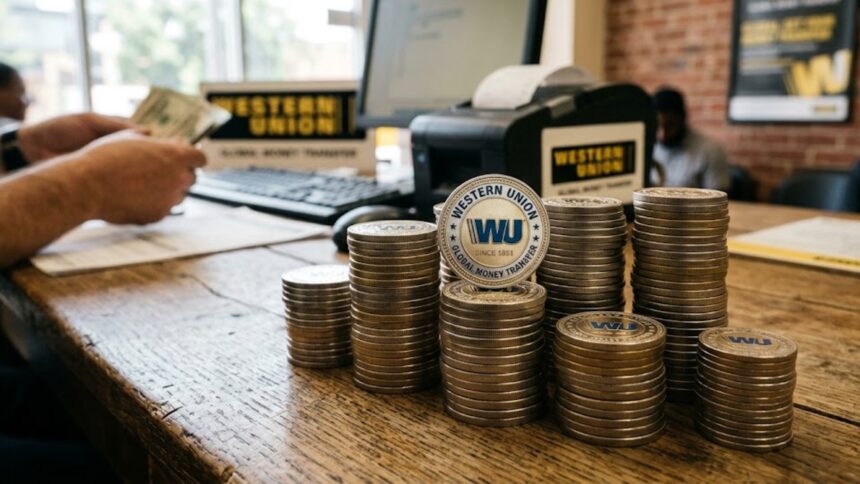
The arrival of Western Union’s stablecoin USDPT on the market does not mean it will compete head-on with leading stablecoins USD Tether (USDT) or USD Coin (USDC). Rather, it aims to be a complementary tool to the ecosystem.
This is what Geronimo Ferrer, business development manager for Argentina, Paraguay and Uruguay at cryptocurrency exchange Bitfinex, told CriptoNoticias. In a statement this Tuesday, May 5th, the executive claimed that assets issued on the Solana network “serve much more as complements through the ecosystem than as direct competitors.”
The executive explained that while digital currencies such as USDT have a high natural adoption rate in various regions such as Latin America due to savings and inflation hedging, Western Union’s proposition sits in a different niche: “payment infrastructure rather than store of value.”
“While there may be some volume growth in the long term, it is unlikely to be able to compete with the largest stablecoin liquidity and international expansions we may encounter,” the spokesperson said. “Western Union’s proposal appears to be a more payment-based and managed solution,” he added.
Mr. Ferrer emphasized that the USDPT is a tool. The purpose is to “eliminate structural friction” in the remittance businesssuch as high shipping costs and settlement times for cross-border payments, which operate primarily in cash-based markets.
According to Ferrer, stablecoins like USDPT that operate on a decentralized architecture will certainly facilitate near-real-time money transfers, which “could put pressure on fees in key corridors across Latin America where money transfers can be disproportionately expensive and slow.”
But he cautioned that the true extent of Western Union’s assets “depends on ‘last mile’ adoption (switching to cash), local regulations and user experience.”
Low fees, speed, and convenience sustain the use of stablecoins in three key areas: freelancers and exports, and informal currency conversion and international trade. Rather than a temporary hedge, stablecoins are becoming an integrated financial infrastructure in the digital economy. In this sense, Western Union benefits from integrating this stablecoin into its global physical network in order to further penetrate cash-based markets.
Geronimo Ferrer, Bitfinex.
Ferrer also pointed out that the entry of traditional giants like Western Union into the cryptocurrency ecosystem is seen as a sign of the maturation of the digital asset market.
“Traditional stakeholders have also suggested that stablecoins have moved from being a simple experiment to now becoming a useful financial infrastructure, especially in international payments,” Ferrer commented.
As you can see, the strategy of merging the traditional financial world with decentralized technology aims to improve efficiency. Reduce operating costs Fighting new competitors in the digital environment.
“A kind of bifurcation of the market”
Ferrer’s comments on Western Union’s stablecoin are complemented by the views of analysts such as Anibal Garrido, director of the BT&C Academy at the Universidad Catolica de Andres Bello (UCAB), who defines the current situation as “a kind of market bifurcation.”
Consulted by CriptoNoticias, he said that while USDT has established itself in fragile economies due to its relative independence and autonomy, this is not the case for USDPT. Born under strict compliance and monitoring schemes. In this scenario, Garrido believes Western Union is not competing to provide “free money,” but rather aims to position a “company-programmable hard dollar” that is fully integrated into the traditional financial system.
Economist Aaron Olmos echoed similar sentiments, noting that postal money order companies’ new digital currencies will have to compete for position. Demonstrate efficiency and effectiveness on the shipping platform. According to Olmos, USDPT’s success in the region will depend on its ability to offer tangible advantages in the retail remittance market, as traditional assets are already part of Latin Americans’ daily financial operations.
Indeed, despite Western Union’s institutional support, Latin America’s digital asset ecosystem remains a barrier to entry for new competitors.
In regions experiencing high inflation and economic crises, Latin American peoples have developed a culture based on economic independence. and instant liquidity provided by decentralized networks.
Indeed, Western Union has come to complement the ecosystem as an option for businesses, but it faces regions that have already embraced the liquidity and freedom of the most famous digital assets.
(Tag Translation) Cryptocurrency


