



Bitmine has over $10 billion staked in ETH, making it the largest corporate Ethereum treasury company and a yield-generating bet on the network’s proof-of-stake economy.
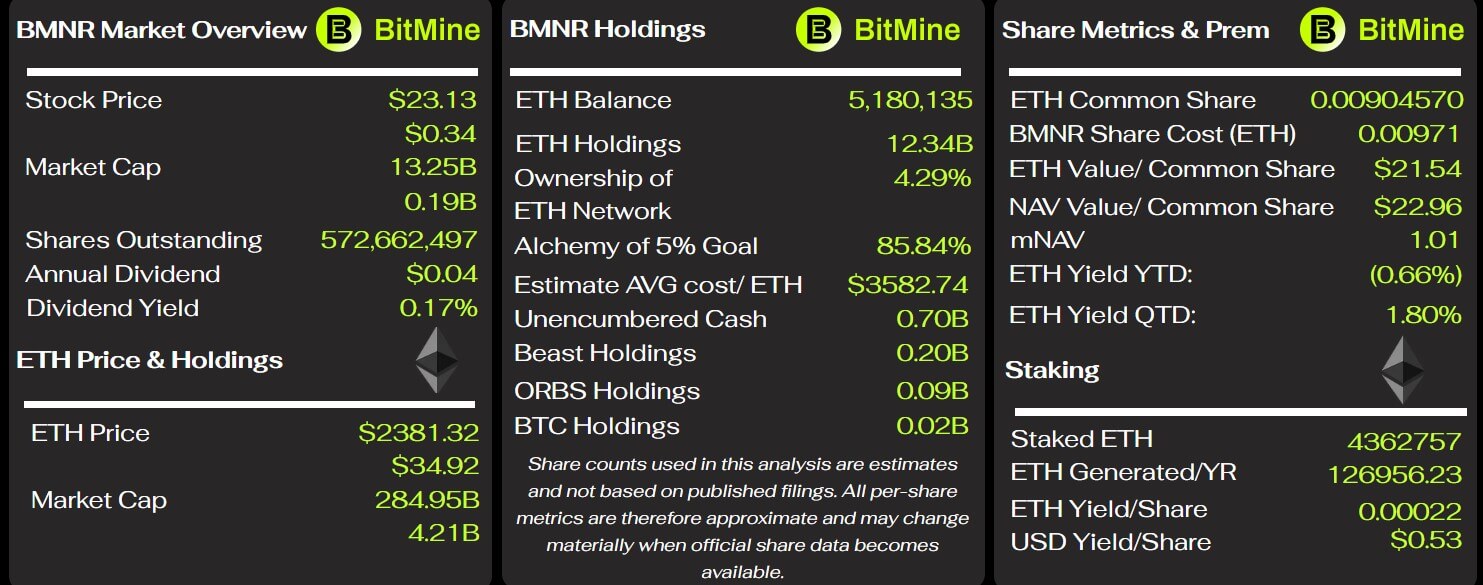
On May 4, the Las Vegas-based company announced that its ETH position was 4.36 million tokens, worth $10.2 billion at an average ETH price of $2,336.
This position represents over 84% of BitMine’s total ETH holdings, giving the company one of the largest visible corporate exposures to Ethereum’s verification system.
BitMine said it held 5.18 million ETH as of May 3, representing about 4.29% of the total Ethereum supply. The company also reported 200 Bitcoin, $700 million in cash, an investment in Beast Industries, and shares in Eightco Holdings, bringing its total holdings in cryptocurrencies, cash, and “moonshots” to $13.1 billion.
Betting on Ethereum vaults becomes a staking business
BitMine said its staking operations generate approximately $297 million in annual revenue based on a seven-day annualized rate of return of 2.91%.
Chairman Thomas “Tom” Lee said that once the company’s ETH holdings are fully staked through MAVAN, the Made in America Validator Network, and other staking partners, the expected annual staking rewards could reach $352 million.
With this disclosure, BitMine’s Ethereum strategy moves from balance sheet accumulation to testing recurring revenue.
Public companies primarily use Bitcoin as a financial reserve asset, with Michael Saylor’s strategy setting the template for corporate accumulation. Ethereum gives BitMine a different structure as you can stake assets directly into the network and earn protocol rewards.
BitMine’s size makes it an open market agency for Ethereum’s staking economy. Investors in BMNR stock are no longer only exposed to fluctuations in the market price of ETH. They are also exposed to the company’s ability to manage its validator infrastructure, earn network rewards, and increase Ethereum’s standing over time.
In particular, as of May 1, BMNR has recorded an average daily trading volume of $625 million over five days, ranking 173rd among U.S.-listed stocks.
This liquidity gives the company a public equity channel where investors can voice their opinions on Ethereum accumulation and staking without directly owning the tokens.
Ethereum validator queue shows widespread demand
BitMine’s staking push comes as Ethereum’s validator entry queue is rapidly increasing, indicating renewed demand for ETH as a yield-producing asset, even as the token’s price story remains contested.
According to ValidatorQueue data, approximately 3.72 million ETH is waiting to join the validator set, with activation delays estimated to be over 64 days. Approximately 346,000 Ethereum are waiting for exit, and the wait time is estimated to be approximately 6 days.
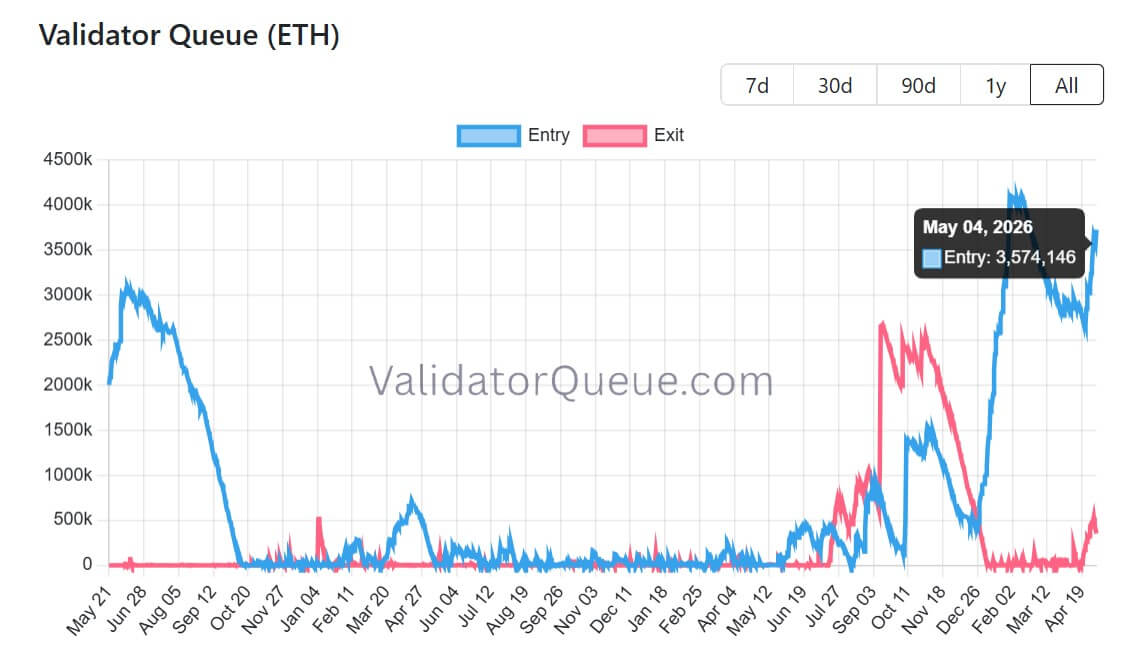
The network had approximately 898,000 active validators with 38.6 million ETH staked, and the staking rate was approximately 31.7% of supply.
Ethereum limits the amount of ETH that can enter and exit validation at any one time through a churn mechanism designed to protect the stability of consensus. This throttling can create long queues if new deposits can exceed the rate at which validators can be activated.
On the other hand, a queue does not mean that all of that ETH has already earned rewards. Deposited Ethereum must wait for activation before it can begin participating in validation.
Still, the imbalance between entry and exit queues indicates that more capital is trying to enter Ethereum staking than is going out.
This is a noteworthy signal for the Ethereum market. While a larger staking base can quickly reduce liquid supply, validator rewards turn ETH into a productive asset for holders willing to accept lock-ups, technical and operational risks.
Yield comes with operational risk
Ethereum staking differs from crypto lending because rewards come from the protocol rather than from the borrower.
Validators lock ETH as collateral, run software, certify blocks, and ensure the security of the network. If you do it right, you can earn rewards, but if you go offline you can lose them. In more serious cases, validators can be penalized by a slash for harmful behavior.
While this structure makes staking attractive to institutions seeking native crypto yield, it also creates a new category of operational risk for public companies.
This is because corporate ETH holders staking at scale need to control validator uptime, client selection, custody, key management, and exposure to staking partners.
For BitMine, the revenue opportunity is clear. A 2.91% annual staking yield on billions of dollars of Ethereum creates a significant income stream. However, the risk is that staking is not passive, unlike holding Spot Ether in a corporate wallet.
The company’s MAVAN infrastructure is central to that strategy. If BitMine continues to stake a large portion of its Ethereum, its financial model will depend not only on the price of ETH, but also on the performance of its validators and how reliably they can generate staking rewards across market cycles.
As such, BitMine’s model is different from traditional crypto companies. We hold ETH and explore the possibility of acquiring digital assets and increasing our share of the asset over time through protocol rewards.
Ownership is different from control
Additionally, BitMine’s staggering ETH holdings also raise more precise questions about the decentralization of blockchain networks.
In Ethereum’s proof-of-stake system, validators stake Ethereum into the network and participate in consensus.
According to Ethereum.org, an attacker can interfere with finality if they hold more than 33% of the staked Ether, and the higher the threshold, the greater the risk. Finality depends on a two-thirds supermajority vote of the Ether staked at the checkpoint.
So while BitMine’s 4.29% share of the total ETH supply is economically significant, it alone does not grant it control over Ethereum.
Considering this, the more relevant questions are how much ETH BitMine control is actively staked, whether the stake is distributed across operators and clients, and how much of the network depends on a small group of institutional validators.
Discussions about Ethereum decentralization have long focused on staking concentrations, liquid staking protocols, centralized exchanges, and client diversity. Large pools and staking providers can influence the network as they manipulate validators, shape defaults, and orchestrate upgrades.
The arrival of BitMine adds a new corporate layer to that discussion. Public companies staking billions of dollars of Ethereum can increase the security of ETH by increasing the value locked in verification.
However, concerns may also increase as the share of validator privileges increases and becomes concentrated among a limited number of operators, custodians, or software clients.
Public markets test Ethereum’s staking economics
The question for the market is whether BitMine’s strategy will be treated as leveraged ETH trading, as a staking income vehicle, or as a hybrid of both.
As Ethereum rises, the financial value of companies increases. If the staking yield is stable, BitMine can generate rewards denominated in ETH on a regular basis. If validator queues remain elevated, new entrants may have to wait longer to earn rewards, further increasing the value of a company’s initial staking size.
At the same time, the opposite risks are also clear. A fall in the ETH price could rapidly reduce the dollar value of the treasury.
As more Ethereum enters the validation process, staking yields may decrease. Revenue strategies can become a source of loss due to operational errors, partner concentration, or client failure.
For Ethereum, the Bitmine move shows how proof-of-stake has changed the role of assets in public markets. ETH is no longer held solely as a speculative token or reserve asset.
At BitMine’s scale, it is also being used as productive capital that can generate revenue, secure the network, and reshape the debate around institutional participation.
(Tag Translation) Featured


