

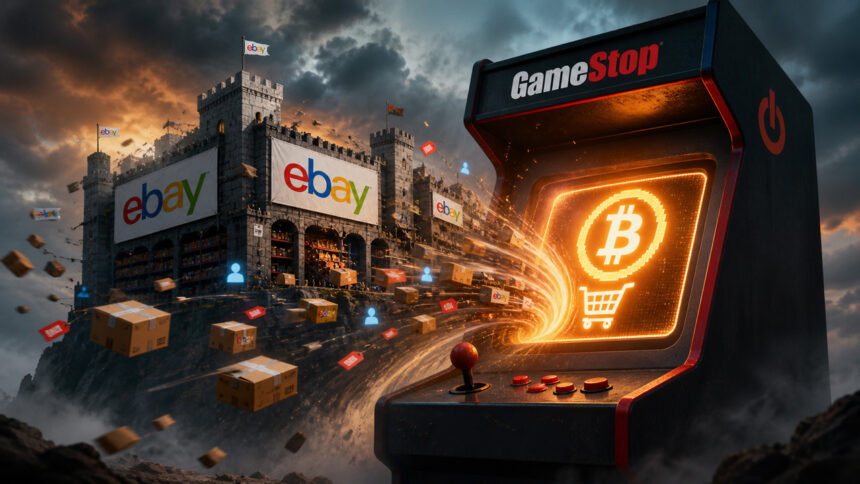


GameStop’s unsolicited $55.5 billion bid for eBay could give the video game retailer a much larger e-commerce platform, a broader resale network, and a potential opportunity to test whether Bitcoin can move beyond corporate treasuries and into consumer payments.
On May 4, GameStop offered eBay $125 per share in a cash and stock offer that valued the online marketplace at about $55.5 billion.
The offer consists of 50% cash and 50% GameStop common stock, and includes stockholder voting rights and pro rata shares. GameStop said the offer represents a 27% premium to eBay’s 30-day volume-weighted average price and a 36% premium to its 90-day average.
The company said it has built a 5% economic stake in eBay through derivatives and beneficial ownership of common stock.

Small buyers target larger markets
The offer would be an unusual deal in size and structure, given that GameStop is financing its bid with a combination of cash, outside funding and its own stock to acquire a company several times its size.
GameStop said the cash portion will be funded by cash and liquidity investments on its balance sheet, which totaled approximately $9.4 billion as of Jan. 31, as well as third-party acquisition funds. The firm said TD Securities provided a highly confident letter of up to $20 billion.
Still, any bid would depend on the value of GameStop’s stock, additional financing and support from eBay shareholders.
eBay announced Monday that its board of directors and financial advisors would consider the unsolicited proposal, adding that there were no discussions with GameStop before the proposal was received.
The company said the review will focus on the value provided to eBay shareholders, including the value of GameStop stock and GameStop’s ability to submit a binding and viable offer. eBay advised shareholders not to take any action while its board evaluates the bid.
GameStop’s stock fell after the announcement, while eBay’s stock rose, reflecting investors’ skepticism about whether GameStop could finance and complete a deal of that size.
Why GameStop wants to buy eBay
GameStop acquisition discussions center on Ryan Cohen’s claims that eBay can generate higher revenues under his leadership through cost cutting, retail consolidation, and more aggressive expansion into categories such as collectibles, authentication, and live commerce.
The company said it will realize annual cost savings of $2 billion within 12 months of closing the acquisition. The plan includes approximately $1.2 billion for sales and marketing, $300 million for product development, and $500 million for general and administrative expenses.
GameStop pointed to eBay’s sales and marketing spending of $2.4 billion in 2025 and said the marketplace added only about 1 million net active buyers in the same year.
It also said product development costs rose 11% and revenue rose 8%, giving Mr. Cohen reason to argue that he could reduce eBay’s expense base without hurting its business.
The operational case is not just about cost savings. GameStop said its approximately 1,600 retail stores in the U.S. could support eBay’s marketplace by serving as authentication, ingestion, fulfillment and live commerce sites.
That would tie the rest of GameStop’s store network to eBay’s global platform, especially in categories where trust, grading, returns and physical inspection can influence buyer behavior.
The store network could also support collectibles, trading cards, retro games, sneakers, luxury goods, electronics, and more. These are the categories where eBay already has a presence and where GameStop is trying to reposition itself as sales of physical games are declining.
If the deal goes through, Cohen will become CEO of the combined company.
In particular, he brings a track record of corporate turnarounds. Since January 2021, he has taken GameStop from a net loss of $381 million to a net profit of $418.4 million in fiscal 2025. The company closed its unprofitable overseas business and shifted its focus to high-margin retro games and trading cards.
Mr. Cohen receives no salary or cash bonus and owns 9% of GameStop stock.
How will this affect Bitcoin?
While GameStop hasn’t explicitly said it intends to integrate Bitcoin with eBay, the proposed acquisition raises a structural question for the emerging industry: What happens when a BTC-holding company buys a marketplace with 135 million active buyers?
Until now, GameStop has treated the top cryptocurrency as a corporate finance tool. After approving Bitcoin as a Treasury reserve asset, the retailer purchased 4,710 BTC in May 2025 for $513 million.
Rather than simply holding the assets, GameStop pledged its stash to Coinbase as collateral for a yield-generating options strategy. This move maintained financial exposure to BTC while earning passive income.
But an eBay acquisition could move GameStop’s cryptocurrency capabilities from its balance sheet to its market infrastructure.
Although Bitcoin has achieved institutional status through exchange-traded funds, its day-to-day utility remains narrow. High fees and complex tax treatment limit consumer adoption.
Considering the above, eBay provides the scale that is missing in the digital asset space. There are 135 million active buyers across 190 markets, with approximately $80 billion in gross merchandise value in 2025.
If Cohen secures the platform and leverages GameStop’s crypto fluency, the impact on Bitcoin could extend beyond simple checkout options. A crypto-enabled eBay could leverage the broader Bitcoin ecosystem to solve specific market problems.
To illustrate, GameStop is also adding Bitcoin payments to eBay and using the Lightning Network to instantly process cross-border transfers for international sellers.
Additionally, eBay is a major hub for trading cards, sneakers, and luxury goods. The company uses Bitcoin-native tools like Ordinals to create immutable digital certificates for physical items that can permanently authenticate their origin on the blockchain.
Additionally, user identities and seller reputations could be tied to verified Bitcoin wallets to reduce fraud, while large sellers could be given the option of holding their eBay balances in Bitcoin or participating in a revenue-generating strategy similar to GameStop’s own corporate strategy.
Notably, none of these initiatives have been formally proposed. However, the size of the eBay ecosystem means that deployment does not need to be widespread to be significant.
GameStop-controlled eBay will be the biggest real-world test of whether Bitcoin can serve as the foundational layer of global commerce, even if limited to high-value international transactions and collectibles.
GameStop’s eBay trade faces potential hurdles
However, achieving such lofty goals remains a challenge as eBay transactions remain uncertain.
Currently, GameStop’s eBay offer is non-binding and the e-commerce company’s board of directors has not approved it.
This means GameStop will need to convince eBay shareholders that its stock is a reliable consideration, that debt financing can be arranged on acceptable terms, and that Mr. Cohen’s cost-cutting plans will not damage eBay’s market.
There are also timing and governance hurdles. However, Cohen said he was prepared to make a proposal directly to shareholders if eBay’s board rejects the proposal, although the board nomination window for eBay’s June annual meeting has ended.
Meanwhile, regulators will also review transactions involving two consumer companies with overlapping interests in resale, gaming, collectibles and online commerce. The antitrust risks may be lower than a direct partnership between two e-commerce giants, but the size and financing structure of the deal will still require scrutiny.
For eBay, this offer comes after your business has gained momentum. The company reported strong first quarter results, continued growth in total distribution volume, and aggressive efforts to expand its recommerce, live sales, and AI-assisted marketplace tools.
This gives the board reason to argue that shareholders may receive more value from eBay’s standalone strategy than by accepting GameStop shares as half of the consideration.
For GameStop, the bid is the biggest test in Mr. Cohen’s attempt to pivot the company out of its shrinking traditional business.
The retailer became a market icon in 2021 with its meme stock rally, followed by a shift to cost cuts, a stronger balance sheet, collectibles and Bitcoin. Buying eBay would make that strategy a much bigger bet on e-commerce.
If the bid fails, the Bitcoin angle will remain largely theoretical. GameStop has adopted a covered call strategy and will continue to be a retailer holding BTC.
However, the discussion will change once the bidding progresses. Companies that have purchased Bitcoin for their balance sheets will be in a position to decide whether one of the internet’s oldest marketplaces should become a testing ground for BTC payments, stablecoin payments, and commerce related to cryptocurrencies.
(Tag Translation)Bitcoin


