


The aftermath of a security lapse usually leads to speculation about its cause and effect.
Notably, the total amount of $600 million in user funds compromised in three recent DeFi hacks follows this pattern.
But now the concerns are not just about the impact these hacks will have on agency deployments, but also about the potential for system overhauls through the integration of AI-driven security solutions.
For example, JPMorgan notes that DeFi exploits are hindering adoption by institutional investors, while BitMEX co-founder Arthur Hayes argues that AI-focused tokens that power agent economies could soon overtake the existing cryptocurrency narrative.
Naturally, Ethereum ($ETH) is at the very center of this discussion.
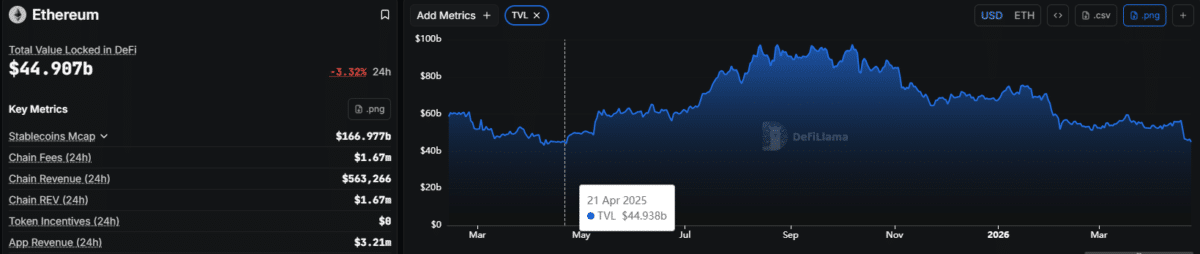
In terms of DeFi, Ethereum remains the dominant player, with no other L1 coming close for the time being.
Naturally, the impact of these breaches is significant for networks. As the chart above shows, Ethereum’s Total Value Locked (TVL) has fallen to a yearly low of $44 billion, with more than $10 billion lost this week alone following the $294 million KelpDAO hack.
Technically, this suggests that liquidity across DeFi is shrinking rapidly, likely driven by capital rotation from protocols that have been exposed to recent exploits.
In this context, Arthur Hayes’ commentary carries even more weight. According to him, Ethereum could soon fall out of the top three by 2030 due to the rise of AI-driven solutions that strengthen DeFi security while also contributing to overall AI token growth.
The resulting frenzy further fueled the surrounding FUD. $ETH. Against this background, the recent $1 billion $USDT Is the mint by Tether a coincidence or a strategic move?
$USDT Ethereum supply will be the main catalyst for the market
The impact of rising on-chain liquidity in stablecoins typically refers to one of two scenarios.
First, it could signal a risk-off movement as investors move towards stablecoins as a safe haven. In this case, liquidity increases not through new risk-taking, but through a reduction in exposure.
Alternatively, it may indicate a bullish setup where capital is being accumulated in preparation for market deployment.
Looking at Ethereum, the latter scenario seems to be taking shape. In particular, stablecoin activity on the network during the second quarter $ETH10% rebound.
Zooming in, we see that Ethereum’s supply is increasing by more than 5.5% month on month, with Tether holding the lion’s share. In fact, the latest $1 billion mintage brings the total to about $3 billion. $USDT Published in the last 5 days.
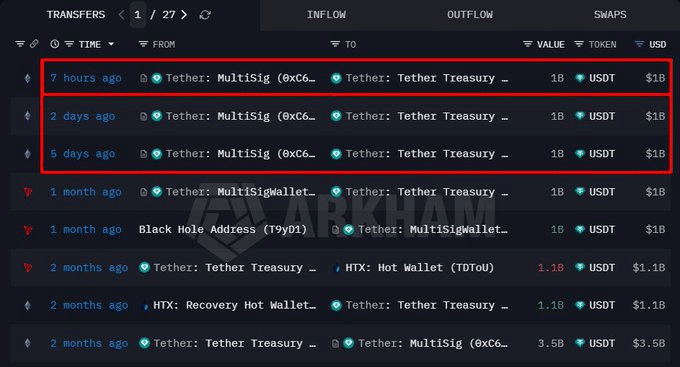
According to AMBCrypto, the timing of this move is important.
As mentioned above, FUD is building around Ethereum’s DeFi and growing AI narrative, with analysts even pointing to TAO/.$ETH As capital rotates into AI assets, Arthur Hayes’ recent insights are noteworthy.
However, with the recent increase of $3 billion, $USDT Supplies add another layer to your setup.
Stablecoin mints like this often indicate new liquidity coming into the system, or “dry powder” waiting on the sidelines. Simply put, Tether may be counting on capital to return to DeFi once the current FUD cools down, suggesting this move is “purely” strategic.
If this trend continues, Ethereum’s TVL could be gearing up for a solid rebound, potentially challenging JP Morgan and Arthur Hayes’ recent outlook.
Final summary
- DeFi hacking and changing AI narratives have increased FUD regarding Ethereum.
- big $USDT The mint could signal that new liquidity is accumulating for a possible return to DeFi if sentiment improves.


