



Ethereum has struggled to regain the $2,400 level as the broader market consolidates and buyers look for the confidence needed to push through the overhead resistance. The price chart shows hesitation. However, on-chain data shows a completely different story. And it comes from the same organization that has been quietly reshaping Ethereum’s supply structure for months.
Arkham Intelligence data confirms that Bitmine has staked an additional 112,656 ETH (equivalent to approximately $260 million at current prices). The deal is the latest in a series of large and intentional commitments that have been building since the company launched its Ethereum financial strategy earlier this year. Each stake is followed by another. The pace hasn’t slowed down. The direction has not changed.

Companies that started with a theory about Ethereum’s long-term value have consistently executed on it at scale through market volatility, price declines, and uncertainty that has caused most participants to pause rather than commit further.
Ethereum’s struggle to clear $2,400 as one of its largest holders continues to lock more supply into the network is a structural tension not yet reflected in the price chart, but impossible to ignore when looking at on-chain data.
8.8 billion dollars has been invested. 75% committed. The endgame is becoming the focus
The cumulative numbers define the scale of what Bitmine has built. With 3,814,245 ETH currently staked ($8.8 billion at current prices, or 75% of total holdings), the company has built what is arguably the largest staked Ethereum position by a single entity in existence. Three-quarters of everything Bitmine owns is locked into the network’s verification infrastructure, which generates revenue and removes supply from liquid markets at the same time.
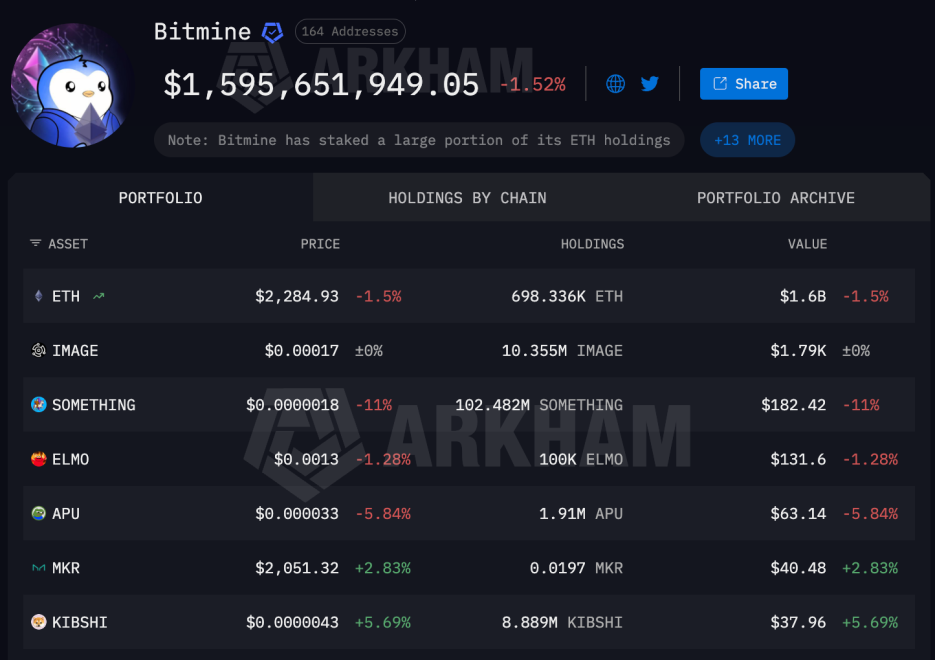
The endgame the data shows is not speculative. This can also be seen from the movement itself. Bitmine does not accumulate Ethereum for trading. You are not building a position to exit at the peak of the next cycle. This commitment to staking comes with intentional friction through exit delays, debonding periods, and illiquidity, but reflects a company deciding that Ethereum’s value as a yield-generating and network-securing asset outweighs its value as a tradable token.
Similarities to MicroStrategy are often pointed out, and for good reason. But the staking aspect goes further than what Strategy has built with Bitcoin. Bitmine is not just withdrawing supply from the market, it is embedding itself into the protocol’s operational infrastructure. Every enabled validator deepens their commitment and expands the network’s dependence on Bitmine’s continued participation.
While 75% of stakes are still being added, the end goal appears to be to control Ethereum’s structural position, which generates revenue, impacts network security, and creates a supply floor with every additional stake. The accumulation does not stop. The position has not reached its peak. The direction remains unchanged.
Long-term support for Ethereum testing
Ethereum is trading near $2,280 on the weekly chart, a level that currently sits at the intersection of major long-term moving averages. The recent structure shows a sharp rebound from the $3,800-$4,000 region early in the cycle, followed by a deep correction that bottomed out around $1,500. Prices have since recovered, but the momentum has been uneven and clearly subdued.
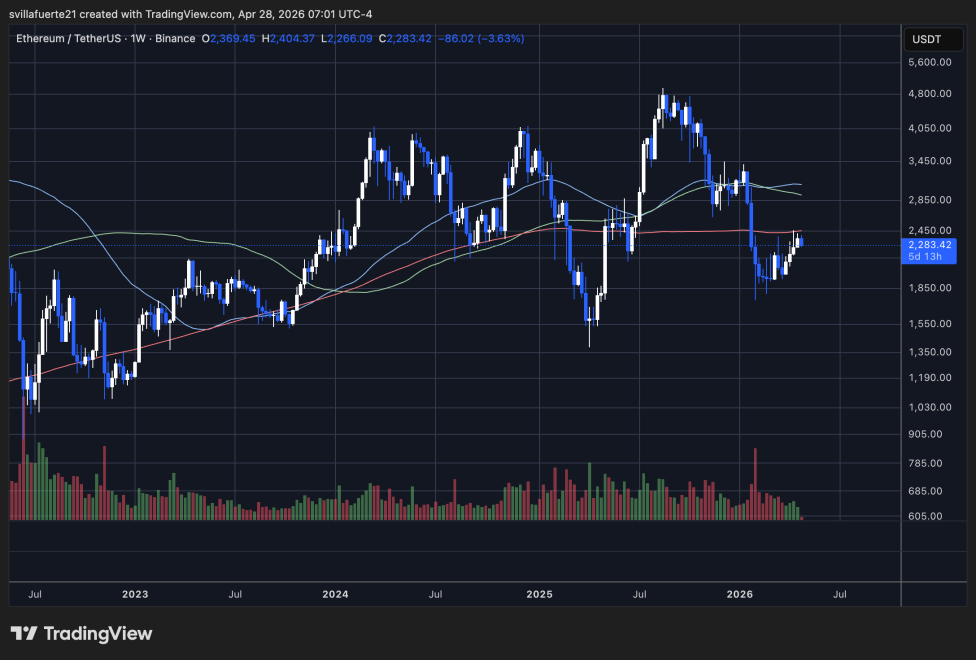
The current range of about $2,100 to $2,400 is a hotly contested area. Ethereum is trying to regain its 200-week moving average, which has flattened out and is starting to act as resistance rather than support. At the same time, the 50-week and 100-week moving averages have now converged just above the price, reinforcing the indirect supply zone around $2,400-$2,600.
The volume pattern suggests that the decline generated more conviction than the recovery. Although the spike in volume during the decline indicates forced selling or aggressive distribution, the rally is unfolding based on relatively low participation, which is a typical feature of a corrective rally rather than an impulsive trend reversal.
Structurally, Ethereum is compressing under resistance after a bailout rebound. A clean break above $2,600 would shift the medium-term outlook to continuation. However, failure to hold $2,100 could send the structure back into the low demand zone.
Featured image from ChatGPT, chart from TradingView.com
editing process for is focused on providing thoroughly researched, accurate, and unbiased content. We adhere to strict sourcing standards, and each page is carefully reviewed by our team of top technology experts and experienced editors. This process ensures the integrity, relevance, and value of your content to your readers.


