

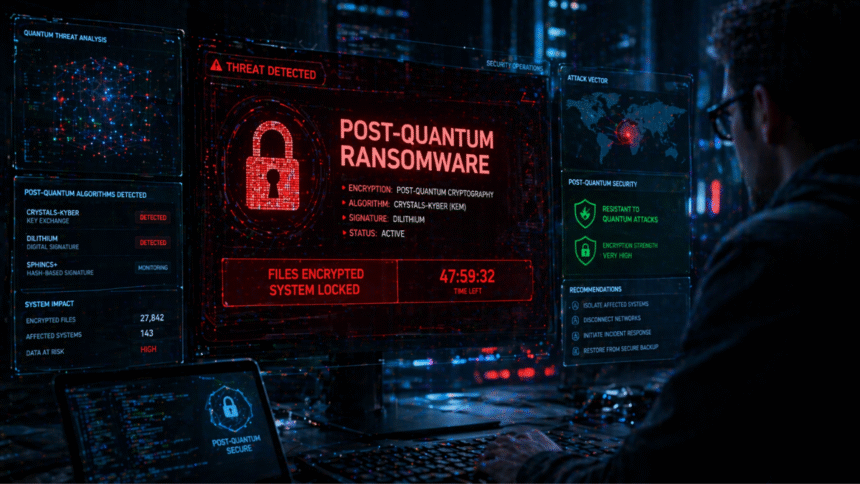
Cybersecurity company Rapid7 has revealed analysis that confirms through reverse engineering that a ransomware family called Kyber uses ML-KEM 1024, a post-quantum encryption standard approved by the National Institute of Standards and Technology (NIST).
The purpose of the post-quantum shield is Protect the key that encrypts the victim’s filesresearchers wrote in a report published on April 21 this year on the specialist site Ars Technica.
Brett Callow, a threat analyst at Emsisoft, is quoted in the report. This is the first confirmed case of ransomware using post-quantum cryptography.
The Kyber family has been active since at least September last year. Its name is taken from the ML-KEM standard itselfalso known as Kyber in the cryptographic literature.
This coincidence is no coincidence. The group behind the ransomware chose the name to emphasize its use of post-quantum schemes, while Rapid7 has confirmed that ransomware is implemented in at least a variant of its malware that attacks Windows systems.
Ransomware, on the other hand, is a type of malicious software that encrypts the victim’s files and demands payment, usually in crypto assets, in exchange for giving access back.
How does a post-quantum scheme work in Kyber?
Our analysis shows that malware does not directly encrypt files using post-quantum standards because this step would take too long. Instead, it generates a random key based on the AES-256 scheme (a symmetric encryption that is already resistant to quantum attacks) and uses that key to encrypt the file.
after that, Protect AES keys using ML-KEM 1024. That way, only the attacker can recover the original key and decrypt the data. According to Anna Širokova, a researcher at Rapid7 and author of the analysis, implementing ML-KEM required very little work. Open source libraries are available and well-documented, and you can integrate the scheme by adding dependencies to your project.
However, Rapid7 research found that not all ransomware variants live up to their claims.
The version of Kyber that attacks VMware systems (a virtualization platform widely used in corporate environments) claims to use ML-KEM, but reverse engineering revealed that it actually encrypts keys with 4,096-bit RSA. It will take even longer for a classical scheme to be compromised by a quantum computer than for ML-KEM itself.
Why would they use post-quantum security with Kyber?
The most striking element of the analysis is The use of post-quantum cryptography offers no real technical benefit to attackers.
Researchers at Ars Technica point out that it will be at least three years, and likely longer, before we have a quantum computer capable of running Scholl’s algorithm, a mathematical procedure that allows us to break RSA and elliptic curve schemes. Meanwhile, Kyber’s ransom note Give the victim only one week of payment. On that timeline, post-quantum benefits become meaningless.
According to Shirokova, the answer to why Kyber uses encryption is: “Victim-oriented marketing”«. “Post-quantum encryption sounds a lot scarier than ‘we’re using AES,’ especially to a non-technical decision maker considering whether or not to pay for it,” the researcher said in an email cited by Ars Technica.
“It’s a psychological trick. They’re not worried that someone will break the encryption in 10 years. “They want payment within 72 hours,” he added. The target is not the victim company’s technical team, but the company’s executives and lawyers who decide whether to accept bailouts. They can associate the term post-quantum with insurmountable cryptographic strength.
The Kyber incident is important not so much for its technical sophistication as for what it reveals about the cyber threat ecosystem. Post-quantum cryptography, a topic that was mainly prevalent in the world until recently paper It is already well recognized among academics and research teams. Acts as a social engineering weapon.
(Tag Translation) Quantum Computing


