


As the market moves into a new quarter, forecasts are starting to build for second quarter end targets.
However, it is important to look back to determine potential directions. Bitcoin ($BTC) The stock closed down 22.2%, its worst quarterly performance since 2018.
Ethereum ($ETH) Meanwhile, the quarter ended with a decline of 29.36%, which was still better than the decline of 45.41% in the first quarter of 2025.
However, if we consider the 2025 cycle as our base case, Ethereum’s 36.48% gain in the second quarter outpaced Bitcoin by approximately 1.2x, which is highlighted. $ETHStronger repulsive force. That said, a recent CryptoQuant report suggests that this trend may already be playing out, with March leading the way.
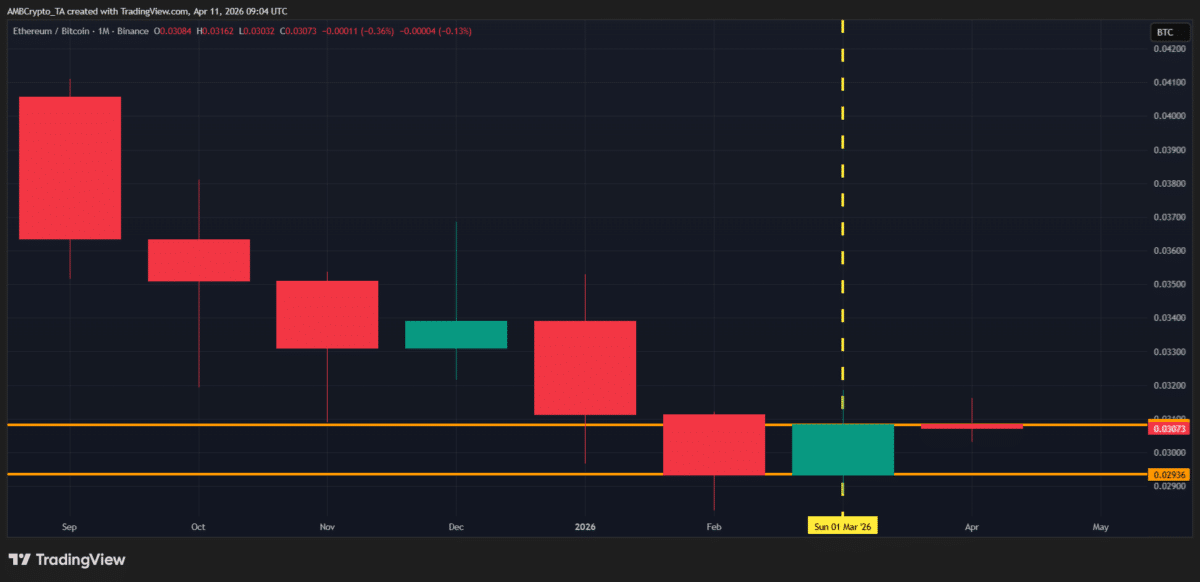
During the month, Bitcoin registered a modest increase of +1.83%, while Ethereum rose +7.12%, showing a clear turnover of capital.
At the same time, Bitcoin’s market cap contracted slightly (-0.43%), while Ethereum expanded (+2.97%), reinforcing the narrative of capital shifting to high-beta assets.
Notably, this divergence is further verified in supply-side dynamics.
For example, Ethereum’s continued exchange outflows indicate a gradual shift towards long-term holdings. Furthermore, on-chain data also supports this. Coinbase’s premium gap is improving, indicating an early recovery.
Meanwhile, Ethereum’s active addresses continue to trend upward, indicating an increase in network usage.
Essentially, $ETH/$BTC It was no fluke that the ratio rose to 5.15% in March. Instead, it was driven by a combination of rotating flows, tightening supply dynamics, and improving on-chain activity.
Naturally, this leads to an important question – is Ethereum poised to outperform Bitcoin in Q2?
Institutional trends are starting to catch up with Ethereum fundamentals
Ethereum’s strengths are not always fully expressed through short-term technical price movements.
Rather, prices tend to lag underlying fundamentals. The logic is simple. In DeFi, increased network activity directly leads to increased demand on the network. $ETH. However, this demand is not immediately reflected in price changes.
Instead, it is first accumulated on-chain before ultimately being priced in by the market.
Looking at the recent CryptoQuant report, Ethereum appears to be approaching this stage. As shown in the data, Ethereum’s 7-day SMA for “total transfers” has once again exceeded 1.3 million, returning to levels last seen at an all-time high in mid-February.
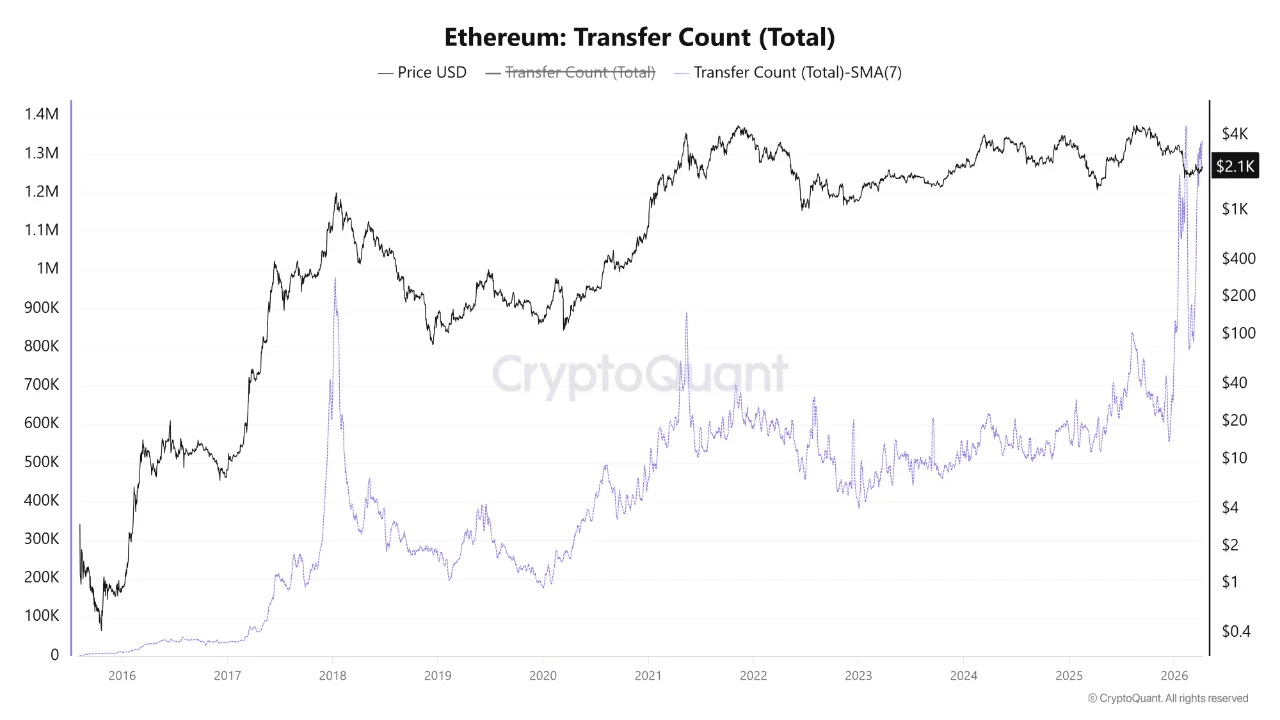
For context, a high 7-day SMA for “total transfers” typically indicates an increase in on-chain activity, reflecting increased usage across transfers, trades, and DeFi interactions.
More importantly, recent accumulation trends suggest that institutional participation may be beginning to catch up with the strength of this underlying network.
Now, when combined with the rise in the Coinbase Premium Index, the increase in active addresses, and the strengthening capital flows observed in March, the situation becomes more constructive.
These indicators “collectively” indicate on-chain demand, with both retailer and institutional participation showing early signs of alignment.
Taken together, this suggests an early foundation. $ETH/$BTC Second quarter rotation. Ethereum is increasingly positioned to outperform Bitcoin as the second quarter ends.
Final summary
- Capital turnover and improvement in March $ETH/$BTC Flows suggest that early stage positioning is shifting towards Ethereum.
- Increased transfer activity, improvements in Coinbase Premium, and increase in active addresses indicate strengthening on-chain demand, setting the stage for Ethereum to outperform in Q2.


