




Bitcoin (BTC) moved from around $67,000 to $72,000 in the days surrounding the US-Israel-Iran ceasefire announcement, rebounding 7.5%, reducing volatility and boosting sentiment across risk assets.
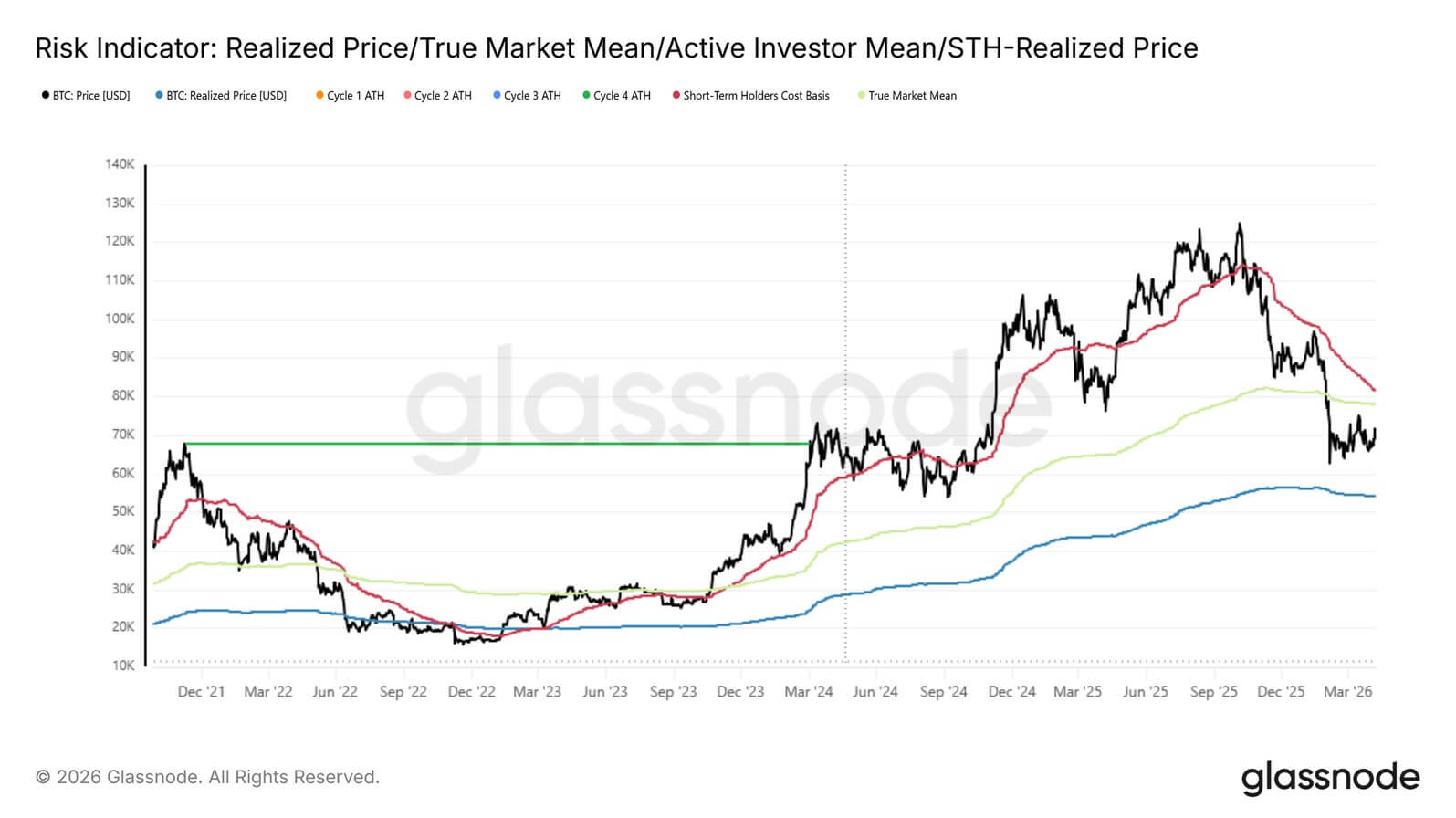
Glassnode’s on-chain report for the week of April 8th noted that the recovery and stabilization remain consistent with the bear market rebound signature. BTC is still trading within the bearish market value zone, and the level at which things will truly reverse is $81,600.
This number is on a short-term holder cost basis and is the sum of the break-even prices of Bitcoin purchased in recent months. Glassnode identifies this as the line the market needs to recover before the rally plausibly represents a sustained move.
Below that, recent buyers have been in losses as a cohort, and the report says that each rise into this range tends to encounter supply from trapped holders looking to exit near breakeven.
The ceasefire eased macro shocks and compressed options market volatility. Short-term implied volume has fallen to the low 40% range, and six-month contracts have settled at around 45%.
Reuters reported on April 9 that the ceasefire deal already looks fragile, with oil rebounding within a day of the announcement and broad risk sentiment weakening.
three numbers
Glassnode’s framework has contracted to a clean transition, with dealer positioning pointing to the $69,000-$71,500 zone indicating long-term gamma concentration, a mechanical structure that could help absorb short-term selling.

At the time of writing, BTC is trading just above $72,000, with the market above the upper support shelf. The true market average of $78,000 is 8.5% higher and represents the expected ceiling of the relief rally.
Glassnode positions the AVIV ratio at 0.92, which has been below 1.0 since early February. The company said this number is comparable to the bear market period of May-June 2022 and far exceeds the extremes of the deepest capitulation in late 2022.
The current setup is a rebound within an ongoing bearish phase, with a reasonable bottom, likely a near-term top, and more important levels above both.
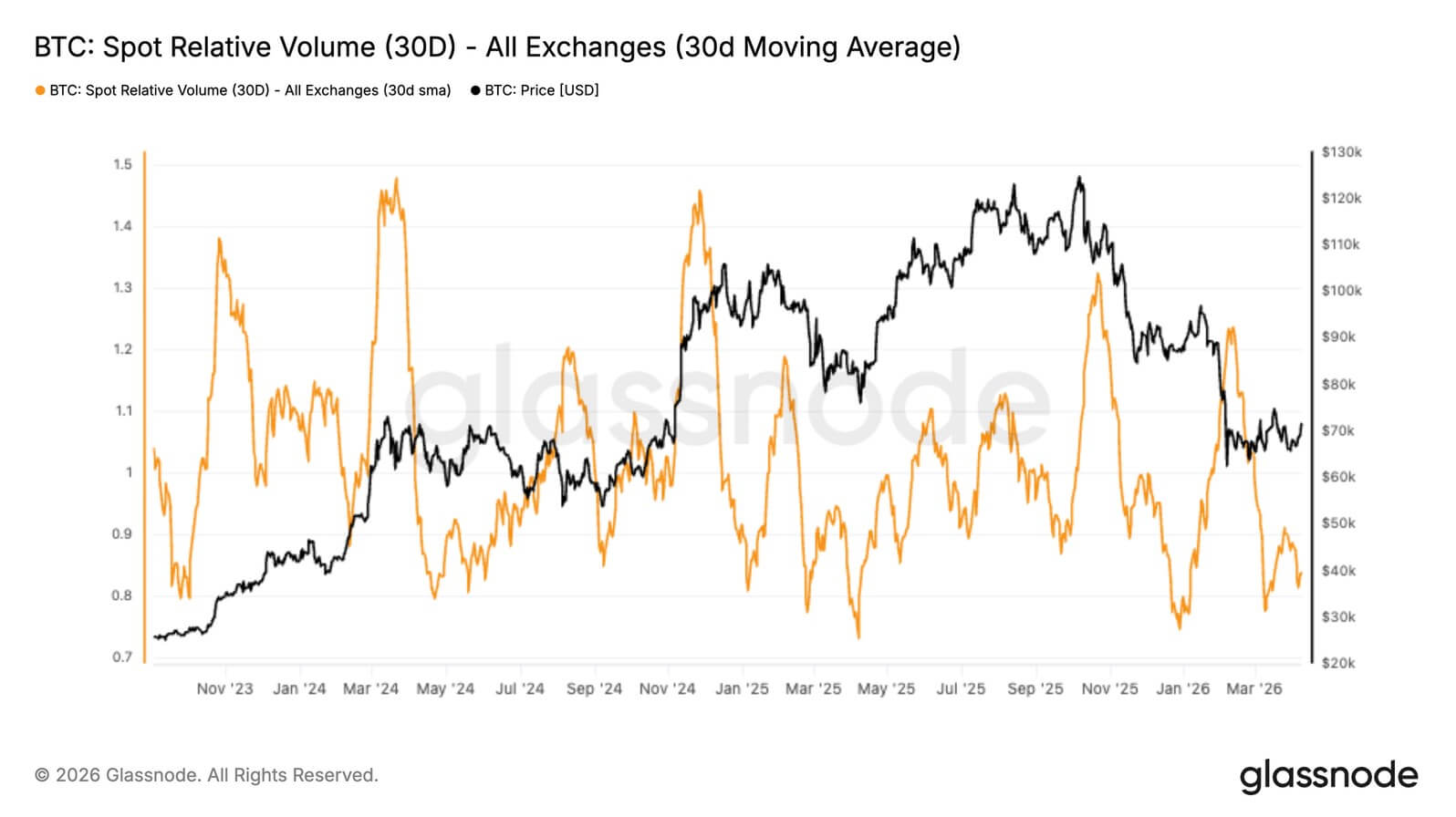
Binance’s 30-day relative spot trading volume is below the 1.0 baseline, which Glassnode considers to be weak organic demand. US spot ETF flows turned slightly positive on a 14-day basis, ending a long period of outflows, with April 7th and 8th still showing negative records.
Although futures volume has contracted sharply and rolled over on a 30-day basis, the skew of the 25-delta option remains tilted toward puts, meaning traders continue to pay a premium for downside protection.
Taken together, these data indicate that the market is stable with few participants.
Relief rally structure
Glassnode says the market has entered a more balanced state, a catastrophic downside is not too imminent and a struggle towards $78,000 is plausible, but durability remains questionable. The difference is determined by whether the buyer base is absorbing or diversifying.
Below $81,600, recent buyers are in losses, creating a mechanical constraint on upside momentum. Every rally towards break-even presents an exit opportunity for groups that have piled up at high prices and are waiting for a drawdown.
Glassnode clearly explains the mechanism, stating that distribution pressure from trapped holders is making the current range-bound rally structurally fragile.
Long-term holders have realized losses of over 4,000 BTC per day since November 2025. The report pointed out that keeping this number below 1,000 BTC per day and recovering $81,600 would be the clearest on-chain signal of a true regime change.

potential routes
In the bullish case, BTC recovers $81,600, ETF inflows continue to grow, futures participation expands again, and trading volume returns to the market.
Glassnode’s proprietary framework provides that tamper testing. In other words, cost-based recovery for short-term holders, combined with the substantial cooling of realized losses for long-term holders, will be the most reliable on-chain confirmation that the current bearish phase is giving way to a pre-bullish recovery structure.
As a result, the ceasefire was the catalyst that began a real demand regime transition.
In the bearish case, BTC loses the support shelf between $69,000 and $71,500 and is unable to absorb supply from trapped holders due to weak spot demand.
The relief rally stalled well short of $78,000, and the current pullback is being footnoteed as a volatility event. Glassnode data on soft futures, continued defensive option positioning, and still weak spot volumes indicate the results are consistent with the current participation profile.
Although the ceasefire has reduced short-term volatility, sustained demand improvement has yet to continue.
| scenario | what will the price be | What happens if you participate? | what it means |
|---|---|---|---|
| bear market rebound | Maintain or lose between $69,000 and $71,5000, stall below $78,000 or $81,600 | Spots remain weak, futures remain weak, options remain defensive | Rescue rally inside bear structure |
| reliable recovery | collect $81.6,000 | ETF inflows expand, futures prices accelerate again, LTH realized losses subside towards the beginning of the year Less than 1,000 BTC/day | Transition towards pre-bullish recovery |
| Failure/recurrence | Definitely lose the support shelf | Trapped holder supply overwhelms weak demand | A bounce becomes a volatility event, not a regime change. |
Shock after the ceasefire
The macro context sets an upper bound on sentiment-based demand. The US-Israel-Iran ceasefire compressed volatility faster than it reshaped risk appetite, and the one-day reversal in oil prices captured by Reuters on April 9 shows why geopolitical rescue rallies have a time limit.
Once the deep fears subside, the demand structure strengthens again, and Glassnode data shows that the underlying structure remains thin.
Realized volatility of 42.5% and implied volatility in the low 40s represent a benign market that has not yet turned bullish.
A sustained breakout requires volume expansion, more-than-modest improvement in ETF flows, and a futures curve that shows genuine speculative appetite. Glassnode’s April 8th data shows no such situation yet.
For now, the clear information from Glassnode is that Bitcoin has found enough footing to rebound.
Below $81,600, the market is still rising in a bearish structure, and the participants most likely to sell on the next push are the same buyers who have been underwater since the rally peaked.
(Tag translation) Bitcoin


