




On April 8, Morgan Stanley’s Spot Bitcoin Exchange Traded Fund began trading on the NYSE Arca under the ticker MSBT, posting a highly anticipated opening day trading volume of 1.6 million shares and approximately $34 million.
The MSBT fund purchased 430 Bitcoins on its first day with net inflows of $30.6 million.
Commenting on this performance, Bloomberg ETF analyst Eric Balchunas said MSBT’s performance is firmly in the top 1% of all ETFs launched in the past year.
For comparison, the majority of newly launched ETFs across all asset classes average less than $1 million on their first day of trading.

On the other hand, the performance is particularly noteworthy given the broader market situation. The first trading day saw $124 million in outflows from the broader Bitcoin ETF sector, with only MSBT and BlackRock’s iShares Bitcoin Trust (IBIT) managing to record positive inflows.
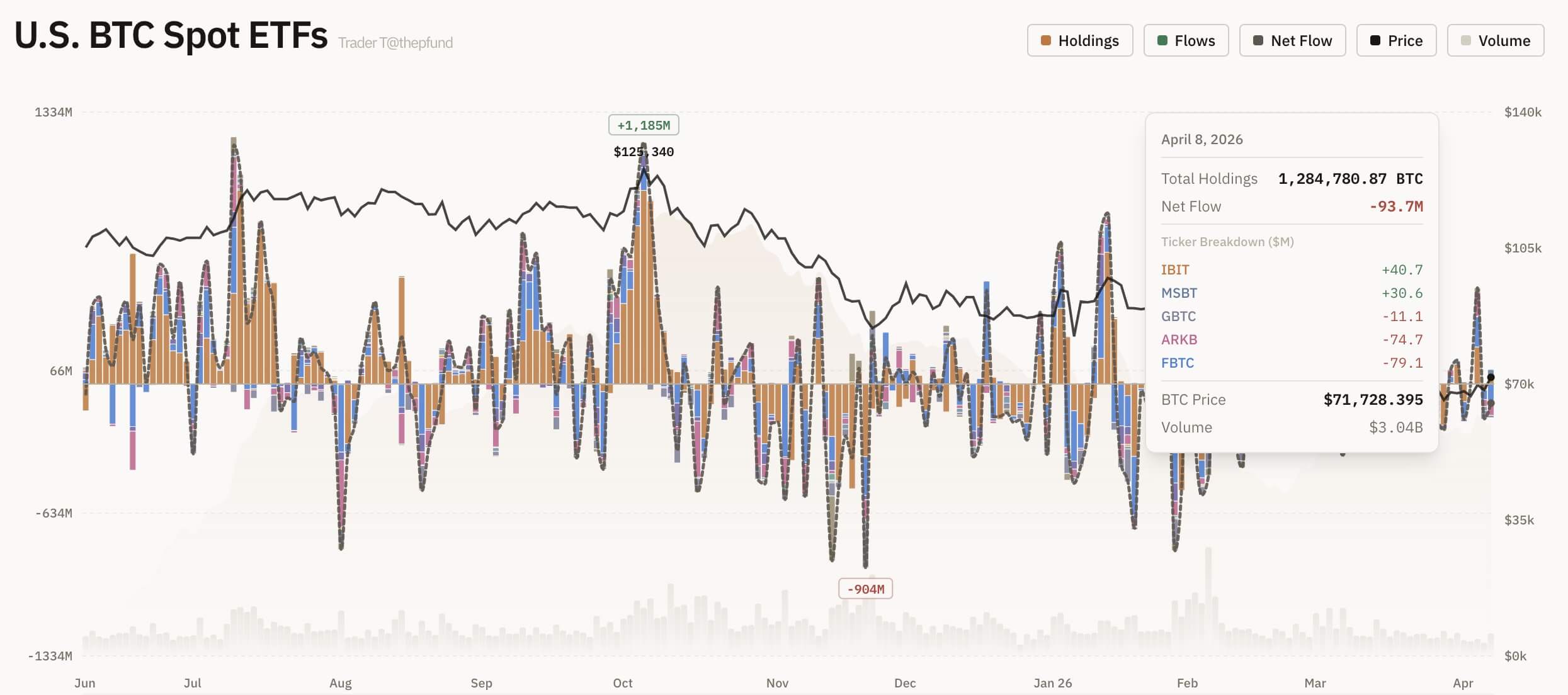
This confirms that Morgan Stanley’s services are gaining traction in the market for some time, and suggests that the way institutional capital flows into the sector may change.
A race to the bottom erupts over fees
With this launch, Morgan Stanley becomes the first major U.S. bank to issue a spot Bitcoin ETF under its own name, breaking away from traditional financial institutions that have remained on the sidelines until now.
Wall Street’s leading companies don’t just rely on the prestige of a century-old brand. They intentionally caused a fierce fee war in the Bitcoin ETF market.
MSBT charges a single mandated sponsor fee of 0.14%, making it the absolute cheapest spot Bitcoin ETF currently available to American investors. This is aggressively below market-leading IBIT, which currently charges an expense ratio of 0.25%, and Grayscale’s Bitcoin Mini Trust ETF, which currently charges an expense ratio of 0.15%.
Industry experts say the lowest fee structure could also force other incumbent asset managers to cut their expense ratios to remain competitive, mirroring the wave of fee waivers and aggressive price reductions seen when the first 10 spot funds debuted in early 2024.
MSBT’s low costs present a compelling mathematical argument for fee-sensitive institutional investors.
MSBT competition moat
Despite the low fees, market players say Morgan Stanley’s real competitive advantage lies in its unparalleled distribution network.
The firm employs approximately 16,000 wealth management advisors and oversees a vast array of client assets, with firmwide client assets estimated at up to $9.3 trillion and assets directly managed by its wealth advisory division reaching $6.2 trillion.
Nate Geraci, president of Novadius Wealth Management, emphasized that distribution is “king in the ETF space.” He noted that Morgan Stanley’s vast network of advisors, combined with the industry’s lowest fees, creates a very powerful formula for large-scale asset collection.
The company’s advisors currently recommend a 2% to 4% allocation to Bitcoin for growth-oriented portfolios, but a strict 0% allocation for conservative, income-oriented portfolios.
Systematic and company-approved integration into traditional portfolio construction represents a major shift in how traditional finance views and utilizes digital assets.
Behind the scenes, MSBT operates strictly based on institutional-level infrastructure. The Fund seeks to track asset performance as measured by the CoinDesk Bitcoin Benchmark 4PM NY Settlement Rate.
To ensure security and operational efficiency, Morgan Stanley will utilize Coinbase and BNY to provide digital asset custody services, with BNY also acting as a custodian to handle accounting, recordkeeping, and cash management.
Amy Oldenburg, head of digital asset strategy at Morgan Stanley, cited the company’s paper, noting that MSBT reflects a firm-wide approach to “thoughtfully building digital asset capabilities based on traditional governance and market infrastructure that aim to meet the long-term needs of our clients.”
MSBT market outlook
This prudent institutional approach meshes seamlessly with the current macroeconomic context.
Bitcoin’s latest traditional financial wrapper comes as the underlying digital asset approaches the critical $70,000 level.
This represents a healthy cooling-off period following the cryptocurrency’s most recent all-time high above $126,000, and points to a potential accumulation window for traditional capital that may have missed out on the initial retail-driven rally.
Investor interest in risk assets got off to a somewhat sluggish start in 2026, but demand for Bitcoin ETFs has shown signs of recovery. Inflows into the nine funds totaled $1.3 billion in March, bringing total U.S. Bitcoin ETF assets to more than $90 billion.
Still, Balciunas predicts that the MSBT fund could eventually accumulate $5 billion in assets under management in its first year of operation.
Despite the monumental service launch and strategic advantages, questions remain as to whether MSBT can truly defeat its established predecessors.
BlackRock currently dominates this space, with more than $55 billion in net assets in its IBIT fund. When asked if MSBT could eventually surpass BlackRock’s behemoth, Balciunas was blunt:
“Nothing short of a miracle.”
Whether MSBT can maintain its initial momentum against IBIT’s abundant liquidity and options market dominance will ultimately determine whether direct Wall Street entry fundamentally reshapes the competitive balance.
But for now, the arrival of the traditional giant in the arena serves as undeniable confirmation of BTC’s permanent entrenchment in traditional finance.
(Tag translation) Bitcoin


