


Recent media reports stated that Binance has fired a compliance investigator after flagging crypto transactions linked to Iran. The Wall Street Journal, New York Times and Fortune published similar claims, suggesting the exchange retaliated against staff for disclosing possible sanctions violations. Headlines like this have sparked a heated debate in the industry regarding the internal compliance culture of the world’s largest digital asset platform.
Binance leadership directly addressed these allegations as baseless and false. The exchange sent formal legal letters to both the Wall Street Journal and the New York Times, demanding immediate corrections and complete retractions of the allegedly defamatory statements. Binance executives have now come forward to explain the internal investigation and reveal the real reasons behind recent employee departures.
Direct denial from company leaders
Company executives adamantly reject the theory that the compliance officer was fired for doing his job. In a recent interview with David Lin, co-CEO Richard Teng addressed the controversy head-on, saying, “Investigators are not and never will be fired from Binance because of escalating compliance concerns. On the contrary, we need our investigators to properly investigate and quickly escalate investigations so we can protect our platform.”
Mr Teng continued to comment on compliance standards, saying, “What we haven’t compromised on, and what we will never compromise on, is that we uphold global standards, cooperate with global regulators, and uphold the rule of law, including sanctions and countering the financing of terrorism. These are very important and we continue to make significant investments.”
The company relies heavily on internal investigators to identify risks and promptly report concerns. Today, our entire compliance program, which involves more than 1,500 employees representing approximately 25% of our global workforce, relies on this internal vigilance. Firing employees to accomplish this very mission would actively undermine the system the company has spent hundreds of millions of dollars building.
As a result of these efforts, the ratio of sanctions-related exposure to total trading volume decreased by 96.8% from January 2024 to July 2025, from 0.284% to 0.009%.
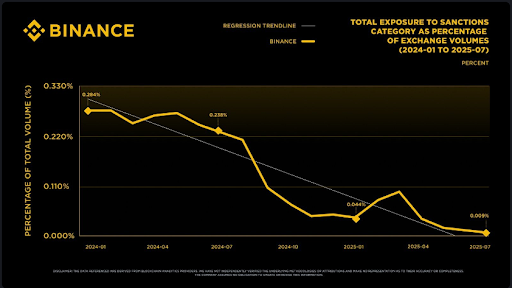
Following the media reports, Binance sent a legal letter requesting a retraction of the relevant publication. Mr. Teng characterized the article as false and misleading reporting that does great injustice to compliance programs and the professionals who run them.
What the company claims actually happened
Addressing the heart of the controversy, Noah Perlman, Binance’s chief compliance officer, offered a frank assessment of the retaliation claims. “The idea of firing an employee who raised an issue is preposterous on its face, as evidenced by the fact that the investigation continues, the relevant accounts were offboarded, and the relevant reports were filed,” Perlman explained.
Internal investigations into reported accounts did not stop even after certain employees left the company. The compliance team continued its work and eventually removed the affiliated entities from the exchange and made the necessary reports to law enforcement. The company claims this proves its compliance program worked as designed.
Mr. Teng emphasized this series of events in his public remarks. He said the truth was that the investigation continued even after the investigators left. Teng said these employees are dissatisfied. He noted that Binance has completed these investigations, suspended the operations of the affiliated entities, and cooperated with appropriate law enforcement agencies to resolve the issues.
Data protection description
If investigators weren’t fired for raising compliance concerns, what caused them to leave? The company points directly to its strict internal security policies. A Binance blog post claimed that several compliance employees left after an internal investigation discovered the company’s violations, a position Perlman confirmed in a recent interview. “Certain individuals have been disciplined in connection with the unauthorized disclosure of confidential customer information,” he said. Binance treats data breaches as serious violations that may lead to immediate termination. And Perlman says this is true regardless of the employee’s role or seniority.
Binance cannot comment on individual personnel matters due to privacy restrictions. But that didn’t stop executives from making clear distinctions regarding schedules. They said these specific departures were strictly about policy violations and mishandling of classified information, and not any form of retaliation for sanctions-related findings. The leadership team claims the layoffs are meant to enforce the company’s standard data security protocols.
Records shown by Binance
Leadership has categorically denied firing anyone who raised compliance concerns regarding sanctions. They point to the ongoing nature of the investigation as key evidence, noting that the reported accounts were successfully offboarded and reported to the appropriate authorities.
Binance said the employees who left were former employees who were dissatisfied with the company’s data protection policies. The exchange reported that sanctions-related exposure decreased by 96.8% between January 2024 and July 2025, supporting the broader compliance story. Binance also helped seize more than $131 million in illicit funds last year. The company formally requested corrections from the relevant publications and maintained that its compliance infrastructure remains strong and effective.


