




Bitcoin continued to hold near a key long-term support level near $68,000 this morning as traders awaited President Donald Trump’s latest deadline on Iran.
Tensions escalated after President Trump said on Truth Social that “the entire civilization is going to die tonight” as the 8pm ET deadline for a deal with Iran approaches.
The warning coincided with reports of an attack on Iranian oil infrastructure on Kharg Island, raising concerns that the conflict could move from deadline politics to a more destructive energy shock.
These tensions have left the market caught between a crypto structure that has so far resisted further collapse and an increasingly difficult macro environment.
Bitcoin showed some optimism throughout the trading day, with prices reaching $69,000 before falling to around $68,500 as traders struggled to decipher President Trump’s latest threat that “the entire civilization will perish tonight.”
Oil is the engine of the transmission
Oil has become the main channel through which the US-Iran conflict impacts the crypto market.
Oil prices have soared above $100 since the US-Iran conflict began. This is largely due to the closure of the Strait of Hormuz, a key oil shipping route that typically transports about 20% of the world’s oil a day.
As President Trump’s latest deadline approaches, U.S. crude oil prices topped $116 a barrel, extending a bull market that had already pushed prices toward multi-year highs.
The risks increased further following reports that Iran had threatened to close the Bab al-Mandeb Strait. The strait accounts for about 12% of global seaborne trade and has become even more important since the closure of Hormuz.
Any disruption there could squeeze another major shipping route and push oil prices to $150 a barrel, the Kobeisi letter said.
That’s where the market threat becomes even more serious for Bitcoin.
When oil prices enter that range, concerns extend beyond war headlines and day-to-day fluctuations in risk appetite. Sustained energy prices could heighten inflation concerns, support the dollar and reduce central banks’ room to ease policy.
This combination tends to create a more difficult backdrop for speculative and volatile assets, including cryptocurrencies.
Negative funding suggests substantial buying below.
One of the reasons Bitcoin has held up is reflected in its derivatives positioning.
Data from CryptoQuant showed that the flagship digital asset has rebounded recently even as the total funding rate across exchanges remains negative.
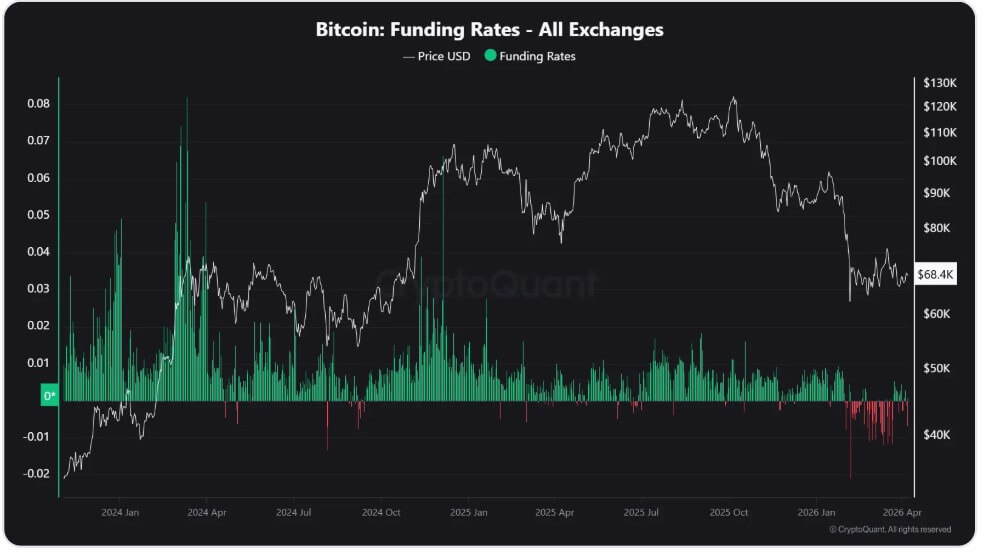
This suggests that the move was not driven by traders piling up leveraged bullish bets. Instead, short sellers are still paying to maintain their bearish positions even as prices steadily rise in increments.
This is usually a healthier setup than a rally fueled by aggressive leverage.
If Bitcoin rises while funding remains negative, it suggests that spot buyers are absorbing selling pressure, rather than momentum traders chasing market gains. A rebound built with leveraged longs can quickly fade if conditions change.
However, the rally, supported by physical buying, is likely to continue while the broader market remains skeptical.
On the other hand, this leaves short sellers vulnerable. If Bitcoin continues its recovery and liquidations start to occur, bearish positions opened below current levels could provide fuel for a sharper rally.
This dynamic helps explain why Bitcoin did not follow the geopolitical context in a more definitive way. Although the market remains bearish, price trends have not yet supported that view.
Still, that support has its limits. If the recovery loses momentum before enough short positions are liquidated, it could quickly resume its decline as the market is not making much use of the underlying long support.
The narrower the range, the more vulnerable your next move will be.
At the same time, BTC trades within a structure that leaves little room for error.
Glassnode data shows the token is in a severe negative gamma pocket between around $65,000 and $70,000, an area where dealer hedging could strengthen short-term moves in either direction.
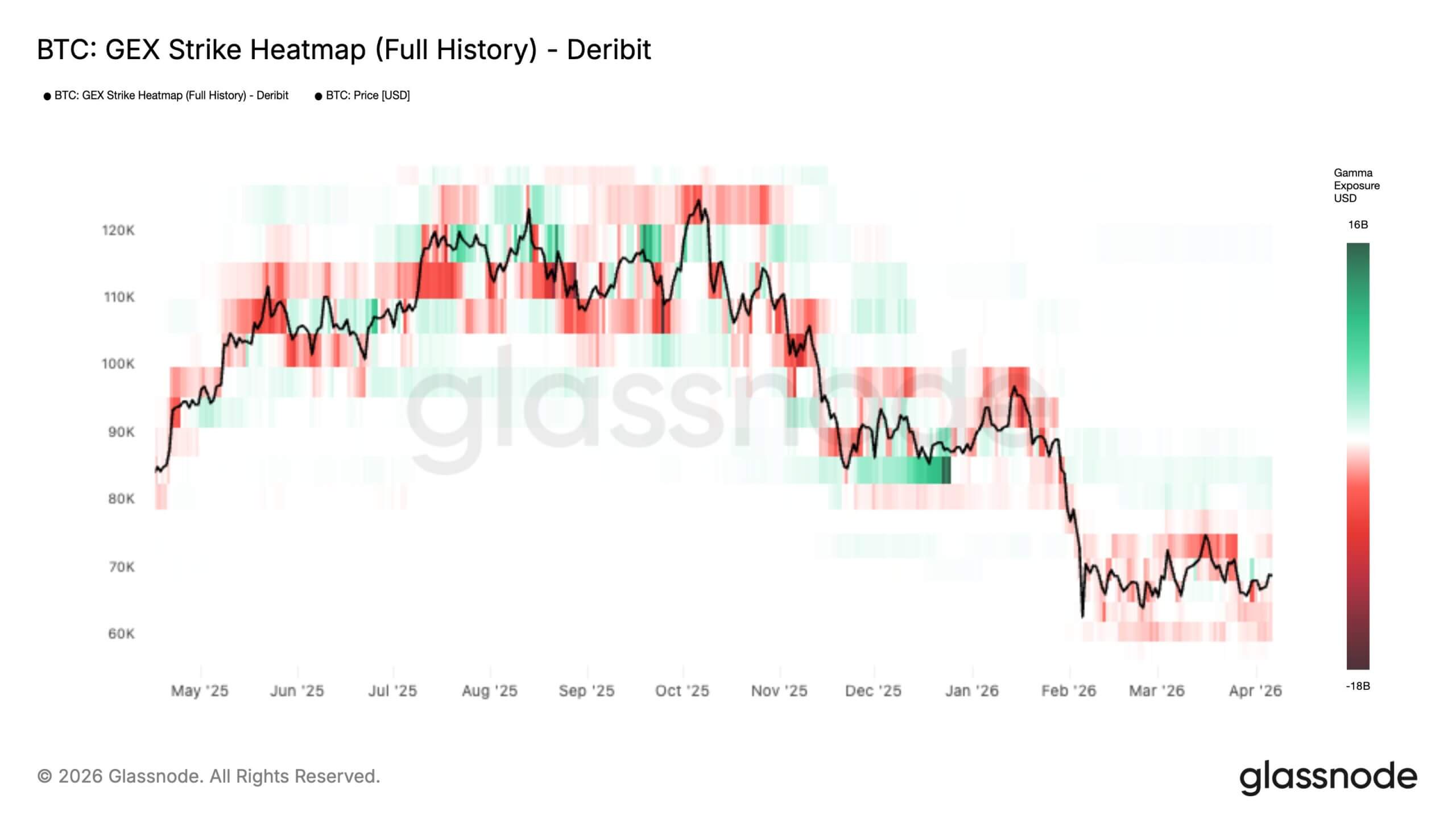
According to the company, there is resistance near $72,000, but if momentum weakens, support below current levels will fade. As a result, markets can appear stable for a while, but then suddenly fluctuate when a catalyst arrives.
The trigger here is coming from Washington, not from within crypto. Traders aren’t taking positions based on earnings announcements, network upgrades, or ETF flows. Instead, they center on deadlines that could move oil, change inflation expectations and reprice risk assets within the same session.
As long as Bitcoin remains in that $65,000 to $70,000 range, the market can move sharply in either direction with each new signal that diplomacy will hold or break.
Markets are weighing further postponements against further shocks
Part of the suppression of price fluctuations reflects pattern recognition.
QCP Capital said the market took a few weeks to absorb the weekend’s escalation rhetoric, followed by de-escalation signals earlier in the week, with stock prices largely stable and cryptocurrencies being more resilient than the headlines alone suggest.
This pattern has made traders reluctant to price in any new threats. At the same time, risks are not eliminated. Every new attack, every new warning, every new threat to energy infrastructure increases the cost of assuming this too will be over.
President Trump has left room for the deadline to be changed again if talks progress and something concrete emerges. At the same time, Iran appears to have suspended diplomatic talks following recent threats. As such, confidence is low and volatility remains near the surface.
For now, Bitcoin is holding its position without escaping peer pressure. Buyers are defending key support areas, and negative funding suggests that the bearish positioning did not result in the breakdown that many expected.
However, the market remains stuck within a narrow range as soaring oil prices and policy risks dominate trading. A softening in Washington could force short sellers to cover, pushing Bitcoin back towards $70,000 and then $72,000.
However, if there is a more serious escalation, attention will quickly shift back to inflation, financial conditions, and whether cryptocurrencies can withstand broader risk aversion.
Until then, Bitcoin remains tied to the next signal from the White House.
(Tag translation) Bitcoin


