



Charles Schwab operates 38.9 million active brokerage accounts and has $12.22 trillion in client assets. For years, investors in these accounts have been able to access Bitcoin and Ethereum through ETFs, crypto stocks, and futures.
The phased start from the second quarter will close the gap with direct investment. Schwab Crypto, offered through Charles Schwab Premier Bank (SSB), allows eligible customers to buy and sell Bitcoin and Ethereum directly.
The offer is available in every U.S. state except New York and Louisiana, and the schedule starts with employees and a small initial cohort, then expands.
Why this is important: Schwab is not introducing cryptocurrencies to a crypto-native audience. This is testing whether direct ownership of Bitcoin and Ethereum can fit within the workflow of mainstream brokerage clients. If this model gains traction, its impact will extend beyond Schwab to the next layer of product design, broker competition, and retail crypto adoption.
Product architecture includes structural boundaries that are immediately felt by clients and operators. Schwab Crypto operates through dedicated accounts with affiliated bank subsidiaries.
This means that the structure exists in a separate account from the brokerage account in which the investor already holds stocks, bonds, and ETFs. Cryptoassets are not protected by SIPC or FDIC.
Schwab does not currently accept deposits in cryptocurrencies, nor does it settle securities or futures transactions in cryptocurrencies. Mainstream access is genuine and accessed based on carefully managed broker-defined conditions.
What pushes the timing to 2026 is a policy calendar that resolves three major institutional frictions within four months.
In January 2025, SAB 122 rescinded the previous SAB 121 crypto protection guidance that made custody economics unattractive for traditional banks.

In March 2025, the OCC reaffirmed that national banks are allowed to store cryptocurrencies, certain stablecoin activities, and participate in distributed ledgers, and removed the supervisory non-challenge requirement.
In April 2025, the Federal Reserve withdrew its previous guidance on cryptocurrencies and moved to overseeing their activities through standard processes.
Schwab CEO Rick Wurster said these regulatory moves are “pretty green” for large companies to move into cryptocurrencies, and the timing of the launch confirms how directly the policy calendar has shaped the product calendar.
| date | Regulation/Market Development | Why it matters to Schwab |
|---|---|---|
| January 2025 | SAB 121 canceled SAB 122 | Reduces critical accounting friction when storing cryptocurrencies |
| March 2025 | The OCC said that cryptocurrency storage, certain stablecoin activities, and participation in DLT are permissible. Removed supervisory no-objection requirement | Pursuing bank-linked cryptocurrency activity is now easier |
| April 2025 | Federal Reserve rescinds previous guidance on cryptocurrencies and shifts to regular oversight | Reduce friction in specialized processes for large institutions |
| March 2026 | Schwab research says Bitcoin has matured into a mainstream asset | It showed that the internal position was moving towards normalization. |
| Q2 2026 | Schwab Begins Gradual Deployment of Cryptocurrency | Product timing due to policy changes |
Assets being normalized by Schwab
In March 2026, Schwab released research showing that Bitcoin had matured into a mainstream asset and, by some measures, had become less volatile than certain Magnificent 7 stocks.
This research reflects the internal positioning that led to direct trading as a natural next step.
Reuters reported that Wurster believes the target users are investors who already own stocks and bonds and want to hold small amounts of Bitcoin or Ethereum alongside those positions.
This is a narrower and more defensible market than the speculative base that drove volumes in 2021. Schwab is building products for mainstream investors who already believe in securities brands and want direct exposure within the securities environment they use.

Schwab enters a market already occupied by Fidelity. Fidelity’s cryptocurrency account allows customers to buy, sell, and transfer cryptocurrencies through its platform and the Fidelity app, alongside existing brokerage positions.
E*TRADE will soon launch a page for direct trading of Bitcoin, Ethereum, and Solana, with reports pointing out that Morgan Stanley plans to implement the service through Zerohash in the first half of 2026.
Schwab enters this race as a scale normalizer, a company with a distribution footprint that turns the multi-broker pattern into the industry default.
When Fidelity launches Direct Cryptocurrency, the market could see it as a unique call by a company.
The mental category moves when Schwab, Fidelity, and E*TRADE each offer some version of direct access to BTC and ETH. If Schwab, Fidelity, and E*TRADE each offer some form of direct access to BTC and ETH, then direct ownership of the cryptocurrency is placed on the same page as any other asset sleeve within a diversified brokerage account.
Schwab’s own site already sells crypto exposure “from a brand you know,” but this launch extends that brand promise from the wrapper to the asset itself.
A distribution thought experiment allows us to frame the scale without exaggerating price spikes.
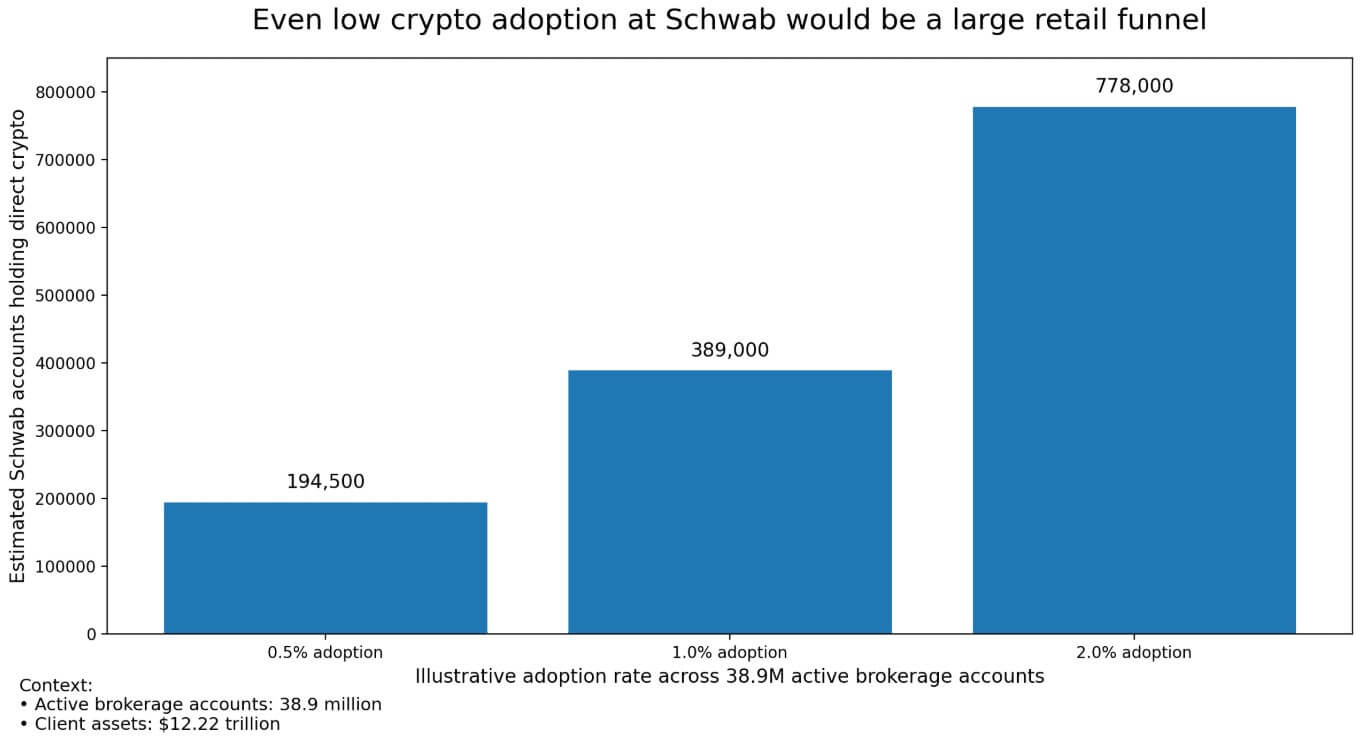
If 0.5% of Schwab’s 38.9 million accounts end up holding cryptocurrency directly, that equates to approximately 194,500 accounts. At 1%, that would be about 389,000, and at 2% adoption, that funnel would reach about 778,000 accounts.
There are two paths from here
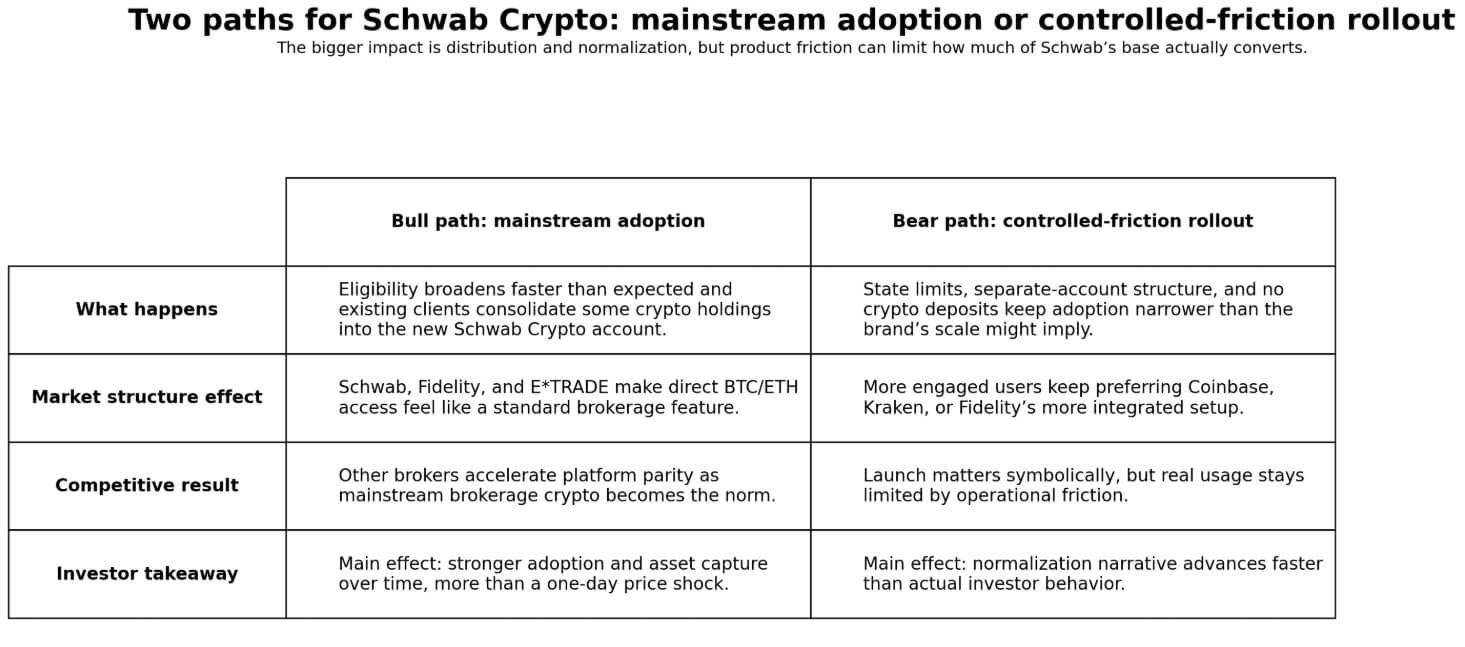
A bullish path opens up if Schwab expands eligibility faster than the tiered language suggests and proves a clean enough product experience for existing customers to consolidate their crypto holdings into new accounts.
In that scenario, Fidelity, E*TRADE, and Schwab would work together to build a demand flywheel within the mainstream brokerage channel. This is the type of adoption by end investors cited by Citi in its bull case for Bitcoin at $165,000 and Ethereum at $4,488.
With Schwab’s distribution footprint alone, all brokers that exclusively route their crypto clients to ETFs and educational pages will see an accelerated timeline to parity with their own platforms.
A bear’s path runs through friction. Schwab Crypto account state restrictions, bank subsidiary architecture, lack of crypto deposits, and current transfer restrictions each create a gap compared to crypto-native venues that more avid users will notice.
If these frictions lead to narrow adoption and investors who want direct exposure to cryptocurrencies continue to prefer the more integrated setups of Coinbase, Kraken, or Fidelity, this launch could be operationally diluted.
Investors who want cryptocurrencies to sit side-by-side with equities within a single operational view may find the bank subsidiary’s rails an exposure vehicle with tighter product boundaries than the brand’s integrated portfolio framework suggests.
The next readable data point arrives as Schwab reveals how quickly the initial Q2 cohort will convert and whether the broader rollout will accelerate as planned.
How quickly Schwab can move this cohort to general availability will tell the market whether this launch is a true scale goal or a carefully managed compliance exercise.
(Tag translation) Bitcoin


