



Ethereum is trying to hold $2,000. The market is stirring for big moves. And the organization that has been selling this asset for months has just changed how it uses ETH.
Data from Arkham Intelligence confirmed the change in Ethereum Foundation behavior that the market had been unknowingly waiting for: the foundation stopped selling ETH and started staking. A sentence needs context to convey its full weight.
Over the past few months, the Ethereum Foundation’s regular ETH sales have been one of the most psychologically damaging overhangs in the market. Each sale transaction confirmed from a Foundation wallet arrived as a signal from within. The organizations that created Ethereum had a deeper understanding of the technology than outside participants and chose to convert their holdings into cash. The market interpreted these sell-offs as the most credible expression of institutional doubts possible. Prices have fallen accordingly.
The chapter seems to be coming to an end. Staking is in every sense the opposite of selling. We lock it, commit, remove it from circulation, and earn yield based on our belief that Ethereum’s future justifies our commitment. The Foundation no longer exists. It embeds itself deeper.
This is no longer a one-time decision
Arcam’s on-chain data records specific transactions that embody behavioral changes. The Ethereum Foundation staked an additional $46.64 million in ETH, bringing the total staking position to $96.59 million. That cumulative number is the most important number. Not because of its size relative to the Foundation’s total finances, but because it presents itself as a repeated, deliberate, and escalating effort.

A single staking transaction can be ignored as a financial optimization. That’s not possible with two transactions totaling nearly $100 million. The Foundation has now made the same decision twice in the same direction at a price level that the broader market is treating as weak support. Each transaction is a vote. The second vote confirms that the first vote was not an anomaly.
The consequences of supply are direct and permanent for the duration of the stake. Currently, $96.59 million ETH remains in staking contracts, but it is unsellable and has been removed from the liquidity float, making no contribution to the sell-side pressure that has been weighing on the $2,000 level for weeks. The foundation’s previous sale added to the pressure. The current staking position aggressively reduces that.
The organization that built Ethereum has now committed nearly $100 million to its proprietary protocol at the exact moment the market is deciding whether $2,000 is reasonable. The timing is no coincidence. That’s a statement.
Related article: Lost $410 million in Bitcoin in one week. Two important indicators that the stress isn’t over yet
Ethereum’s weekly structure indicates that the market is at an inflection point rather than a confirmed breakdown. The price is currently holding near $2,060, slightly above the 200-week moving average. This level has historically served as a boundary for long-term trends. That positioning is important. Unlike the lower time frames, structural bull and bear markets are defined here.
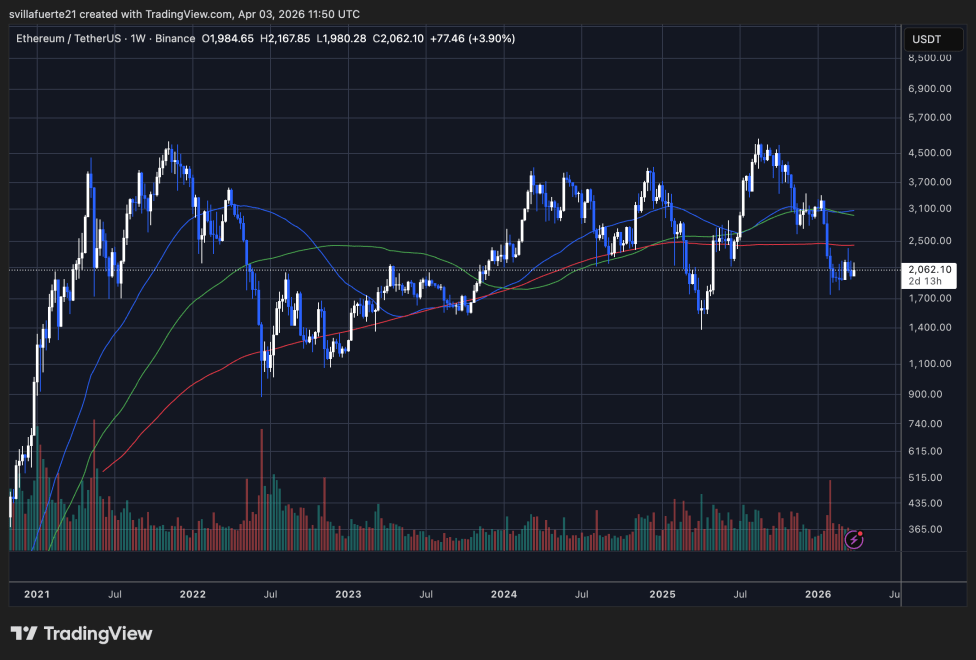
The rejection from the $4,000 to $4,500 area established a clear lower high and broke a series of higher highs that had defined the previous expansion phase. Since then, Ethereum has fallen sharply, losing its 50-week and 100-week moving averages, both of which have now leveled off and begun to reverse. This change indicates a weakening of momentum, but the trend reversal is not yet complete.
The key issue is follow-through. The recent rebound from sub-$2,000 levels has not been strong enough to decisively retake the 100-week average. Without that, prices remain vulnerable to the challenge of the 200-week level.
Volume is not showing aggressive accumulation at current levels. This absence raises the question: is this a structural defense or a temporary pause?
If $2,000 fails on a weekly basis, the next meaningful support will be significantly lower. If that holds, Ethereum remains in a contested but still salvageable long-term structure.
Featured image from ChatGPT, chart from TradingView.com
editing process for is focused on providing thoroughly researched, accurate, and unbiased content. We adhere to strict sourcing standards, and each page is carefully reviewed by our team of top technology experts and experienced editors. This process ensures the integrity, relevance, and value of your content to your readers.


