

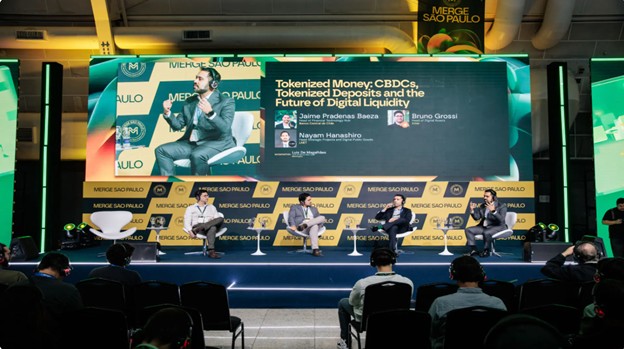
Yesterday (19th), representatives from central banks, multilateral institutions and the private financial sector met in São Paulo during the MERGE São Paulo event to discuss the advances and challenges of asset tokenization and digital money in the region.
The panel “Tokenization of Money: The Future of CBDCs, Tokenized Deposits, and Digital Liquidity” featured Bruno Grossi, Head of Digital Assets at Intel; Jaime Pradenas Baeza, Head of Financial Technology Hub, Central Bank of Chile. Nayam Hanashiro is LNET’s head of strategic projects and digital public goods.
The moderator was Luis De Magalhães, Latin America Team Lead at BeInCrypto.
Core problem: system fragmentation
For Bruno Grossi, the biggest challenge facing the current financial system is technological fragmentation.
He said that money tokenization, the process of converting financial assets into digital tokens registered on a blockchain (a type of distributed digital ledger), acts as a technological “lingua franca” that allows different systems to communicate.
Grossi’s proposal is that stablecoins (digital currencies pegged to stable assets such as the dollar) and tokenized central bank money would operate on similar technology to improve payments and transfers between cities, countries and banks.
Chilean regulatory authority perspective
Jaime Pradenas Baeza emphasized that innovations in payment methods are not new and the current debate represents a new step in the historical evolution of money. For him, the central point is how to settle, i.e. finalize and confirm, transactions with tokenized assets.
Pradenas Baeza explained that Chile’s central bank has conducted a proof of concept (POC, controlled practical test of an idea) of liquidating tokenized assets using central bank money in a wholesale environment, without necessarily issuing a public digital currency.
The executive also presented the International Monetary Fund’s taxonomy, which categorizes different ways to settle transactions in DLT (distributed ledger technology, the technological foundation of blockchain), from platforms run exclusively by central banks to mixed models with the private sector.
“At the end of the day, money is trust,” Pradenas Baeza summed up.
The Drex Affair: Strategic Advances and Setbacks
Bruno Grossi detailed Drex, a project by the Brazilian Central Bank to create central bank digital money. The project went through two testing phases with 16 financial institutions.
During our testing, we discovered that the privacy solutions available on Ethereum (one of the major public blockchain networks) are not yet mature enough.
In view of this, the Brazilian Central Bank has chosen to take a step back and develop a simpler use case that does not use blockchain for now and retains the concept of digital currency to solve liquidity and asset transfer issues in Brazil’s financial system.
“Drex is an experiment in using new technology to build a new financial system,” Grossi summarized.
Regional cooperation: 12 central banks participating in the same project
Nayam Hanashiro introduced CB Web3, an IDB Lab initiative implemented by LNET, a non-profit foundation created from the Inter-American Development Bank’s LACCain program.
The project brings together 12 central banks in Latin America and the Caribbean into a test network to issue, redeem and test digital currency use cases, including cross-border payments (payments and remittances between different countries).
This effort also includes the participation of CEMLA (Centre for Latin American Monetary Studies) and FLAR (Latin American Reserve Fund). All code and learning will be made available as a digital public good and exposed to the private sector and community.
Pradenas Baeza did not formally confirm Chile’s participation in CB Web3, but confirmed that there will be cooperation between central banks in the region, including an exchange of experience with Brazil on lessons learned from Drex.
I can’t wait for the discussion
Finally, panelists were asked what pressing questions they needed answered within the next 12 months.
The central question for Hanashiro is how to balance the pace of private sector innovation with stablecoins, deposit tokens and public sector trucks while maintaining digital sovereignty and financial stability.
Pradenas Baeza emphasized the coexistence of different forms of digital money and the need to understand the risks and benefits of each.
Grossi cited AMM (Automated Market Maker) solutions as an example of tools that still need to mature to enable these systems, noting that there is still much to build technically.
The article Central banks and private sector discuss the future of digital money in Latin America appeared first on BeInCrypto.


