

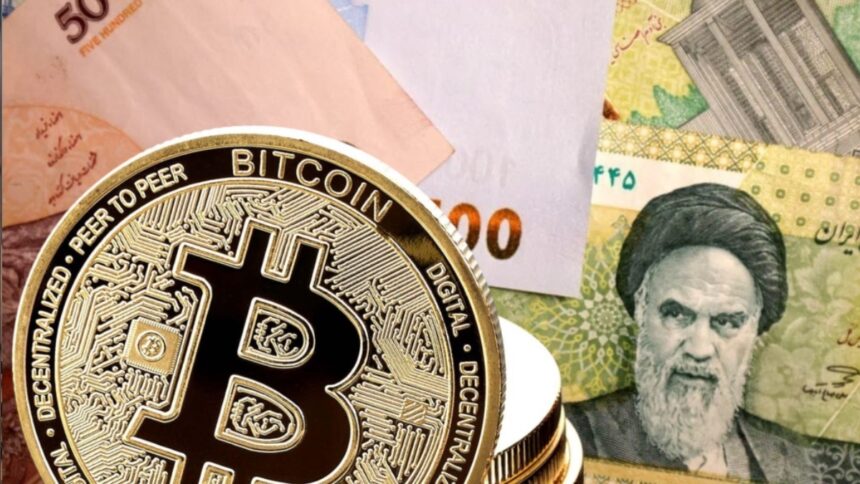
The escalation of the conflict between Iran and Israel, along with increased U.S. geopolitical involvement and regional economic factors, has implications beyond the military and diplomatic realms.
International tensions also affect decentralized financial markets, and the Bitcoin ecosystem is no exception.
Given this fact, we consider five specific ways in which a war with Iran could be waged. affecting the ecosystemfrom capital movements, changes in exchange activity, and regulatory pressures to changes in the narrative of the financial system.
Capital Flight from Iran
The military escalation in Iran is reflected in the flow of capital within the cryptocurrency ecosystem. In the days following the attack, on-chain analysts noticed an unusual spike in withdrawals from local exchanges as tensions in the region escalated.
According to data cited by Reuters and a network analysis firm. Iranian platform spikes up to 873% in hoursmore than US$2 million was withdrawn in the first hour after the bombing, and approximately US$10.3 million was transferred. For individual wallets and international exchanges. These are moves that reflect immediate reactions to geopolitical uncertainty.
This flow is not just from retail investors seeking protection for their capital, as some of the transfers may be related to entities close to the state or to actors seeking to move funds outside the sanctioned financial system.
This behavior is often interpreted as a sign of: capital flighta phenomenon that occurs repeatedly in situations of political or economic crisis.
In the case of the global BTC market, these flows could lead to rapid sell-offs, creating temporary downward pressure or a shift to more liquid markets. In both cases, during times of geopolitical tension, surges in production tend to amplify intraday volatility and intensify price movements.
Market movements: oil; risk off and initial drop
Military escalation is also causing strong reactions in global marketsEspecially because of the risks involved in transiting through the Strait of Hormuz, a key route through which nearly 20% of the oil consumed worldwide circulates.
Faced with the possibility of this energy corridor being disrupted, markets reacted quickly and oil prices soared. WTI rose more than 19% in one day to $108.35 per barrel.
This rise immediately prompted a shift to a risk-averse scenario (risk off), investors reduce their exposure to volatile assets and move capital into traditional assets such as gold, the dollar, and government bonds.
In this context, Bitcoin was also affected. The cryptocurrency fell nearly 7% in a few hours on news of the conflict, dropping from around $68,000 to $63,000.
Volatility also spread to derivatives markets, where more than $1.8 billion in leveraged positions were liquidated in one day. At the same time, the fear and greed index fell to 14 points, reflecting “extreme fear.”
Still, Bitcoin was able to stabilize between $66,000 and $69,000 after a few days.the debate about its role as a refuge in protracted crisis scenarios is reignited.
Impact on mining: operational risks and energy costs
The escalation of the war has also affected Bitcoin infrastructure, especially mining. Iran contributes between 2% and 5% of the global hashrate, which is modest compared to the total, but equates to verifying approximately 1 in every 25 blocks when mining activity increases.
Iran’s cryptocurrency ecosystem has shown significant growth beyond its computing power.
A Chainalysis report estimates that on-chain activity related to the country will exceed USD 7.78 billion in 2025, with an increase seen during episodes of geopolitical tensions. This means that localized disruptions, such as sanctions, conflicts, and infrastructure failures, can impact mining activities and the movement of capital within the ecosystem.
Connection interruptions also had their effect. Data from independent NetBlocks monitors Connections within Iran have fallen to around 4% of normal levels; It then stabilized at around 1% on March 2nd.
These drops are important for miners because the equipment requires constant connectivity with pools and nodes to validate blocks and send transactions.
An energy factor is added to this. If oil prices rise due to tensions between the two countries, Strait of Hormuzincreasing electricity costs in fossil fuel-dependent regions, reducing mining profitability and causing equipment outages, which could temporarily impact global hashrate.
Sanctions, avoidance, and the role of ecosystems in national finances
The use of cryptocurrencies as a tool to circumvent international sanctions has become an increasingly important issue for Iran.
Chainalies data shows that cryptocurrency and Bitcoin activity reflects a sustained increase compared to the previous year. Part of this growth is explained by the use of digital assets to make international payments and move capital outside the traditional financial system, which is restricted by sanctions from the United States and Western allies.
State-linked actors have been exploring mechanisms to leverage cryptocurrency mining and trading. In some cases, The government allowed licensed miners to operate Under the condition that they sell Bitcoin directly to central banks. This will enable the country to acquire digital assets that can be used to finance imports and make international payments without relying on the traditional banking system.
This pattern has a direct impact on Bitcoin. As flows related to licensed jurisdictions increase, regulators increase pressure on exchanges and liquidity platforms. Organizations such as OFAC and the Financial Action Task Force have warned that intermediaries need to tighten controls against money laundering and illegal lending.
In practice, this could lead to stricter KYC/AML controls, address locks, and on-ramp closures in certain markets, reducing liquidity for some crypto brokers.
In the case of Bitcoin, the effects are typically not structural, but they can increase regional volatility and temporarily alter capital flows within global markets.
Corporate intervention and strategic purchasing
The volatility created by the crisis also created opportunities for large institutional investors.
A recent example reported by CriptoNoticias is Strategy, which is considered the largest. holder Bitcoin company. According to a report released this week, The company acquired 17,994 BTC for approximately USD 1.28 billionthe average price is nearly USD 70,946 per coin. With this operation, its total reserves reached 738,731 BTC, strengthening its strategy of accumulating assets.
This type of acquisition has a direct impact on market trends. When companies with significant balance sheets absorb large amounts of BTC, it reduces the supply available on exchanges, limiting some of the immediate selling pressure.
In market parlance, this reduces the “float” (the portion of Bitcoin that actually circulates in the physical market), which could help limit declines during times of financial stress.
Furthermore, an increase in the concentration of reserves on a firm’s balance sheet changes the elasticity of the market in the face of liquidity shocks.
When available supply is low, relatively small capital movements can lead to more pronounced changes in prices. At the same time, these institutional purchases could provide technical support and strengthen bullish views over the medium term, especially when coinciding with episodes of global uncertainty.
Ultimately, the crisis shows that Bitcoin is part of an increasingly interconnected financial system, where regional conflicts, sanctions, and corporate decisions can quickly upset market balance.
But it reaffirms the idea that when all else fails, the state covers itself. Bitcoin will continue to be the most accessible asset Portable to escape from war.
(Tag translation) Bitcoin (BTC)


