



Ethereum has regained the $2,000 level after weeks of volatile price swings, providing a brief sense of relief for the market following sustained selling pressure across the broader crypto sector. This recovery comes as derivatives activity begins to normalize, suggesting that leverage levels may be stabilizing after months of structural changes in the Ethereum futures market.
A recent report by CryptoQuant analyst Arab Chain highlights notable developments in Ethereum’s derivatives positioning. Binance’s ETH Open Interest Z-Score (30-day rolling) data shows that there have been significant changes in market structure in recent months, particularly in how traders deploy leverage.
According to the latest data, the total open interest of Ethereum contracts on Binance stands at approximately $4.26 billion, with a 30-day moving average of nearly $4.18 billion. The standard deviation for the same period would be approximately $285.8 million.
These numbers give a Z-score of approximately 0.29. This is a moderate value indicating that open interest is currently close to its historical average. In fact, this data suggests that the market is not extremely leveraged.
Ethereum derivatives market shows signs of structural reset
The report also highlights deeper changes unfolding in the Ethereum derivatives market. One of the most notable signals appears in the 30-day moving average of open interest, which has fallen to its lowest level since May 2025. While the headline numbers may seem modest, the trends behind them reveal important structural adjustments in market positioning. ”

A drop in open interest generally indicates that traders are closing positions faster than they are opening new ones. In the case of Ethereum, the gradual decline suggests that leverage has steadily flowed out of the market in recent months, rather than collapsing in a single liquidation event. This process often follows a period of volatility where traders reduce exposure and risk appetite wanes across derivatives platforms.
This change also indicates a potential change in market composition. When speculative liquidity disappears from futures markets, activity tends toward spot accumulation or low-risk strategies. Although this dynamic can temporarily suppress momentum, it often results in a structurally sound market.
From a practical perspective, the Ethereum derivatives market now appears less crowded and less reliant on leveraged positioning. Historically, such resets tend to occur near transitional periods in market cycles. Current deleveraging could provide a cleaner basis for the next expansion in derivatives activity as new liquidity flows into the market and risk appetite recovers.
Ethereum Price Tests Significant Support After Major Correction
Ethereum is currently trading around $2,050 after a sharp correction following the rally in late 2025. The weekly chart shows that ETH is slowly recovering after briefly dipping below the psychological mark of $2,000. This level has historically served as an important support and resistance zone in previous market cycles.
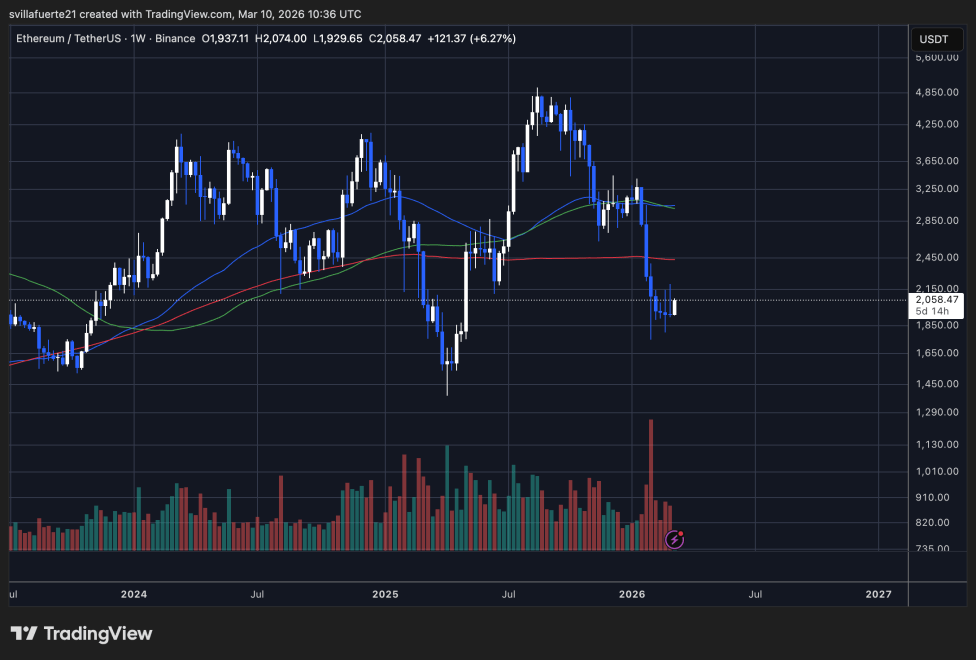
The broader structure suggests that Ethereum is still in a correction phase after peaking near $4,800 in 2025. Since that high, the market has recorded a series of new highs and loss of momentum, reflecting changes in market sentiment due to macro conditions and tight crypto liquidity.
Technically speaking, ETH is currently below the 50-week moving average and 100-week moving average, which are acting as overhead resistance in the $2,800 to $3,000 range. The 200-week moving average near $2,450 also represents an important structural level that was lost during the market’s recent decline. The loss of long-term support accelerated downside volatility and caused the large amount of declines seen on the chart.
Despite the bearish pressure, the recent rally around $1,900 suggests that buyers are holding on to the lower bound of the current structure. If Ethereum is able to regain its 200-week moving average, the market could attempt a broader recovery towards the $2,800 resistance zone.
Featured image from ChatGPT, chart from TradingView.com
editing process for is focused on providing thoroughly researched, accurate, and unbiased content. We adhere to strict sourcing standards, and each page is carefully reviewed by our team of top technology experts and experienced editors. This process ensures the integrity, relevance, and value of your content to your readers.


