

Global spending on security products and services is expected to reach $522 billion in 2026, according to data from Cybersecurity Ventures. This number represents a fundamental disconnect from the logic that drove previous market cycles. In 2021 and 2022, exchange dominance was often measured by stadium naming rights and celebrity endorsements. By the end of 2025, the metric had increasingly shifted to the “cost of doing business”, specifically the cost of infrastructure hardening.
As digital assets have become more deeply integrated into traditional finance over the past 12 months, marketing visibility is no longer the primary driver of user acquisition. It became trust. Capital allocation strategies have aggressively pivoted from customer acquisition costs to business resilience. In this mature environment, the platform’s ability to remain solvent and secure during times of stress provides the highest return on investment of any advertising campaign.
Why security investment expands non-linearly
The mathematics of risk management has changed. As platforms grow, attack vectors will become increasingly driven by artificial intelligence, requiring defense spending to outpace user growth.
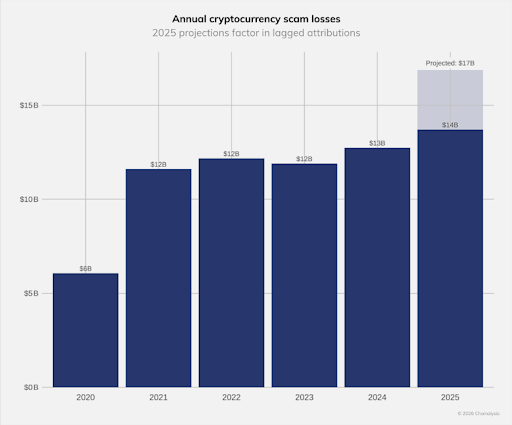
Chainalysis estimates that crypto fraud and fraud reached $17 billion in 2025 alone. This suggests that the key vector is no longer just code vulnerabilities, but the human element.
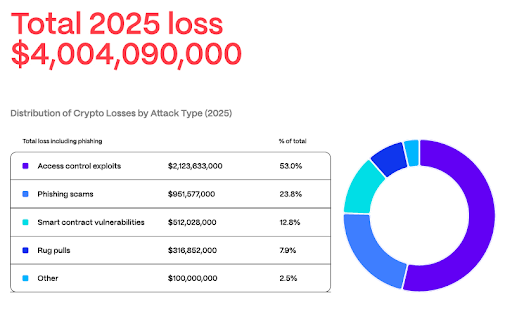
According to Hacken data, losses due to access control failures reached approximately $2.12 billion in 2025. This number represents approximately 53% of all recorded incidents and shows that although smart contracts are getting stronger, internal access remains a key battleground.
This environment requires a regulatory framework that enforces strict internal controls. Binance Co-CEO Richard Teng said securing the first global exchange license under the ADGM framework “means we adhere to ADGM’s gold standards for risk management, governance and compliance across the entire scope of our activities.” This obsession is not just bureaucratic. This is a structural prerequisite for handling scale, as the platform recently “surpassed 300 million users worldwide.”
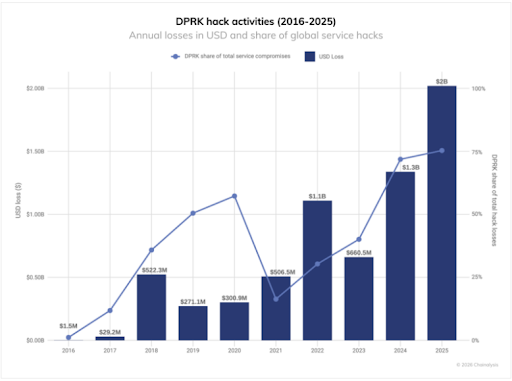
The need for this scale-up becomes clear when looking at the sophistication of state-sponsored actors. According to Chainalysis, Lazarus Group alone stole $2.02 billion in 2025, turning large centralized platforms into high-stakes targets. Doubling the number of users does not simply mean doubling the risk. This creates a honeypot effect and requires rapid investment in defense systems to counter AI-driven social engineering and advanced intrusion attempts.
Institutional expectations redefine baseline standards
Individual traders may seek volatility, but institutional investors demand custodial certainty. The Basel Committee on Banking Supervision’s Principles on Business Resilience state that financial institutions must be judged on their “tolerance for disruption.” This change effectively ended the pioneering days of wealth management. If the infrastructure cannot withstand severe stress scenarios, financial institutions will not deploy capital.
Data from 2025 supports this commitment to quality. Binance’s Year in Review noted that institutional trading volume increased by 21% year-on-year. This influx suggests that sophisticated market participants are prioritizing venues that demonstrate robust infrastructure over those that offer novel and untested features. Catherine Chen, Head of VIP and Institutions at Binance, elaborated on this point further at the recent WEF in Davos, saying, “We believe sensible regulation is essential to enable further institutional participation.” Chen continued: “The next step is consistent risk-based enforcement across jurisdictions, with clear licensing, custody and consumer protection standards.”
Threat situations enhance this vigilance. TRM Labs observed a clear shift in attacker focus from decentralized cross-chain bridges to centralized infrastructure in 2025. As attackers increasingly target centralized exchanges, the security burden on these platforms increases, forcing them to rapidly shift budget away from marketing departments and toward compliance and cold storage technologies. Institutional partners must ensure that their platforms can defend against these targeted strikes before integrating order books.
A platform that competes on resilience, not reach
In the current market structure, compliance functions function more as a product longevity guarantee than a legal protection. Being able to stop funds from leaving the ecosystem illegally is a measurable value proposition.
In 2025, Binance’s risk management prevented $6.69 billion in potential losses for 5.4 million users. Additionally, the platform recorded a 96% reduction in direct exposure to illicit funds between 2023 and 2025.
Noah Perlman, Binance’s chief compliance officer, highlighted this trend, noting that “analysis of independent industry data shows that our direct illegal exposure has decreased significantly,” and said that Binance achieved this feat “despite processing increasing trading volumes comparable to the next six largest exchanges combined.” This points to a new competitive reality. Compliance teams have effectively become growth engines, maintaining a license to operate in the face of increasingly stringent global jurisdictions.
This performance stands in stark contrast to the broader Web3 ecosystem, which often lags in governance. In this sector, Hacken reported that $4 billion was lost due to Web3 incidents in 2025.
The disparity between platforms that can prevent billions of dollars in fraud and a broader market that continues to drain capital is defining a new competitive landscape. Users are moving toward safety, and platforms are competing on their ability to provide it.
Why investment in security correlates with user retention
As the industry moves towards 2026, the marketing budgets of the past have effectively become the security budgets of today. The most effective advertising is a platform that remains solvent and functional during a crisis.
The NIST Cybersecurity Framework 2.0 emphasizes that governance is a core element of risk management. Platforms that effectively manage risk are positioned to survive the next cycle. In a mature crypto market, capital flows to the most powerful vaults, not to the loudest.


