

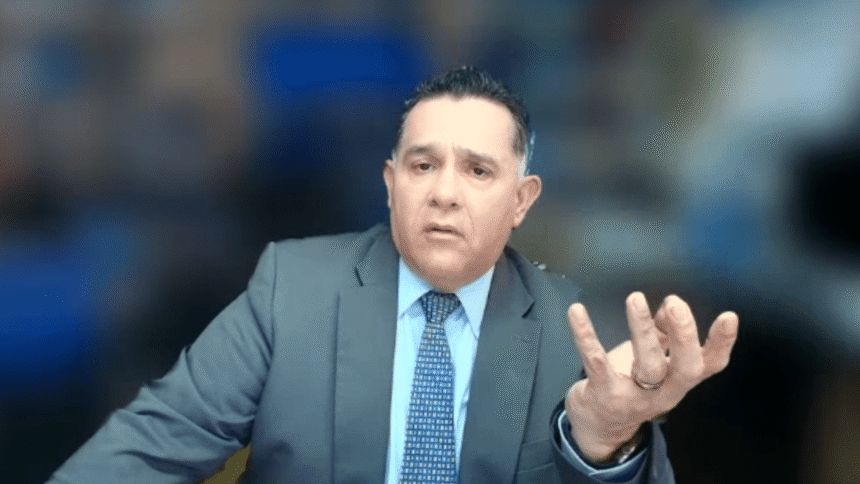
USDT, the stablecoin issued by Tether, has become a trading lifeline for many in countries with limited access to the US dollar. But for Raymond Horta Martínez, director of the Venezuelan Institute of Technology and Law, this mass adoption lacks the legal safety net needed to protect the public.
Although Venezuela already has a legal framework such as a comprehensive crypto asset system and the BA VEN-NIF 12 accounting standard that requires companies to register these assets, Horta argues that the private nature of Tether poses risks that cannot be fully covered by current regulations.
Unlike the decentralized nature of Bitcoin (BTC), USDT depends only on private directives. And in an exclusive interview with CriptoNoticias, Horta warns that this distinction is a significant financial risk. “If the issuing company faces bankruptcy or international regulatory intervention, Venezuelan users could wake up with their savings blocked,” the legal scholar explains.
Tether maintains reserves, verified by international accounting firm BDO, amounting to over $192.8 billion ($6.3 billion excess or cushion over debt) as of December 31, 2025, primarily in U.S. Treasuries.
The company explicitly prohibits the Venezuelan government as a direct user in its Terms of Service and U.S. OFAC Sanctions Compliance Policy. The ban does not apply to civilians, but Tether has frozen wallets related to sanctions evasion in the past.
Some people using USDT in Venezuela point out that the stablecoin facilitates fast and low-cost transactions. This has made it the country’s main tool for everyday payments, imports and value preservation, with annual inflation reaching 549% in 2025, according to estimates by the International Monetary Fund (IMF). During the same period, Chainalysis reported that the country recorded $44.6 billion in cryptocurrency transaction value in one year.
Sunacrip renews license to exchange, but it’s not enough
The National Crypto Assets Supervision Authority (Sunacrip) maintains regulatory momentum by renewing licenses to local exchanges until 2026. The continuation of this regulation occurred despite the fact that Sunacrip underwent significant intervention in March 2023 after the outbreak of the PDVSA-Cripto scandal. The scandal involved the diversion of millions of dollars in oil funds through crypto assets and resulted in mass arrests, suspensions of operations, and complete trading. Organizational reorganization.
Orta emphasizes that licensing a platform to operate is not the same as regulating the assets that circulate on the platform. “Licensing an exchange does not make USDT legal tender,” he points out. For specialists, Countries need to move to plans for traceability and management of the origin of funds It prevents the legitimation of capital without choking the freedom of use that has allowed ordinary citizens to survive high inflation.
Venezuelans had no choice but to adopt an asset that came in time to cover these needs: USDT. However, we must not forget that there are also problems with corruption and money laundering, which is why regulation is needed. That can’t be true. I say this because I have seen cases in court where a company claims to have 500,000 USDT. And one wonders, oh, but where did you get that from? What are the sources of those funds? When talking about crypto assets, companies need to take into account that although they can legally operate between companies, they can also operate between organized crime, where money laundering is also in their hands.
Raymond Orta.
The expert elaborates that the exchange of USDT for bolivars or commodities is not a formal exchange operation, but rather an exchange of assets (similar to exchanging one commodity for another). According to current legal concepts, there is no immediate tax on holding or exchanging, but it warns that the profits obtained (sale) may be taxed. Recommends accounting, tax and traceability standards for transactions between Venezuelanscompanies or individuals, including the auditing and control of the origin of funds to prevent money laundering.
A balance is needed between freedom of use and prevention of abuse
Venezuela remains among the highest in crypto adoption in the region due to its informal dollarization, which has found the most efficient infrastructure in stablecoins. Reports from CriptoNoticias and local analysts indicate that USDT Recommended tool for import and store of value Oppose international banking regulation.
This is not to demonize USDT as a crypto asset, but there needs to be regulation at both the exchange level and accounting level, and there needs to be a story for people to know why they own and use it. Money laundering mechanisms, similar to cash, must exist to minimize the risk that crypto assets are used for crime.
Raymond Orta.
“There need to be different types of regulations to allow it as a means of payment or to actually legalize it,” Orta said. It considers USDT’s traceability, certain accounting and tax rules, and proposes to differentiate it from Bitcoin (which is treated as a commodity in some countries). Warning of risks when companies issue currency without controlemphasizes the balance between freedom of use and prevention of fraudulent activities such as laundering and circumvention.
To ensure market freedom and manage cryptocurrencies from becoming tax havens for criminals, we need to develop effective plans based on our realities. There needs to be a balance between the freedom that was originally proposed for cryptocurrencies and the controls that prevent cryptocurrencies from developing into various types of crimes. Therefore, a balance should be sought through controls that allow individuals to reap the benefits of crypto assets in both investment and asset protection without strangling them.
Raymond Orta.
Meanwhile, Venezuela maintains the highest cryptocurrency adoption rate in Latin America. Driven by informal dollarization Restrictions on access to traditional currencies.
(Tag translation)Criptoactivos


