

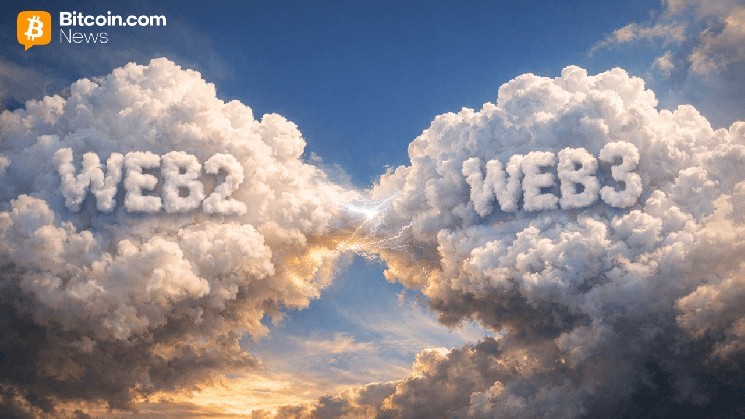
The new partnership aims to address the tension between Web2 cloud speed and Web3 transparency through a progressive decentralization strategy. The partnership also aims to move beyond speculative token models by locking demand into real revenue-generating use cases.
Hybrid leap architecture
The rapidly evolving distributed computing landscape presents fundamental tensions. On one side stands Web2 Cloud, an industry giant built on the pillars of speed, low-latency performance, and centralized efficiency. The other is Web3, a decentralized frontier that promises cryptographic transparency.
When these two worlds are integrated into a hybrid system, important questions arise. Can we maintain the rigorous, deterministic validation required of Web3 without sacrificing the lightweight performance that users expect from Web2? According to industry leaders Bob Miles, CEO of Salad.com, and Pawel Burgchardt, CPO of Golem Network, the answer lies in a “progressive decentralization” strategy.
Central to Sarada and Golem’s partnership is a tactical separation of powers. While traditional Web2 clouds prioritize execution speed, Web3 environments often suffer from “verification burden,” or the additional delay and computational overhead required to prove that a job executed correctly.
“There are many aspects to Web3, and just because it’s a Web3 project doesn’t automatically mean it has to rely on cryptographic proofs to ensure the correct execution of the underlying workloads,” Burgchardt said.
Currently, this integration works on the Marketplace layer rather than the Execution layer. This allows the system to leverage Web3’s strengths in permissionless resource discovery and market access while keeping the actual computation within the high-performance containerized runtime that Salad has already perfected.
Security and “data silo” challenges
For Miles, maintaining performance means choosing what is decentralized. Salad currently utilizes a closed-source reputation system to handle runtime security, intrusion detection, and output validation.
“The closed-source reputation system for salads…will remain closed-source until a proper Web3 solution exists,” Miles said. “ZKP, trusted execution environments, and fully homomorphic encryption are areas of research that we are focused on, and we are excited about the salad opportunity here.”
This cautious approach also addresses the “data silo” problem. Regulatory obstacles often prevent sensitive personally identifiable information (PII) from moving onto public blockchains. Miles points out that while the industry is waiting for technologies like Fully Homomorphic Encryption (FHE) that can securely process sensitive data on idle GPUs, there is a huge market today for non-sensitive workloads such as early-stage drug discovery that can be decentralized.
“In the field of drug discovery, dozens of companies are digitally synthesizing millions of molecules. It is only in the later stages of computation that the results become highly sensitive,” Miles said.
Beyond speculation: Tokenomics of real demand
A recurring criticism of the decentralized physical infrastructure network (DePIN) space is the use of token rewards to “bootstrap” supply. Critics argue that this often creates speculative bubbles rather than sustainable practicality.
Miles observes that many networks are using tokens to solve the problem of two-sided markets, but warns that “if enough demand doesn’t come online, this is an unsustainable model.” The Salad and Golem partnership seeks to reverse this trend by bringing existing revenue-generating demand into the space.
Piotr Janiuk, co-founder of Golem Network, emphasizes that in a healthy market, tokens should primarily serve as a utility.
“In a healthy market, users join a project because it provides real value, and tokens are a core part of the protocol and exist primarily as a utility,” Janiuk said. “In the early stages, there is nothing wrong with using incentives to bootstrap activity… but those incentives should be temporary. Eventually, incentives should be tapered off to allow the system to operate in real market conditions.”
While the long-term goal remains deterministic validation, the immediate focus of the Salad and Golem partnership is business optimization. Salad aims to reduce fees and overhead by more than 5% by leveraging Golem’s compute orchestration and native token payments.
The partnership also prioritizes interoperability to break down silos between the DePIN Marketplace and traditional GPU rental services. This allows Golem claimants and Salad’s “chefs” to seamlessly share computing power, making the power supply as fluid as the power grid.
The road ahead
The consensus is clear. The future of cloud is not a winner-take-all battle. It’s a hybrid model that selectively embraces value-adding decentralized features while maintaining a centralized component where speed and data compliance are non-negotiable.
As Burgchardt points out, “Ensuring computational accuracy in untrusted environments is an entirely different and broader problem that we are not solving as part of this partnership.” For now, the bridge is being built layer by layer, turning idle hardware into a global, efficient engine for the digital age.
Frequently asked questions ❓
- What is the partnership between Sarada and Golem? Combine the speed of Web2 cloud with the transparency of Web3 to create a hybrid distributed computing model.
- How can this help businesses? We make GPU power more affordable and interoperable across regions by reducing fees and enabling permissionless access.
- What workloads will benefit the most today? Non-sensitive tasks such as drug discovery simulations can now be decentralized, but sensitive data requires stronger encryption tools.
- How do tokens fit into the model? These serve as utilities for payments and orchestration, driving sustainability where demand from real users goes beyond speculation.


