

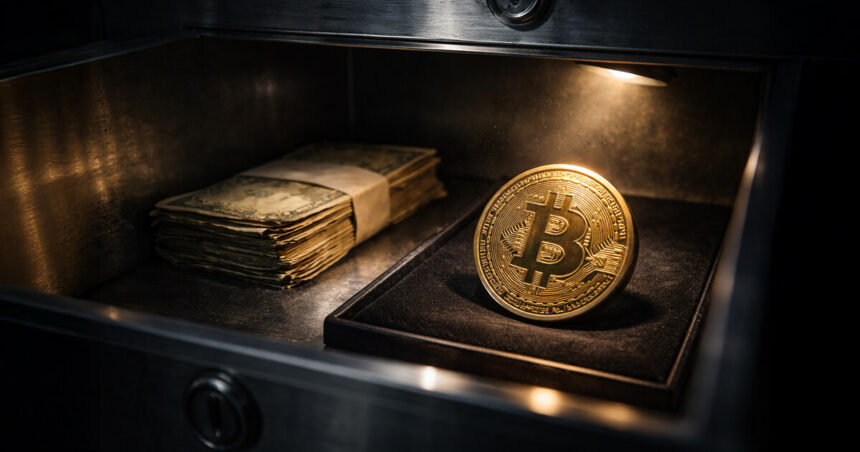
If you hold either USD or Bitcoin, you are a little poorer this morning than when you went to bed last night. It doesn’t matter if you have cash in your pocket or in your wallet. Both have less purchasing power today than they did yesterday.
That’s because Bitcoin is falling and the dollar is also falling, but the feeling is not quite the same. This quiet little subtraction before you drink your coffee usually doesn’t take into account the value of the dollar itself, unless you live outside of the United States.
That’s clear from today’s chart. BTC fell about 3% overnight, but it’s the kind of move that makes holding it feel personal, the kind of move that makes people say “aha” as if it proves a point.

At the same time, on the foreign exchange front, the dollar weakened, down about 0.7% on the day according to the DXY gauge, small enough to shrug off, but large enough to matter if you’re keeping score.

The difference is that the paper in your wallet still says $1, so one of these movements is called a dump and the other is called background noise.
That’s the cash trick. It looks different, but it looks the same.

A dollar isn’t worth another dollar
I feel the same way about the crumpled dollar I recently found inside an old jacket I haven’t worn in three years, but trust me, it’s not. If you’re having trouble understanding this, Frank Reynolds has a great explanation.
All kidding aside, if you want to understand the clearest explanation why, start with purchasing power.
The Bureau of Labor Statistics’ CPI-U index (not seasonally adjusted) was 300.840 in February 2023, according to the BLS.
The latest complete CPI-U print we currently have is 324.054 for December 2025 from FRED. It’s the slow part of loss, the part you don’t feel in the morning.
300.840 divided by 324.054 means that a dollar in February 2023 will have purchasing power of approximately 92.8 cents by December 2025, before introducing foreign currencies.
Now layer the foreign value of the dollar on top. Because the whole point of the DXY style story is that the world sets prices in real time.
The chart shows that DXY is down about 4.56% over a 3-year window, and by using that FX leg in conjunction with the CPI leg, we get the intuition that “my dollar is actually worth 88.7 cents.”
0.955 times 0.928 is approximately 0.887, which we call 88.7 cents. This is before we get into the more complex discussion of how people experience inflation unevenly depending on what they buy.

This is important because there are more conservative ways to make the same comparison, and critics will try to poke holes in the indexes we choose.
FRED’s broad trade-weighted dollar index DTWEXBGS is roughly flat across the comparable window, pushing the aggregate “cash reality” toward about 92.5 cents instead of 88.7 cents.
So at least you can keep it within that range, and it’s hard to argue, but your $1 bill is still a $1 bill, and depending on whether you use DXY or a broad trade-weighted basket, it essentially buys you something closer to $0.93 than $0.89 before.
It is a baseline and has nothing to do with cryptocurrencies. It’s simply the quiet mathematics of living through time.

And then there’s Bitcoin.
On February 3, 2023, BTC was around $23,424. Using that starting point gave us perspective that everyone forgot during the retreat, and we’ve increased about 226% from then to now.
A gain of 226% means simple: $1 is about $3.26.
It’s not a prediction, it’s not a pep talk, it’s just arithmetic, 1 plus 2.26.

A $1 “Bitcoin purchase” in early February 2023 would now be worth about $3.26, even after the recent sell-off.
A $1 bill in early February 2023 will be worth about $0.89 to $0.93 in real terms in late 2025, depending on whether you want a DXY punch or broad trade-weighted caution.
People can hate Bitcoin for a variety of reasons, and many of those reasons are valid, but just because Bitcoin isn’t moving every minute on the charts, it’s hard to look at the scoreboard and act as if your cash is safe.
The part that no one wants to say out loud: Cash also has volatility.
Most people think that volatility looks like a red candle.
They don’t think of volatility as something like the price of your groceries creeping up while your paycheck stays the same. We also don’t think that vacations are going to cost more every year, or the rent will go up even if the apartment doesn’t get bigger.
It’s still a price list, it just lives in your life.
The CPI is the public version of that story, imperfect and averaged, but political in that all measurements are political, and it remains the best widely used indicator.
When the CPI-U rises from 300.840 to 324.054, the world is saying the same dollar will buy less. There is no drama, no chain of liquidations, no influencers with thumbnails of shocked faces, just a steady stream of leaks.
Much of the public discussion about Bitcoin gets bogged down in whether or not it is “money.”
I don’t think that discussion is necessary on this point. The angle of human interest is simpler: people save, people wait, people try to maintain the value of their work. And with cash, or cash-adjacent, being the default savings technology for most people, it comes as a shock to discover that the definition of “safe” is quietly changing.
You can see why the topic keeps coming back every time Bitcoin crashes. That poses a different kind of risk. It’s loud, it’s sociable, it’s the kind of thing you can stare at in real time, and that visibility makes it emotionally difficult.
Cash feels cool, and that coolness is important, and mathematics shows that coolness has a price.
To be clear, this is not a pitch that anyone can become a Bitcoin maximalist. It reminds us that what we treat as neutral is not neutral at all.
What today’s decline actually says about next year
Bitcoin dropping 3% overnight is not a problem, it is an entry point.
The real story is the macro context driving this cluster-like movement and what it means for the coming months. When real yields are high, risk assets tend to be perceived as heavy.
TradingEconomics’ recent 10-year TIPS yield has been around the low 1% range, a sign that traditional systems can deliver “real returns,” drawing attention away from speculative assets and potentially tightening the financial oxygen that Bitcoin often thrives on.
Liquidity is also important. The Fed’s balance sheet, tracked as FRED’s total assets, is a decent weather vane for broader financial conditions, not because it’s magic, but because it’s one of the clearest public signals of how tight or loose the system is.
When liquidity dries up, leverage becomes expensive and marginal buyers become cautious.
Next, we’ll add a new market structure: ETF.
This plumbing changes the shape of Bitcoin demand and how the story turns into flow. The Spot Bitcoin ETF saw about $5.7 billion in withdrawals from November to January.
Emotions can swing quickly when the “easy to access” vehicle is also the “easy to get off” vehicle. Whether you agree with the framework or not, data points that show where marginal pressures are coming from are important.
The combination of real yield, liquidity, and flows provides a useful way to think about the next 3-12 months without pretending to be able to predict Tuesday.
If real yields rise and liquidity remains tight, Bitcoin could still perform well in the long run and could crash, scaring people and leading to more sharp down days.
Once the macro regime shifts to accommodative policies and yields fall, Bitcoin tends to regain momentum.
Once risk is turned off and leverage loosens, Bitcoin will be dragged along with everything else for a while, and while comparisons to cash won’t disappear over the long term, it will become emotionally unsatisfying in the moment.
Take-out you’ll come back to again and again
Most people believe that they are choosing between stability and instability.
They are choosing between visible and invisible volatility.
Over the past three years, Bitcoin has been a noisy asset, converting $1 into around $3.26, even after a severe selloff.
Cash has been a quiet asset that transforms your dollar into something like $0.89 to $0.93 in real terms, depending on whether you prefer DXY framing or a broad trade-weighted dollar approach based on CPI and a broad dollar.
That’s why this moment is so important. It always goes down, not because Bitcoin goes down. This is important because every drop creates the same psychological trap, where people see the red candle and forget about the slow bleeding in the background.
They wake up feeling sick and blame it on something that moved.
They rarely blame anything that is still.
(Tag translation) Bitcoin


