


Ethereum co-founder Vitalik Buterin and other prominent “whales” have amassed millions of dollars. $ETH It added narrative fuel to a market rout that has seen the world’s second-largest cryptocurrency drop below $2,000 since early February.
Although Mr. Buterin’s high-profile sales were the psychological trigger for retail panic, a closer look at market data suggests that the main pressure came from systematic de-leverage and record sales activity across the network.
Nevertheless, these disposals, combined with significant selling by other industry players, have led investors to question whether project leaders are losing confidence or are simply managing runway operations amid extreme volatility.
Why is Buterin selling his Ethereum holdings?
In the last 3 days, Buterin has sold 6,183 pieces $ETH According to blockchain analytics platform Lookonchain, the average price is $2,140 ($13.24 million).
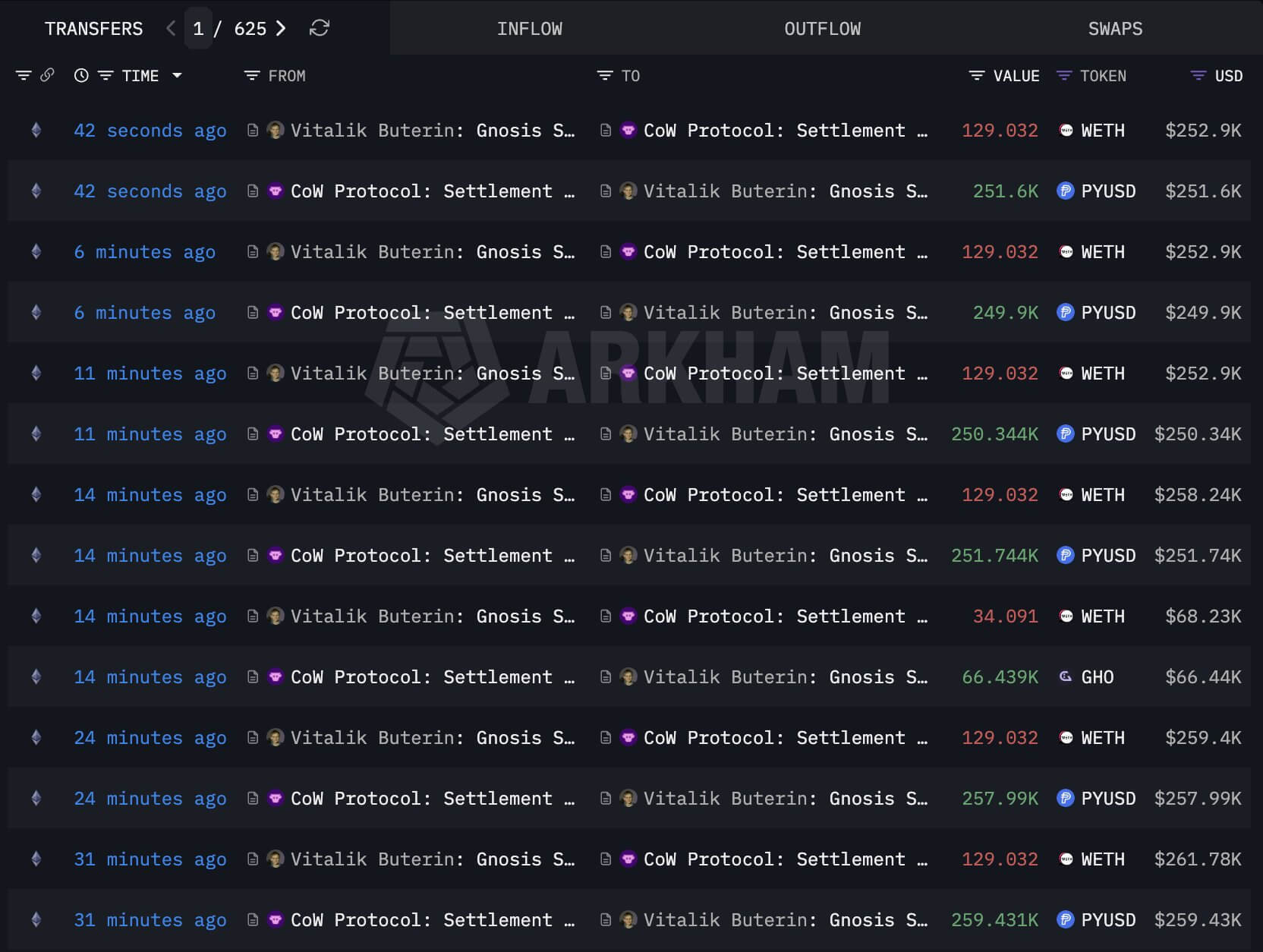
But a look at the details of Buterin’s trades reveals a calculated strategy rather than a panic-driven one.
Notably, Buterin publicly revealed that he had accumulated $16,384. $ETHIt was valued at around $43 million to $45 million at the time and is expected to be rolled out over the next few years.
He said the funds will go towards open source security, privacy technology and broader public interest infrastructure as the Ethereum Foundation enters a period of what he described as “mild austerity.”
Seen from this perspective, the most defensible explanation for “why he sold” is a mundane one. It seems to be a conversion of the pre-allocated $ETH Instead of shooting for the top of the market suddenly, put your budget into available runway (stablecoins) for a multi-year financial plan.
However, the channels through which these sales impact the market are narrative-driven rather than liquidity-based. When investors see founder wallets active on the sell side during a downturn, sentiment tilts and deepens the bearish resolve of an already volatile market.
Still, buterin remains $ETH Whales, holding 224,105 $ETHwhich equates to approximately $430 million.
Buterin’s $ETH Will sales cause a market crash?
The central question for investors is whether Mr. Buterin’s selling was driven mechanically. $ETH Less than $2,000.
From a structural perspective, it’s hard to argue that Buterin’s $13.24 million sales program by itself beats key market levels. $ETHThe daily trading volume reaches billions of dollars.
Therefore, a sell order of this size is small compared to normal volume and does not have enough volume to consume order book depth and drive the price significantly lower.
But Buterin wasn’t just selling. He was part of a broader exodus of large holders that weighed on the market as a whole.
On-chain trackers have flagged significant activity by Stani Kulechov, founder of DeFi protocol Aave. A few hours earlier, Kulechov sold 4,503 Ethereum (worth about $8.36 million) at a price of about $1,857. $ETHThe slide accelerated.
This activity is a symptom of a broader trend. According to CryptoQuant data, the network is facing record sales activity this month.
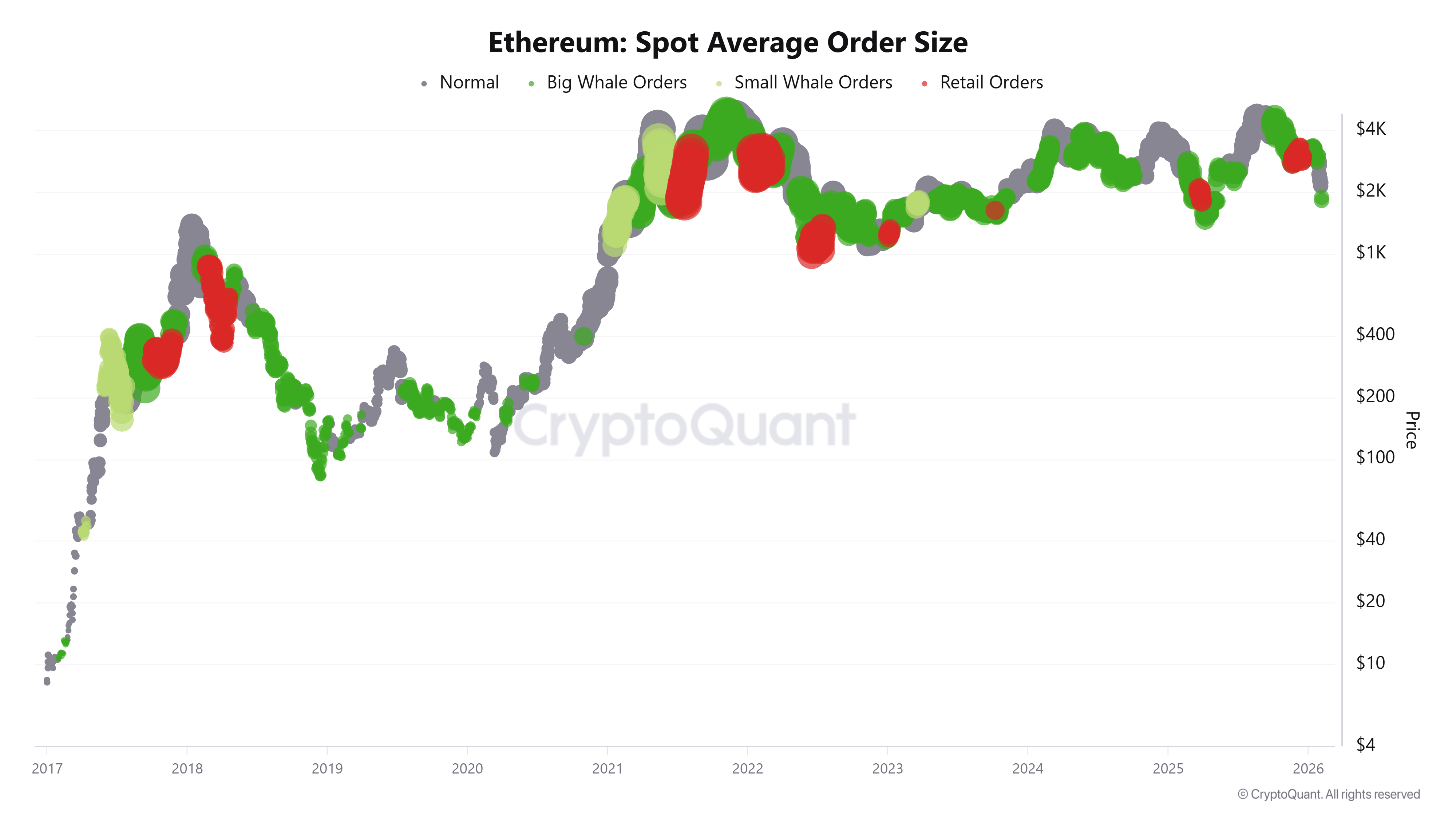
The analytics firm noted that the network saw an increase in big whale order values during the downturn, suggesting that high-net-worth individuals and entities were actively risk-averse to the liquidity created by the decline.
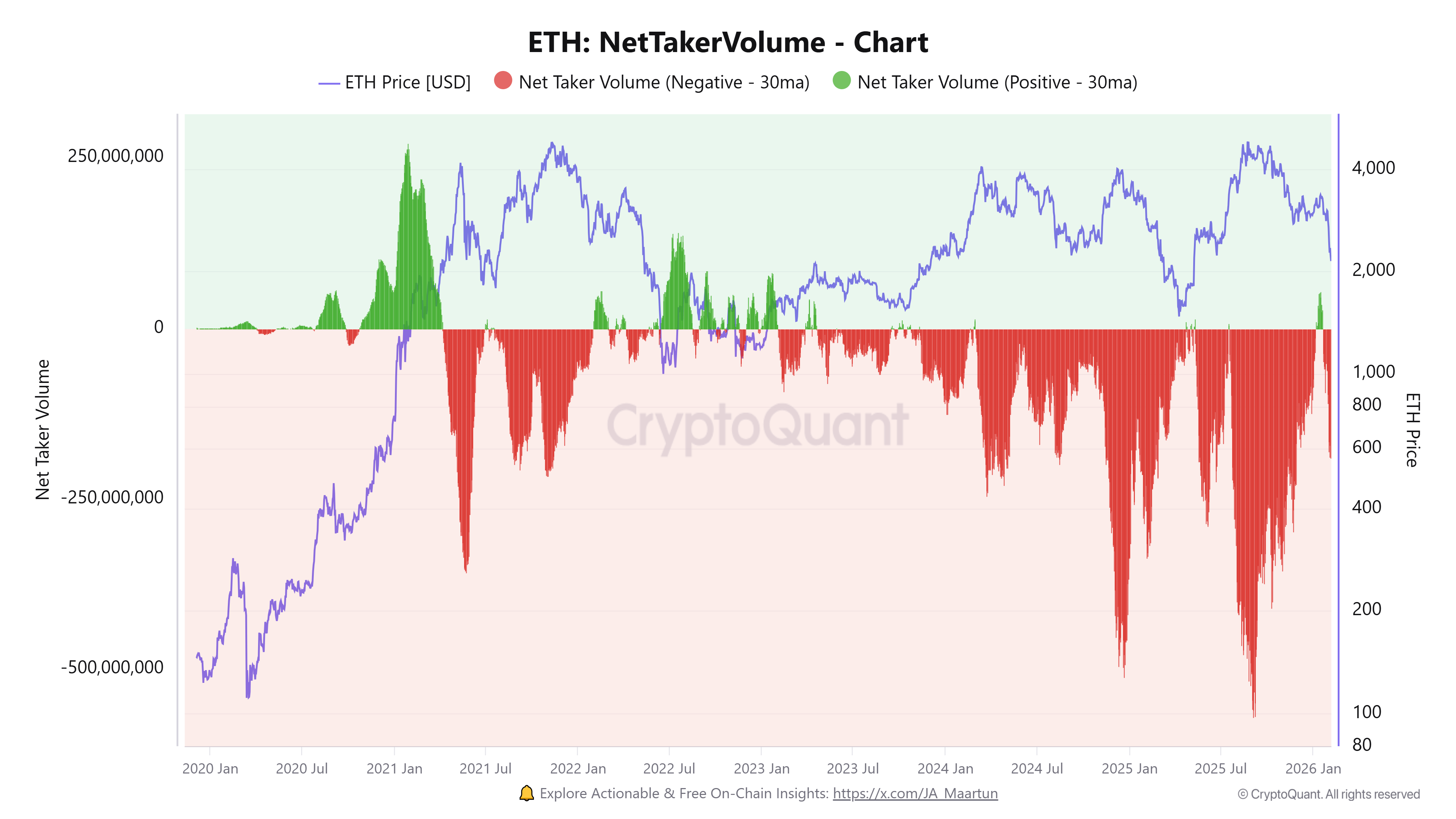
While no single whale can collapse a market, the mass exit of industry leaders could create a self-fulfilling prophecy.
When liquidity is thin and leverage is high, these “headline flows” signal “smart money” risk mitigation throughout the market, encouraging smaller traders to follow suit to preserve capital.
the real driver behind $ETHcrash of
Although the story focused on the founders’ wallets, the crash was largely driven by three different market forces: unwinding leverage, ETF outflows, and macroeconomic headwinds.
Coinglass data shows it’s worth hundreds of millions of dollars. $ETH In the worst case, liquidation took more than 24 hours, and long-term liquidations were predominant.
This created a classic cascade situation where price declines caused forced sales from overleveraged positions, which in turn caused further declines and additional forced sales.
At the same time, institutional support evaporated. usa spot $ETH The ETF has recorded net outflows of about $2.5 billion over the past four months, according to Soso Value data.
This occurred alongside larger outflows from Bitcoin ETFs. This represents more important institutional risk aversion than any wallet at a time when markets are already falling.
Further complicating these crypto-specific issues is the macroeconomic context.
Reuters linked the widespread decline in cryptocurrencies to concerns about declines among assets and a liquidity squeeze. The crypto market has lost about $2 trillion since its peak in October 2025, with about $800 billion wiped out in the last month alone, as investors reduced risk and leveraged unwinding of positions.
Metrics to watch
When markets are trying to find a bottom, three indicators matter more than any whale alarm.
First is liquidation strength. If forced liquidations continue to increase; $ETH Even without additional discretionary selling, the “gap” can still be lowered.
According to Phemex analysts, a decline in total clearings due to stabilization is often the first sign that a cascade is burning out.
The second is the ETF flow regime. A single day’s outflow is noise, but if it continues for several weeks, the marginal buyers change. $ETHThe short-term path of the crisis will largely depend on whether institutional capital flows stabilize or continue to spill over into broader risk-off behavior.
Finally, investors need to keep an eye on currency inflows and the behavior of large holders.
Founder wallets are visible, but more obvious indicators are whether large holders increase their deposits on the exchange (distribution) or whether coins move to cold storage and staking (accumulation). When these signals reverse, the market usually follows.
The bottom line is that Vitalik Buterin’s sales are best understood not as a sudden loss of credibility but as the execution of pre-announced funding plans tied to public goods and open source spending.
But in collapses caused by leverage liquidations, ETF outflows, and macro risk-offs, even “small” founder sales can have a disproportionate impact.
They don’t achieve it by supplying enough $ETH Breaking above $2,000 is by adding narrative fuel to a market already looking for reasons to sell first and ask questions later.


