

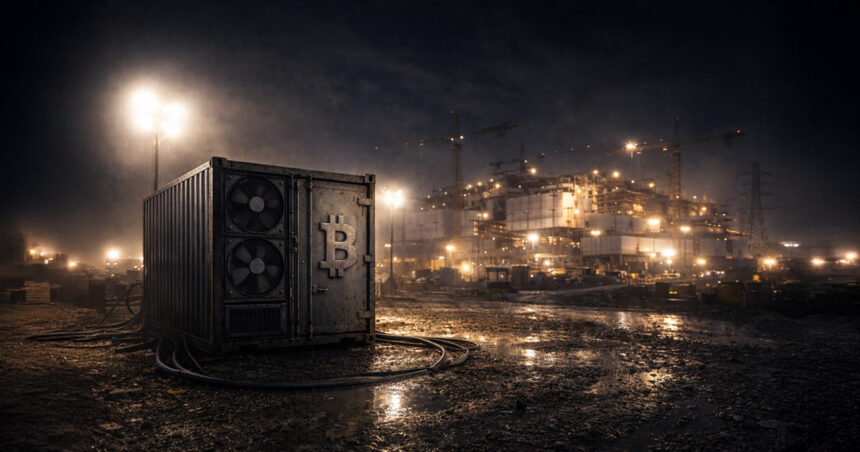
The $500 billion war chest Big Tech companies are planning to dominate artificial intelligence could provide a lifeline to a Bitcoin mining industry on the brink of capitulation.
The headline numbers are impressive. Google’s parent company Alphabet alone plans to spend $185 billion this year.
But the surge in capital will include more than just chip and server purchases, as Microsoft and Meta are also increasing their AI budgets.
This means there is real competition now over physical infrastructure such as pipelines, grid interconnections, and the scramble to secure large power capacity blocks.
The projected spending will therefore reshape the electricity market, favoring the one asset Bitcoin miners still control: “ready-to-run” energy infrastructure.
For Bitcoin miners looking to reinvent themselves as data center landlords, this surge in spending presents a huge growth opportunity just at a time when their core business is in jeopardy.

Mining under severe financial stress
The timing of these companies’ planned surge in spending is significant, as miners are operating under some of the weakest economic conditions in Bitcoin’s history.
According to CryptoQuant data, the recent market correction has pushed miners into what the company describes as “miner capitulation,” a period characterized by severe financial stress that has historically coincided with local market bottoms.
Pressure can be checked with multiple indicators. CryptoQuant’s Miner P&L Sustainability Index has dropped to -30, indicating that miners’ daily revenue in USD terms is approximately 30% lower compared to 30 days ago.

The indicator has entered the “extremely low wage” zone, a level that indicates widespread unprofitability among operators.
At the same time, the Puel multiple, another measure of miner earnings relative to historical norms, has fallen to 0.69, reinforcing the view that the mining economy is deteriorating rapidly.
At such levels, inefficient miners are typically forced to shut down their machines, sell assets, or liquidate their Bitcoin holdings in order to survive.
Notably, some of these miners have already released their BTC holdings during the current bear market.

CryptoQuant’s Miner Position Index (MPI) and exchange miner average inflow indicators have both surged in recent weeks, indicating that large mining entities are moving Bitcoin to exchanges at an accelerated pace.
In January alone, miners transferred approximately 175,000 Bitcoins to Binance, an unusually high number compared to the stable period.
The activity was punctuated by rapid outflows, with daily transfers reaching nearly 10,000 Bitcoins, according to CryptoQuant data.

Such a spike is indicative of deliberate liquidity decisions rather than routine financial management. Transferring Bitcoin to an exchange does not guarantee an immediate sale, but it does increase the available supply on the order book.
In a weak demand environment, that supply can lead to short-term price pressures, reinforcing feedback loops and squeezing miners’ profits.
Historically, there have been periods when miner wages were “extremely low” and peaks in selling pressure preceded cyclical troughs. However, the liquidation process can be grueling and not all operators survive.
Why spending on AI changes the equation
This is why the big tech companies’ $500 billion capital spending plans matter to miners.
The AI boom has created bottlenecks that GPUs alone cannot solve. Computing deployments are increasingly constrained by access to power, cooling capacity, grid interconnections, and permitting. These constraints closely align with the assets miners already manage.
Over the past decade, large miners have built power-heavy campuses designed to run dense computational loads around the clock. They learned how to negotiate long-term power contracts, build transmission links, and operate energy-intensive infrastructure at scale.
Bitcoin mining hardware is not compatible with AI servers, but the underlying sites are rare and increasingly valuable.

The decision by big tech companies to push ahead with AI investments suggests that computing demand remains strong enough to justify building past the constraints rather than waiting for them to ease.
This demand directly supports the economics of converting or co-developing mining sites into high-performance computing facilities at a time when Bitcoin-derived revenues are collapsing.
For context, Alphabet’s Google has provided at least $5 billion in disclosed credit support behind a small number of BTC miners’ AI projects.
These backstops reduce counterparty risk and allow miners to fund projects on terms that are difficult to secure on their own, especially during recessions.
These structures are important because they change the miner’s profile. Rather than being completely dependent on volatile Bitcoin rewards, operators gain long-term, contracted cash flows that can be financed like infrastructure.
That stability could be a powerful and durable lifeline for an industry currently forced to sell Bitcoin to survive.
What $500 Billion Really Represents
From a practical perspective, the $500 billion in AI capital spending planned by big tech companies is a positive for Bitcoin miners for three reasons.
First, the demand for AI data center capacity is strengthening as mining revenue indicators show that miners’ wages are extremely low and they are under pressure to capitulate.
Second, the value of a miner’s core asset, a power-ready campus, increases only when on-chain data shows that the miner is forced to sell Bitcoin to cover costs.
Third, companies like Google are effectively underwriting the transition through backstops and structured finance, turning distressed crypto operators into viable infrastructure partners.
This combination explains why the AI investment boom from big tech companies is seen by miners as a potential lifeline rather than a race for power during the toughest period on record for mining profitability.
Contradictions in Bitcoin’s security model
However, this lifeline also has an unpleasant side.
The current surrender of miners coincides with a tectonic shift in the way infrastructure is used.
If miners are temporarily halted due to a price drop, Bitcoin difficulty adjustment can eventually restore balance. However, once a site is permanently repurposed for AI under a 15-year lease, that power capacity is removed from the network’s security budget indefinitely.
Market observers note that the transformation of mining infrastructure to AI could have a long-term impact on Bitcoin’s hashrate, even if the absolute level of security remains high.
As marginal mining capacity continues to decrease, the risk of centralization increases and the cost of attacking marginal networks decreases.
From a market perspective, this tension reflects a conflict of interest. Big Tech spending could help mining companies survive and stabilize their balance sheets, but it also accelerates the reallocation of resources away from Bitcoin and towards higher-paying AI workloads.
(Tag translation) Bitcoin


