

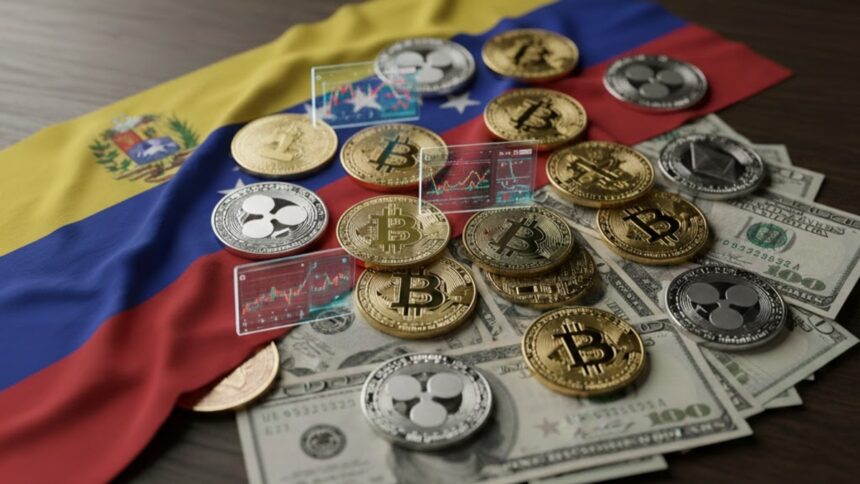
Venezuela’s economic panorama is facing a new phase in currency trends, marking a turning point in the adoption of cryptocurrencies.
Last week, the Venezuelan government notified a group of local banks about the matter. Allocate $300 million from oil revenuesdeposited into your Qatari account.
The money is part of a larger agreement with the US administration of President Donald Trump and will be sold to local businesses to pay for supplies. According to Venezuelan President Delcy Rodríguez, it will also be allocated to natural persons through currency intervention in the country’s banks.
“These initial funds will be utilized and deployed through the Venezuelan exchange market, the National Bank and the BCV, precisely to consolidate and stabilize the market and protect income and purchasing power,” Rodriguez said.
The above concerns the Venezuelan economy. This is because the injection marks the return of Venezuela’s oil money to the exchange system, which was there until last year, after months of foreign exchange shortages. now partially managed by digital assets.
“Virtual currencies are no longer central to the system.”
For Venezuelan economist and analyst Luis Vicente León, the new reality of the currency market suggests that direct provision of regular currency would significantly reduce exchange rate pressures.
In his view, This could take away the leading role that digital assets have played Venezuela’s economy in recent months.
Leon, who heads the socio-economic analysis firm Datanalysis, argues that cash and cryptocurrencies “will no longer be central to Venezuela’s exchange system.” This corresponds to the flow from the oil sector. Eliminate price distortions and gaps Previously, these assets were essential to daily operations.
“There are no special new offers through crypto assets. The businesses that were supplying that channel, especially the oil-related businesses in the informal market, have also slowed down,” he said.
For the analyst, while the use of digital assets by officials, businesses, and ordinary users may decline, “that doesn’t mean the crypto market will disappear. It still has the same characteristics that have made it successful globally: convenience, speed, low cost, and privacy.”
Another voice arguing that injecting foreign currency into Venezuela will slow down the crypto ecosystem is fellow Venezuelan economist Luis Oliveros.
He noted that because of the current oil deal, “everything seems to point to the crypto industry losing its power in Venezuela.” In his opinion, this new dynamic The supply of digital assets previously generated by Petroleum de Venezuela (PDVSA) will decrease..
It is important to consider that Venezuelan state-owned enterprises have had to rely on crude oil payments through stablecoins such as USD Tether (USDT). This is done as a way to ease international financial restrictions. Therefore, in 2025, there will be a significant boom in USDT in Caribbean countries.
In that sense, Oliveros, dean of the Economic and Social Studies Department at the Metropolitan University (Unimet), said that the Venezuelan government: No longer a “main promoter” The amount of cryptocurrencies in the Venezuelan population will decrease, resulting in a “significant” reduction in the supply of cryptocurrencies in the economy.
Cryptocurrency remains a “relevant instrument” in Venezuela
In contrast to Leon and Oliveros, economist and business consultant Asdrubal Oliveros offers a vision in which coexistence is key.
He agrees that currency sales by the Venezuelan state will no longer take place through cash dollars or virtual currencies, but through traditional bank transfers or virtual dollars.
However, experts say: Virtual currency “will continue to be an important tool” In the country. This is especially true for the private sector, he said.
In his opinion, this is because hedging operations by private actors are a “significant part” of Venezuela’s economy. continues to run through these cryptographic mechanisms.
Oliveros also stressed that Venezuela’s informal US dollar market, which has been dominated by USDT prices for the past six months, is not going away. “On the contrary, the exchange rate will continue to be active and will have an important influence on the formation of exchange rate expectations.” “At least for a while,” he added.
Alongside Oliveros is Daniel Arraez, a Venezuelan economist and investor. He questions the theory that Venezuela’s crypto ecosystem will cool as a result of the repatriation of dollars through traditional means.
Venezuelan bitcoiners say they owe the state for promoting the use of the digital currency It’s an analysis error.
As reported by CriptoNoticias, the analyst stressed that it “ignores technological advances in the use of financial products that allow us to send and receive money and participate in the global economy.”
So, will cryptocurrencies lose momentum in Venezuela?
In this scenario, the answer to the question of whether the injection of foreign currency will cause a loss of cryptocurrency strength in Venezuela is negative.
Coincidentally, while the Venezuelan state channels oil revenues through the BCV and private banks for the purpose of stabilizing the exchange rate, the reality is as follows. Digital assets like BTC and USDT continue to offer an escape route.
From the above, it is clear that Venezuela is not abandoning cryptocurrencies for the sake of oil money in banks. Rather, it appears to be evolving towards a dual economy. The problem is that, in effect, currency from oil activities is used to operate the system. but BTC and stables remain as a shelter People who can no longer trust their assets to centralized organizations or geopolitical fluctuations.
The Bitcoin ecosystem is no longer a rescue vehicle in times of crisis, but rather an infrastructure for building resilience in Venezuela. As Luis Vicente León points out, an economy is like a river that always finds its way eventually. And in the case of Venezuela, those waterways are made up of oil money deposited in banks. As well as disruptive alternatives emerging from Bitcoin technology.
(Tag Translation)Bitcoin (BTC)


