

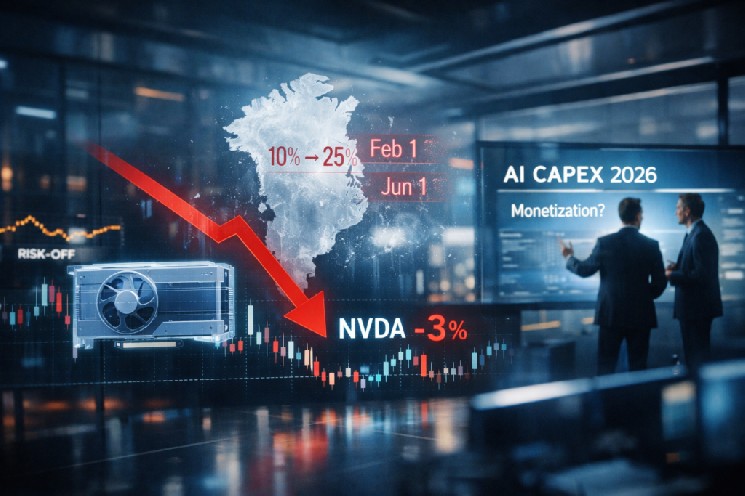
Nvidia stock (NASDAQ: NVDA) fell more than 3% on Tuesday as the technology sector faced uncertainty over President Trump’s escalating push to buy Greenland, triggering a broader risk-off unwind.
At the same time, influential analysts have warned that 2026 could be the year that growth in AI infrastructure spending finally slows, forcing hyperscalers to reconsider whether they can monetize hundreds of billions of dollars in capital spending.
Nvidia stock: geopolitical triggers and trade war fears
Copy link to section
The direct trigger was President Trump’s tariff hikes over the Greenland impasse.
From February 1, the United Kingdom, Denmark, France, Germany, Norway, Sweden, Finland, and the Netherlands will impose a 10% tariff on all exports to the United States, rising to 25% by June 1 unless a territorial agreement is reached.
The market views this differently than a transactional trade dispute.
Traders assess territorial ambitions related to national security as non-negotiable and susceptible to escalation.
That concern is particularly acute when it comes to Nvidia stock.
Markets are reassessing the possibility that President Trump’s aggressive stance extends beyond Greenland to broader Chinese export restrictions, supply chain disruptions, and European retaliation that would directly compress U.S. tech profits.
Nvidia already faces sales headwinds in China, and the uncertainty of new tariffs adds unpredictability to its guidance.
Structural AI challenges: When the honeymoon ends
Copy link to section
Deutsche Bank analysts Adrian Cox and Stéphane Avredan released a note on Tuesday titled “The honeymoon is over for AI” challenging the assumptions underlying NVIDIA’s bull market.
The paper says 2026 will be an even tougher year as expectations collide with supply bottlenecks, infrastructure constraints and companies seeking evidence that their AI investments will actually boost profits.
The numbers reveal the real problem.
Goldman Sachs predicts that cloud capital investment growth will slow by 50-65%, from 54% in 2025 to just 19-26% in 2026.
Hyperscalers are forecasting $527 billion in AI capital spending in 2026, but their growth rate has hit a wall.
While Amazon and Google are the biggest setbacks (about 11% growth), Meta remains positive at 42%.
That’s a concern for those watching the demand cliff market as capital spending growth slows and chip demand also slows.
Additionally, monetization issues are also plaguing investors.
OpenAI is projected to burn $17 billion in cash in 2026, up from $9 billion in 2025, with losses set to continue until 2028 before breaking even in 2030.
As AI’s biggest customers burn cash without a clear business model, questions about whether capital spending will translate into proportionate revenue growth are reinforced.
However, analysts who are bullish have also made strong case for it.
Wolfe Research’s Chris Caso remains bullish, noting that NVIDIA’s forward earnings are 23x compared to the five-year average of 35x, suggesting an “attractive” valuation with a 5x improvement in Blackwell and Rubin’s reasoning that would result in a $40 billion upside in 2026 sales.
Wall Street has favored Nvidia’s stock, but a structural slowdown in capital spending, geopolitical uncertainty and questions about AI monetization suggest the semiconductor giant faces liquidation in 2026.
For investors, Tuesday’s decline reflects repricing, a test of whether AI infrastructure capital spending can sustain the growth built into current valuations, or whether 2026 will be the year that ROI skepticism forces a reset.


