

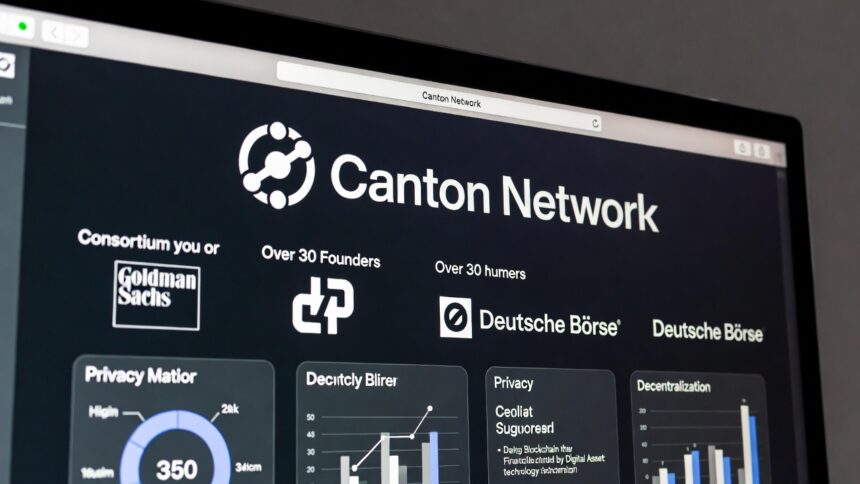
The name of Canton Network is starting to be heard more often in financial markets. And more and more banks and technology companies are looking to partner with this network.
So what is a canton network? The first thing to note is that it is a Layer 1 (L1) network. Designed for the issuance, management and settlement of tokenized financial assetsfor financial institutions.
Its goal is to foster interoperability between traditional markets and digital assets without compromising security or privacy.
Canton Network allows each participant to maintain its own subledger, while a central synchronization layer ensures atomic transactions and regulatory compliance.
This allows for complex operations, Real World Asset (RWA) tokenization, payments, asset settlement, etc.is performed efficiently and reliably while maintaining some degree of data privacy.
The network has a native token, Canton Coin (CC), which is used to pay commissions and incentivize participants who contribute to the security and stability of the platform.
Unlike public networks, the Canton Network operates on a private governance model, with operational, verification, and access rules defined by organizational participants through the Canton Foundation.
As CriptoNoticias explained, in 2023, several companies from the technology and financial sectors came together to help launch the Canton Network. Participants include Microsoft, Goldman Sachs, BNP Paribas and Deutsche Börse Group.
Large companies pay attention to canton network
Although these companies publicly supported and verified their networks, Technology development and protocol creation was carried out by Digital Assetan American company founded in 2014, supplies and maintains power to the Canton network.
Yuval Rooz, co-founder and CEO of Digital Asset, commented: “We chose the name Canton because of the Swiss model. In Switzerland, each canton is sovereign and has its own laws and regulations, but they’re all part of the same federation. That’s a canton. A network where each application has its own sovereignty, but all can natively communicate with each other.”
Interest from large companies quickly grew. Companies such as JP Morgan, Goldman Sachs, BNP Paribas and technology companies such as Microsoft We are starting to consider integrating with our network.
In the case of JPMorgan, it announced that it will bring its dollar-backed deposit token, JPM Coin (JPMD), natively to the Canton Network in early 2026. This allows this asset to be issued, transferred, and redeemed within the network in near real time. As part of a strategy to modernize institutional trading.
Meanwhile, Depository Trust & Clearing Corporation (DTCC) has selected Canton Network as its partner for the tokenization of real-world assets such as bonds and loans. This partnership provides access to certain Treasury securities held in DTC. broadcast on the networkrespects privacy and regulatory compliance.
“For us, Canton is about data privacy, not anonymity. In the world of finance, privacy is a legal requirement, not an option. At Canton, we allow only the counterparty to the transaction to see the data. The network verifies that a transaction is legitimate without ever seeing what’s inside,” explains Rooz.
Difference between Canton Network and other networks
The project’s exposure in recent months has sparked debate about whether Canton Network is a “real network” like Bitcoin or Ethereum.
Unlike these traditional public networks, Canton does not work with mining, or proof of stake. It is a distributed ledger network (DLT) focused on financial institutions, whose nodes are verified by supposedly trustworthy participants selected from a consortium.
Some critics point out that it is not fully decentralized and not available to the public. However, it adheres to the principles of security, record integrity, and asset tokenization.
Confusion often arises in communication. The terms “distributed network” and “DLT” are used interchangeably.. However, as Rouse detailed, the network “uses public-key cryptography, hash-linked data structures, and decentralized consensus.”
“If you adhere to all these principles, then why not think about it that way? Just because it’s not anonymous doesn’t mean it’s not a decentralized network of record,” he added.
Although the network is neither open nor anonymous, Rooz’s discussion makes it clear that the technical standards for security and consensus are the same.
In practice, this means that cantons can offer the same integrity and privacy guarantees as public networks, tailored to the needs of financial institutions, albeit with a different focus on decentralization and accessibility.
NASDAQ joins as super validator
On January 7, Nasdaq joined the Canton Network as a Super Validator (SV) following the approval of Improvement Proposal CIP-0097. This role provides advanced privileges within the protocol. Combine block validation, governance, and economic participation. That is, a system that rewards compliance with technical and strategic milestones verified by the Canton Foundation.
Unlike public networks where validation relies on token staking, on the Canton Network SVs have differentiated weight within consensus. This is called SV weight and defines the influence it has on the network, its ability to participate in governance decisions, and the rewards it can generate.
This weight is activated in stages as follows: Nasdaq achieves agreed upon milestones and associated fees remain in escrow Until verification.
Nasdaq’s entry as an SV will strengthen network reliability and interoperability, especially in the RWA industry.
Additionally, this role allows companies to create their own nodes. Perform specific operational duties to maximize influence on the platform.
“The SV is unaware of the contents of private transactions. The function of the SV is two-fold: it maintains the public CC consensus and it acts as a message repeater. Specifically, the SV allows assets to be moved from one node to another without an intermediary knowing what the assets are or who is sending them,” Rooz concludes.
Ultimately, Canton Network does not aim to replace public networks, but rather to provide an alternative network designed for regulated institutions. Its increasing adoption by major financial institutions suggests that asset tokenization is starting to move from theory to actual infrastructure in the market.
(Tag translation) Altcoin


