


SEC Chairman Paul Atkins told FOX Business in December that he expects U.S. financial markets to go on-chain “within a few years.” This statement, especially coming from the architects of Project Crypto, the commission’s official initiative to enable tokenized market infrastructure, fell somewhere between a prophecy and a policy directive.
But what does “on-chain” mean as it applies to $67.7 trillion in public equities, $30.3 trillion in U.S. Treasuries, and $12.6 trillion in daily repo exposures? And which pieces can realistically move first?
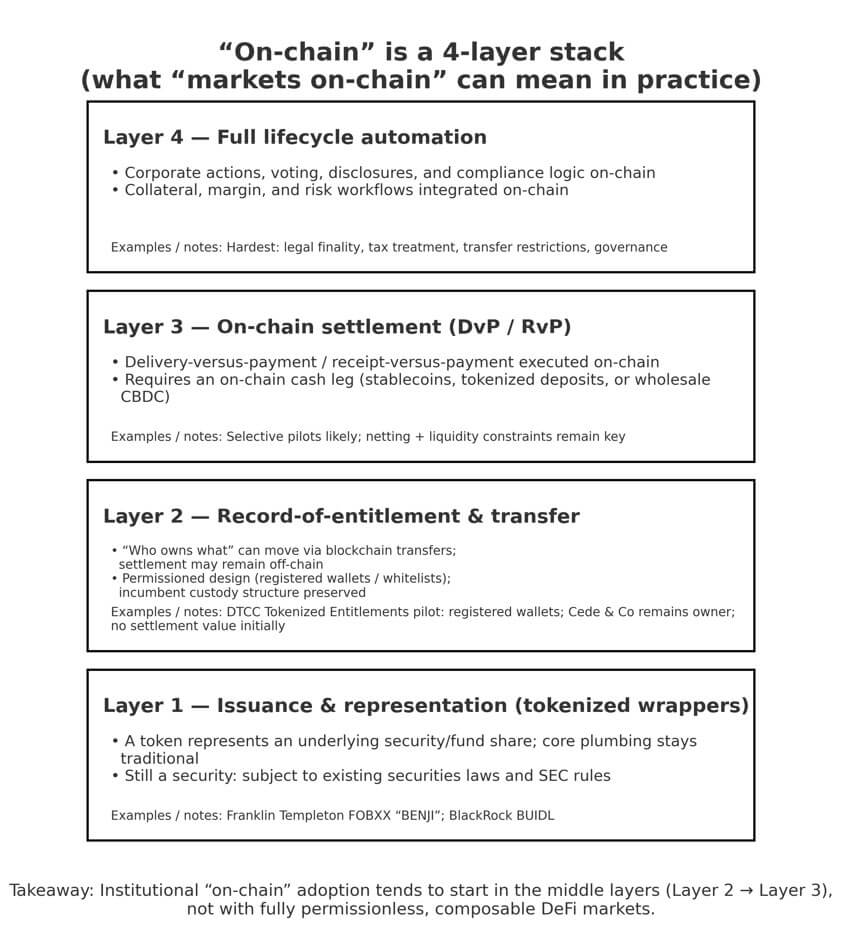
Answers must be accurate. “On-chain” is not a single thing. It’s a four-layer stack, with most of what Atkins described being in the middle tier and not the DeFi-native endpoints that crypto Twitter imagines.
Four flavors on-chain
Definitions are important because the gap between tokenized wrappers and full lifecycle automation will determine what is relevant in 2 years vs. 20 years.
The first layer is publication and expression. The token replaces the underlying security, but the plumbing remains traditional. Consider digitized stock certificates. Atkins explicitly frames tokenization not as a parallel asset class, but as a smart contract representing a security that remains subject to SEC rules.
The second layer is the record of entitlements and transfers. Although the “who owns what” ledger moves via blockchain, payments still occur through existing clearinghouses. DTCC’s Dec. 11 no-action letter from SEC Trading & Markets endorses this very model.
Depository Trust Company can now issue “tokenized rights” to participants via approved blockchains. However, this benefit is only applicable to registered wallets. Cede & Co. remains the legal owner and is not assigned any original security or settlement value.
Translation: Tomorrow, on-chain storage and 24/7 transfer will be possible without replacing the NSCC net.
Layer 3 requires on-chain payments with an on-chain cash leg consisting of delivery-to-payment using stablecoins, tokenized deposits, or wholesale central bank digital currencies. Atkins discussed the theoretical possibilities of DvP and T+0, but also acknowledged that netting is central to clearinghouse design.
Real-time gross settlement changes liquidity needs, margin models, and intraday credit facilities. It’s more difficult than a software upgrade.
Layer 4 is a complete lifecycle on-chain solution covering corporate activities, voting, disclosure, collateral posting, and margin calls, executed via smart contracts. This is the final state with respect to governance, legal finality, tax treatment, and transfer restrictions.
It is also the furthest away from current SEC powers and market structure incentives.
Atkins’ two-year timeline most clearly maps to Layer 2 and Layer 3, rather than a wholesale transition to the composable DeFi market.
Addressable universe sizing
Even if adoption starts small, the benefits will be huge, as only a small portion of a huge market is huge.
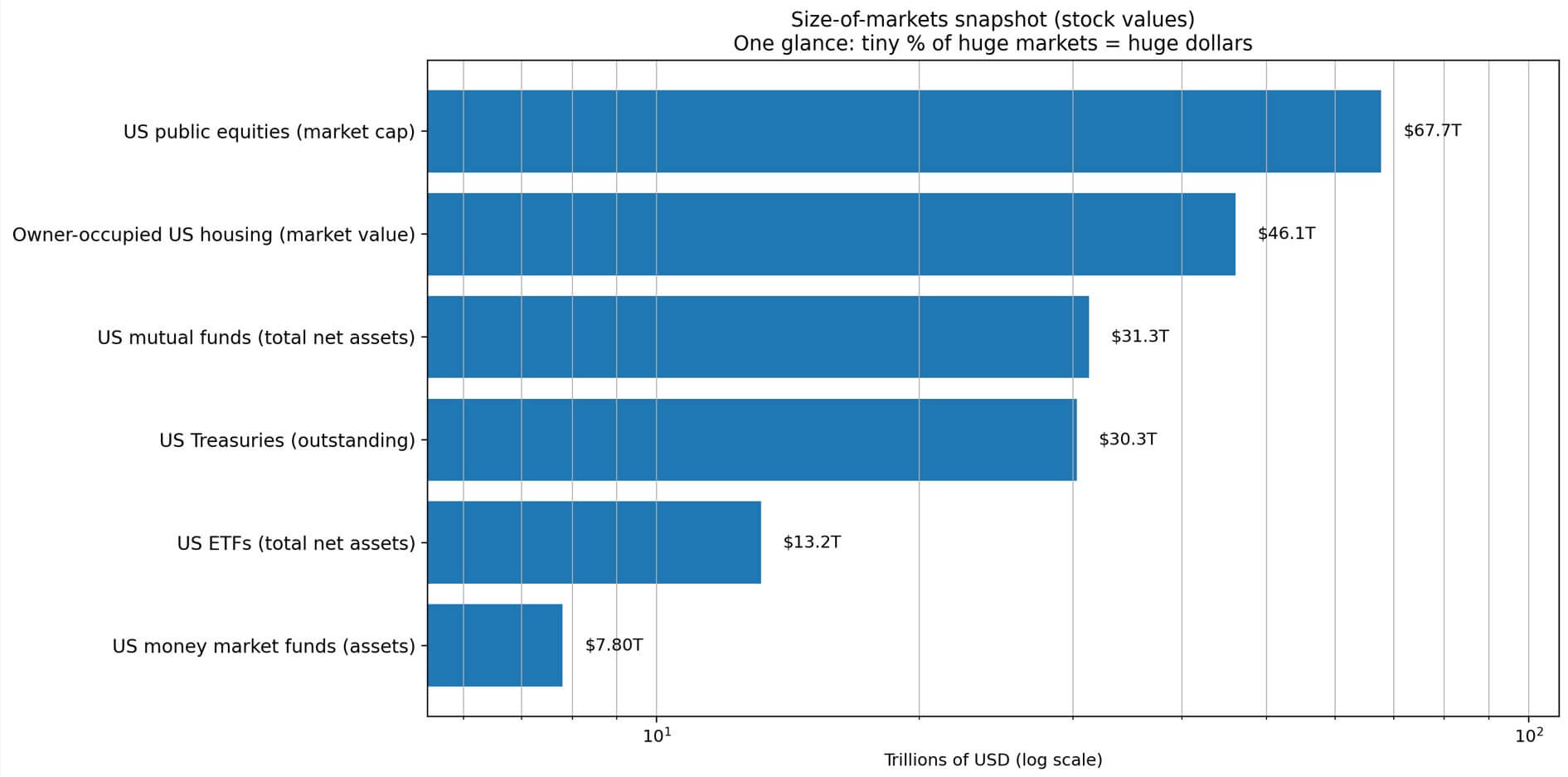
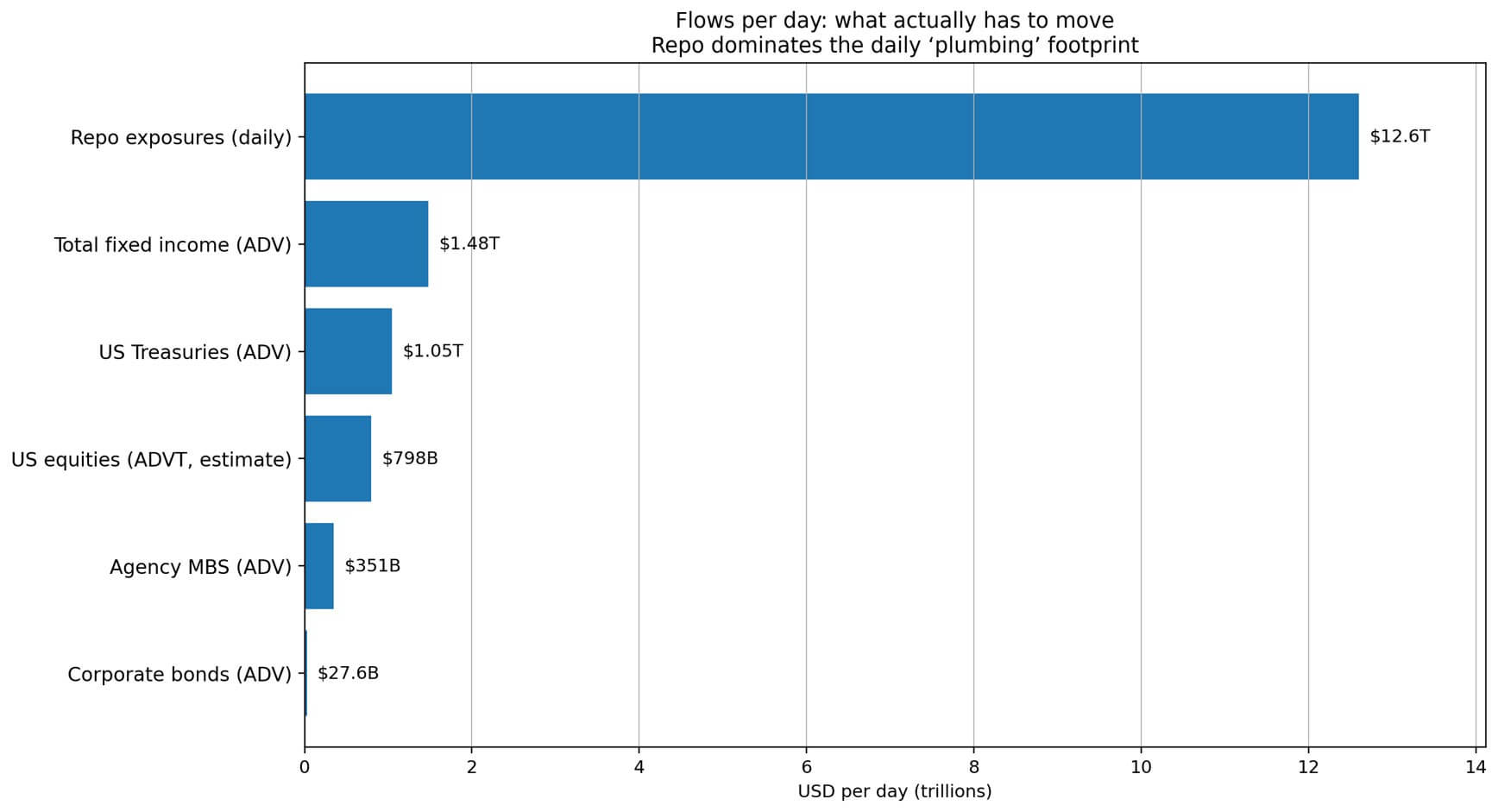
According to SIFMA, the market capitalization of U.S. public equities was $67.7 trillion at the end of 2025. Trading density is estimated to average 17.6 billion shares per day in 2025, with average daily trading value of approximately $798 billion.
1% of stock market capitalization is equivalent to $677 billion in tokenized rights. Assuming blockchain can eliminate the netting that currently collapses billions of transactions into much smaller net debt, 0.5 percent of daily transaction value would represent a total daily settlement throughput of $4 billion.
For the Ministry of Finance, the flow is larger. As of the third quarter of 2025, the market balance is $30.3 trillion, with an average daily trading volume of $1.47 trillion.
But the real monster is the repo. The Financial Research Service estimates that average daily repo exposure will be $12.6 trillion in the third quarter of 2025, including clearing agreements, trilateral agreements, and bilateral agreements.
If the pitch of tokenization is to reduce settlement risk and improve collateral liquidity, repos are where that argument becomes clear. 2% of daily repo exposure is $252 billion and could very well be an early wedge if institutions believe they can manage and be transparent.
Corporate credit and securitized products add another dimension.
The total outstanding amount of corporate bonds outstanding is $11.5 trillion, with an average daily trading volume of $27.6 billion. Agency mortgage-backed securities traded $351.2 billion per day in 2025, and non-agency MBS and asset-backed securities totaled an additional $3.74 billion per day.
The total value of bond trading will reach $1.478 trillion per day by 2025. These markets already operate through custody chains and clearing infrastructure and can be streamlined through tokenization without regulatory formalities.
Fund shares represent different entry points. As of early January 2026, money market funds had $7.8 trillion in assets. Mutual funds are worth $31.3 trillion and ETFs are worth $13.17 trillion.
Tokenized fund shares sit in the product wrapper layer, so there is no need to redesign the clearinghouse. Franklin Templeton’s FOBXX positions itself as an on-chain money fund, and BlackRock’s BUIDL reached nearly $3 billion in assets last year.
RWA.xyz tracks a total of $9.25 billion in tokenized government debt, making it the top on-chain real-world asset category.
Real estate is divided into two categories. The market value of U.S. owner-occupied homes reached $46.9 trillion in the third quarter of 2025. Still, the real world of property law and government moves slower than software, so county deed registers won’t be tokenized at scale within two years.
The financialized portion, consisting of REITs, mortgage securities, and securitized real estate exposures, is already in the securities pipeline and could migrate sooner.
First mover: The ladder of regulatory friction
Not all on-chain adoption will face the same level of resistance. The path to minimizing friction starts with products that behave like cash and ends with registries embedded in local government administrations.
Tokenized cash products and short-term invoices are already occurring.
The $9.25 billion tokenized government bond represents meaningful size compared to other real-world assets on-chain. As distribution expands through broker-dealer and custody channels, there is a real possibility that it will grow 5x to 20x, from $40 billion to $180 billion in two years, especially as stablecoin payments infrastructure matures.
Collateral liquidity follows closely. Repo has $12.6 trillion in daily usage, making it the most reliable target for the delivery-versus-payment pitch in tokenization.
Even if only 0.5% to 2% of repo exposures were moved to on-chain representation, that would equate to between $63 billion and $252 billion in transactions where tokenized collateral reduces settlement risk and operational overhead.
The next step is the authorized transfer of rights to mainstream securities.
The DTCC pilot will authorize tokenized rights in Russell 1000 stocks, U.S. Treasuries, and major index ETFs held via registered wallets on approved blockchains.
If participants treat this as balance sheet and operational upgrades such as 24/7 movement, programmable transfer logic, and increased transparency, 0.1% to 1% of U.S. equity market capitalization could become “on-chain eligible rights” within two years. This equates to between $67.7 billion and $677 billion in tokenized claims even before settlement funds are allocated.
Stock settlement and netting redesign sit at the top of the friction ladder. Moving to T+0 or real-time gross settlement changes liquidity requirements, margin calculations, and intraday credit exposures.
Central counterparty clearing exists because netting reduces the amount of cash that has to be moved.
Eliminating netting means finding new sources of intraday liquidity or accepting that gross settlement only applies to a subset of flows.
There is significant notional value in private credit and private markets, estimated at $1.7 trillion to $2.28 trillion. However, transfer limitations, service complexity, and bespoke trading terms have slowed standardization.
Tokenization helps enable fractional ownership and secondary liquidity, but regulatory clarity regarding exemptions and custody models still lags.
Real-world registries rank last. Tokenizing real estate deeds does not exempt you from local recording laws or title insurance requirements. Even if financial exposure moves on-chain through securitization, the legal infrastructure supporting ownership claims does not.
Less than the hype, greater than zero
Most tokenized securities are on-chain but not publicly available.
DTCC’s pilot model is also permitted on public blockchains with registered wallets, permission-listed participants, and institutional controls. It is still “on-chain” in the sense of transparency and operational efficiency described by Atkins. However, not everyone can provide liquidity.
The addressable wedge in DeFi is maximized when the asset already behaves like cash.
Tokenized banknotes and money market fund shares are already collateralizing cryptocurrency market infrastructure, with BlackRock’s BUIDL being a notable example.
The stablecoin provides a bridge layer with a supply of $308 billion and serves as an on-chain payment asset base that enables delivery-to-payment even without a wholesale CBDC. Dollars went on-chain before stocks went on-chain.
A specific way to size this: using a tokenized cash instrument as a starting molecule, applying haircuts to the transfer restrictions and custody model, and estimating the parts that can interact with smart contracts.
If tokenized US Treasuries and money market fund products reach $100 billion to $200 billion, and 20% to 50% can be posted to permissioned or semi-permissioned smart contracts, that means $20 billion to $100 billion of reasonable on-chain collateral.
This is enough of a problem for repo workflows, margin posting, and institutional DeFi.
what this actually means
Atkins didn’t offer a detailed roadmap, but pieces are visible.
The SEC issued a no-action letter to the DTCC in December 2025 to pilot tokenized rights. Tokenized government bonds and money market funds are expanding. A stable supply of coins provides an on-chain cash layer. The repo market dwarfs stocks with daily flows, and the strongest argument for tokenization risk reduction is the liquidity of collateral.
The two-year timeline does not mean all securities will migrate to Ethereum. It has to do with the critical mass of the middle class. That is, second-tier rights that exist on-chain but are settled through familiar infrastructure, and third-tier experiments where deliveries and payments occur on-chain for specific asset classes and counterparties.
Even a 1% adoption rate across Treasury, money market funds, and equity rights would amount to over $1 trillion in on-chain representation.
It’s not just the US. The UK has opened a digital securities sandbox. Hong Kong has issued a HK$10 billion digital green bond. The EU’s DLT pilot scheme establishes a framework for regulated experimentation in distributed ledger issuance, trading, and payments.
This is a global market and infrastructure modernization cycle, not a speculative phenomenon.
DTCC’s quarterly metrics on tokenized rights, including total amount, daily transfers, registered wallets, and approved chains, will help you keep track.
The same goes for repo transparency data from the Financial Research Bureau, tokenized Treasury and money market fund assets under management, and the supply of stablecoins as a proxy for settlement capacity.
These numbers will show whether “on-chain within a few years” was a policy or an aspiration.


