

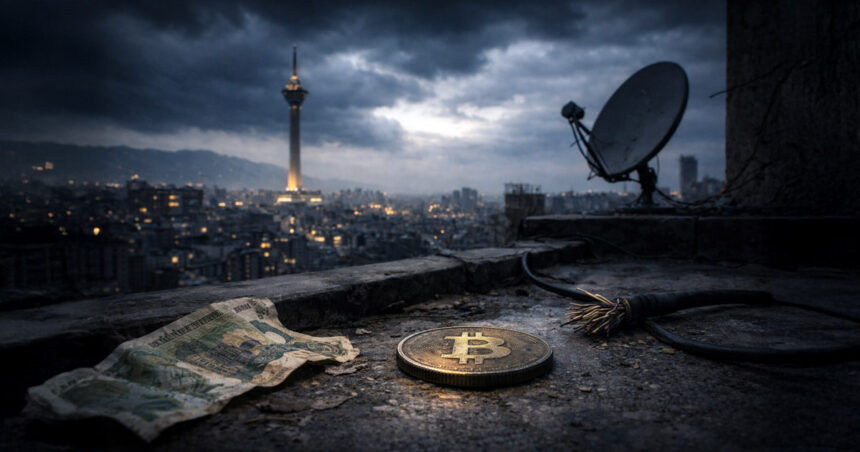
Iran’s currency, the rial, has plummeted to around 1 million per US dollar, and the record highlights how quickly savings can disappear when confidence in money collapses.
The currency lost almost half its value throughout 2025, with the official inflation rate reaching 42.5% in December. Protests have recently erupted in Tehran’s Grand Bazaar, sparked by the plunging value of the rial and fluctuations that have made it impossible for merchants to price and plan their purchases.
Despite the use of satellite services being banned and criminalized in Iran, the state responded with a nationwide communications blackout, and some Iranians turned to Starlink to circumvent the restrictions.
Before the near-total collapse on January 9, the rial had fallen to about 42,000 rials to the dollar. It then soared to just under $1 million per US dollar and has hovered around that level ever since. This translates into a loss of approximately 95% of your purchasing power overnight.
However, the reality is much worse due to domestic volatility and lack of practicality, with rates ranging from approximately 1 million to 1.5 million to the US dollar.

This crisis is economic and political, but it is also an infrastructure crisis. If governments can shut down access to the internet to quell protests, whether Bitcoin can serve as a safe haven depends not only on its design but also on whether people can access the network in the first place.
Even if the reality of 2026 is more chaotic than the white paper imagined, these twin challenges of currency devaluation and access denial are the scenarios that Bitcoin’s architecture is intended to address.

What was Bitcoin actually created to do?
Bitcoin’s white paper, published in 2008, frames the system as a “pure peer-to-peer version of electronic money,” allowing online payments to be sent “directly from one party to another without going through a financial institution.”
While its design goal was a technical one, eliminating the need for transaction validation by a trusted third party, the choice to pursue it was political. The Genesis block, mined in January 2009, has a message embedded in it that reads: “The Times, 3 January 2009, Prime Minister on the brink of second bailout for banks.”

This reference is to the UK government preparing a second bailout for the banking system in the event of a financial crisis, and has been widely interpreted as a commentary on financial fragility and the risks of relying on institutions that socialize losses while privatizing profits.
Bitcoin was not invented specifically for Iran, but for a world where trust in financial intermediaries may be lost and value may need to be transferred without the permission of banks, governments, and payment processors.
Real collapse makes that use case concrete.
What the collapse of reality reveals
Weakness in the real is a symptom of structural dysfunction that makes everyday economic life impossible. The central problem for bazaar sellers is not just depreciation, but price fluctuations.
When currencies fluctuate unpredictably, merchants are unable to decide whether to buy or sell inventory, and households are unable to plan purchases or save in local currency without seeing their purchasing power evaporate.
Sanctions and institutional capture exacerbate dysfunction. The combination of sanctions and the Revolutionary Guards’ control of the economy limits the state’s ability to stabilize the economy and fuels a crisis of legitimacy.
The World Bank expects Iran’s economy to contract in 2026 amid high inflation and currency pressures, a baseline outlook that suggests the current crisis is more than a temporary shock.
This collapse creates demand for alternative currencies such as the US dollar, gold, stablecoins, and Bitcoin, but also triggers state countermeasures. The High Council of the Central Bank of Iran has set an annual cap of $5,000 on stablecoin purchases and $10,000 on holdings, an apparent effort to curb digital dollarization and maintain the role of the rial as the only legal tender.
This cap shows that when people try to escape from economic decline, governments view their escape as a threat and try to close their doors.

Bitcoin as a hedge and Bitcoin as a lifeline
The “Bitcoin is a safe haven” framework confuses two different claims.
The first is Bitcoin as a hedge, a store of value that maintains purchasing power when fiat currencies decline. The second is Bitcoin as a lifeline that comes into play when banks and payment processors are unavailable or compromised.
Bitcoin as a hedge has clear advantages, including limited supply, self-custody, portability, and protocol-level censorship resistance.
However, there are also obvious drawbacks.
Due to price fluctuations, Bitcoin can lose 20% or 30% of its value in a few weeks, making it a poor substitute for stable purchasing power in the short term (but still better than losing 95% in a few hours). Doorways are restricted, especially in jurisdictions with capital controls or aggressive enforcement.
The regime could target exchanges, ban peer-to-peer trading, and impose stiff penalties for violations.
Bitcoin as a lifeline is a different proposition. It allows cross-border money transfers without going through banks, and in theory the network can work with satellite or mesh connections even if the traditional internet is blocked.
However, when governments close fiat entry and exit exits, usage shifts to over-the-counter markets, where prices diverge, liquidity becomes diluted, and user safety becomes less important.

Reuters reported that Iran’s use of Starlink during the power outage exemplifies this: access to the network is as important as the design of the protocol.
In many high-inflation environments, stablecoins are the first dollar replacement because they are less volatile than Bitcoin and easier to use for everyday transactions. But Iran is seeking to place limits on the purchase and holding of stablecoins precisely because they undermine the state’s financial control.
This regulatory response illustrates the tension between what Bitcoin-style systems were built to enable and what governments will tolerate when those systems threaten monetary monopolies.
Three scenarios that will happen next
Iran’s trajectory will test whether censorship-resistant value transfer actually works or whether it can be contained by state power. Three scenarios capture different outcomes.
The crisis deepens and controls tighten. Prolonged insecurity, tougher sanctions, more frequent power outages, and tighter foreign exchange and crypto controls are determining this path.
As trust erodes and the demand for cryptocurrencies increases, the real rate will fall further, but its use will become unofficial over the counter. Starlink-style connections become financial variables.
Be aware of the frequency of blackouts, enforcement actions against exchanges, and new restrictions on access to stablecoins and foreign exchange.
Repression stabilizes the streets, but not the currency. Structural inflation and dysfunctional institutions cannot be addressed by suppressing protests.
Although the rial may temporarily stabilize at a weak level, confidence in the currency remains undermined and households continue to seek stores of value other than the rial. Watch for signs of inflation, import restrictions, and the spread between the official and parallel exchange rates.
Political reset or lifting of sanctions. A change in leadership, negotiated sanctions relief, and trade normalization will restore access to foreign exchange and rebuild some confidence in the currency.
As households regain access to formal banking channels, the real stabilizes or strengthens and demand for cryptocurrencies shifts from necessity to speculation. Watch for signs of sanctions, oil export restrictions, and reopening of banking channels.
| scenario | trigger | What will be the IRR? | What will happen to the use of cryptocurrencies? | Biggest risk to civilians |
|---|---|---|---|---|
| Increasing crisis/strengthening management | long-term anxiety. tougher sanctions. Internet outages occur more frequently. Tightening restrictions on FX/cryptocurrency. aggressive execution | Parallel IRR is even lower;The gap between official and parallel is widening. Volatility remains high | Demand increases but changes More OTC/Unofficial;Higher spread/premium. Increased reliance on alternative connections | Access + Safety: Loss of connectivity/rails, increased legal risk, risk of fraud/robbery in over-the-counter markets |
| No suppression/macro modification | The crackdown has stabilized the streets, but inflation continues. Continued sanctions pressure. Stricter import/price control | Temporary stabilization at a weak levelinterrupted by a spike. Purchasing power continues to decline | more “store of value” behavior (USD/Gold/Stablecoin/BTC) However, there are limitations on the on/off ramp. slow and careful introduction | Grind slowly: Lower real wages/savings, scarcity, and selective enforcement that punishes ordinary users. |
| Unzip/Reset | Negotiated sanctions relief. Normalization of trade. Leadership/Policy Transformation. Improving FX access and banking channels | IRR is stabilized or strengthened;Volatility decreases. parallel premium compression | From necessity to usage → Speculation/Portfolio;increased activity on formal rails; Over-the-counter insurance premiums fall | Caning + unequal access: Sudden rule changes, winners and losers from reopening, potential backlash against recent ‘exit’ strategies |
What Bitcoin was created to fix, and what it can’t fix
Iran’s real crisis is not an outlier. This is part of a global pattern in which financial instability prompts safe haven behavior. Gold reaches record levels amid geopolitical and institutional uncertainty, and Bitcoin rises during a period of uncertainty in 2025.
This convergence shows that people are fleeing to similar assets in different crises, and strengthens the theory that as trust in institutions declines, the demand for censorship-resistant value transfers increases. But the reality of dual use complicates the story.

As civilians use cryptocurrencies defensively, states and sanctioned entities also experiment with cryptocurrency rails to circumvent regulation and move value outside the traditional financial system.
This dynamic is why regulators remain aggressive even when humanitarian use cases are legitimate, as the same tools that help individuals evade currency controls can also help regimes evade sanctions.
The collapse of 1 million rials to the dollar is a reminder that money can stop working, not in the theoretical sense, but in the practical sense, where savings evaporate, merchants can no longer set prices for goods, and states use inflation and capital controls to maintain power at the expense of purchasing power.
Bitcoin’s architecture was designed for exactly that scenario: a system where the transfer of value does not require permission from financial institutions or governments, and where supply is fixed rather than subject to political discretion.
But the reality in 2026 is that states are fighting back. Iran’s stablecoin caps, internet blackouts, and enforcement efforts show that the government treats alternative currencies as a threat and is trying to shut down exits if people try to escape a weak currency.
The question is not whether Bitcoin’s design is censorship-resistant as it is, but whether its resistance remains when governments can block internet access, target exchanges, criminalize use, and impose stiff penalties for violations.
The answer depends on your infrastructure. If people can access the network through alternative connections such as VPNs or satellite internet, and peer-to-peer markets can function despite state opposition, then Bitcoin will work as intended.
If the access rails are shut down and enforcement makes them unsafe to use, the design of the protocols doesn’t matter because people won’t have access.
That is the challenge posed by the Iran crisis. The question is whether a system built to repair a broken currency can withstand the backlash from states that rely on financial regulation to maintain power.
(Tag Translation) Bitcoin


