

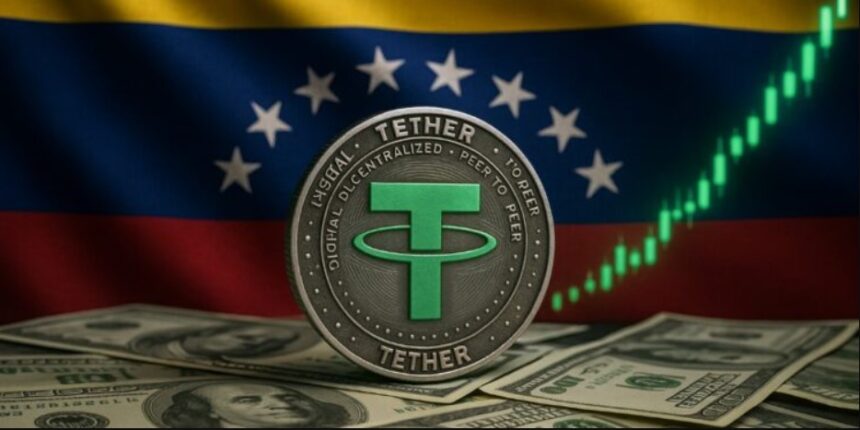
The Venezuelan cryptocurrency market is undergoing a period of serious restructuring. Following the recent trade agreement between Petroleos de Venezuela (PDVSA) and the US government, which includes trading up to 50 million barrels of crude oil, various analysts are beginning to question the permanence of digital currencies in the local economy.
While some economists have suggested that financial normalization could replace these measures, Javier Bastardo, communications manager at Bitfinex, offers a different vision. In his opinion, Venezuela is heading towards “hybrid dollarization”. A world where fiat currencies and cryptocurrencies coexist.
For Bastard, Venezuela’s stablecoin infrastructure has been built by its people in recent years and will be difficult to dismantle. Even in a scenario of complete economic opening.
In a statement provided to CriptoNoticias, Bastardo said that although the arrival of cash dollars and access to international bank accounts is a positive step, There is no denying the operational benefits of digital currencies.
“For me, the complete disappearance of the adoption of Bitcoin, digital assets and stable currencies in Venezuela is very complicated,” the expert said. In his opinion, even if banking systems are revamped, the operational costs imposed by traditional financial institutions are not necessarily affordable for average users in developing countries.
Venezuela’s “hybrid dollarization”
The concept of “hybrid dollarization” proposed by Bastardo suggests that the adoption process is not limited to the currency used. Rather, it is a technical means of mobilizing value. In this sense, the use of USDT has allowed Venezuelans to connect with a global economy that does not rely solely on traditional banking rails.
According to experts, the use of this digital asset is more efficient, reduces settlement times, It’s cheaper than traditional international money transfers.
“USDT is well established in the world, and Venezuela could be an interesting first experiment in hybrid dollarization,” Bastardo said. Under this scheme, the discussion is not focused on choosing between physical dollars and digital currencies, but on understanding how both can coexist.
Bastardo envisions an infrastructure where local banks can offer US dollar and USDT options simultaneously. This simplifies operation Reduce costs by using these assets for international markets.
In this multi-currency environment panorama, Bitcoin retains its fundamental role as a reserve asset. Bastard argues that major digital currencies remain key resources for those looking to protect long-term wealth in a censorship-resistant manner.
He commented, “Bitcoin is a good reserve asset for long-term savings and a censorship-resistant asset because understanding and using USDT makes using Bitcoin more accessible.” For analysts, USDT serves as an educational gateway to Bitcoin technology.
bolivar won’t go away
Despite the dollar’s potential for dominance, Bastardo believes: Bolivar will not disappear completely. This is because of its institutional roots and because it helps with everyday expenses. This includes paying for public services, taxes and urban transport.
In this way, the Venezuelan economy will present multiple payment and savings channels. The bolivar for everyday life, the dollar and stable cryptocurrencies for commerce and global connections, and Bitcoin for sovereign savings.
Bastardo suggests that if traditional Venezuelan banks were able to integrate digital assets, users would prefer to use regular bank accounts rather than applications that “could be complicated” for non-specialists.
“Exchanges are here to stay for their original purpose of trading and investing, not as a banking tool,” he explained, adding that ordinary users would likely choose the traditional banking side if they offered the same ease of access.
Finally, Mr. Bastard emphasizes that hybrid dollarization will allow traditional dollarization to be formalized. A process based on the needs of the people.
While a hybrid dollarization process would make dollarization more formal and leverage mass users of dollars in cash and banking alternatives along with USDT, it would not necessarily mean the end of the bolivar, much less the departure of Bitcoin as a means of savings.
Javier Bastardo
In this scenario, Venezuela will continue to be a financial space Where technology meets traditional money To provide solutions to a population that has learned how to navigate economic uncertainty.
(Tag Translation)Bitcoin (BTC)


