

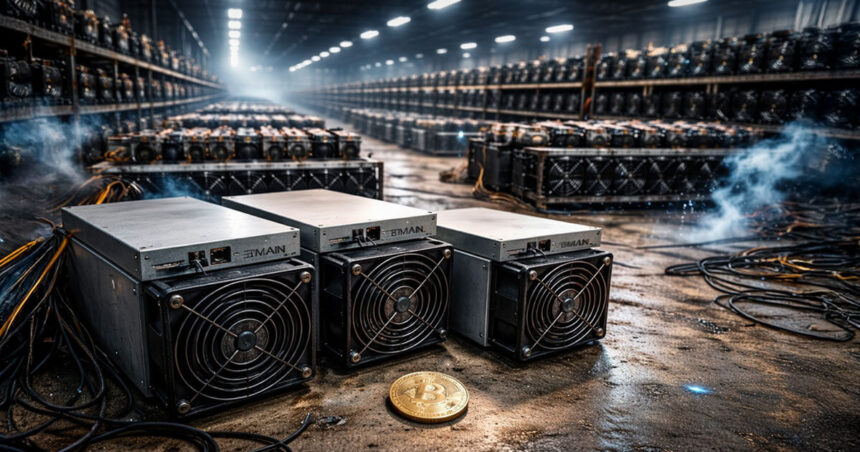
Bitmain lowered the price of its Bitcoin mining rigs on December 23rd after miner income per unit of hashrate decreased in November.
This discount also applies to the current generation of hydro and immersion products, creating a cycle in which Bitcoin price strength is not reflected in the expansion of mining margins that previously caused hardware scarcity and rapid price increases.
Market capitalization $1.75 trillion
24 hour volume $32.79 billion
Best ever $126,173.18
According to TheMinerMag, container bundles of the S19 XP+ Hydro (approximately 19 J/TH) are priced close to $4/TH and shipping is expected to begin in January 2026.
The report cites internal price lists quoting prices as low as $3 per TH for some S19 hydro models and as high as $7 to $8 per TH for new S21 immersion or hydro models before coupons.
Bitmain combines some of these offers with hosting packages that reportedly charge electricity costs of approximately 5.5 to 7.0 cents/kWh, plus an administration fee of approximately 0.3 cents in several regions.
| metric | Recent data points |
|---|---|
| Bitmain Promotional Price (Bundle Based) | ~$4 per TH for S19 XP+ Hydro Container Bundle (December 23 promotion), shipping starting January 2026 |
| Internal list citation range | Before coupons, as low as $3/TH (some S19 Hydro), ~$7 to $8/TH (some S21 Hydro/Immersion) |
| Hosting price range for bundle offers | ~5.5–7.0¢/kWh + ~0.3¢ Management fee |
| Hash Price (Average for November 2025) | $39.82/PH/day |
| Hash Price (November 22, 2025) | $35.06/PH/day (new low) |
| Network difficulty level (monthly average for November 2025) | ~153.33T (+2.7% compared to previous month) |
Compressed hash prices are rewriting miner economics and ASIC demand
Price action reflects fundamental constraints. In other words, if the hash price remains compressed, the miner’s demand will be eliminated in the payback calculation.
According to Luxor’s November 2025 lookback, the USD hash price averaged $39.82/PH/day, with a print price of $35.06 on November 22nd.

In the same monthly review, Luxor said that relief for operators was limited because transaction fees made up a small portion of rewards during the period and the network difficulty averaged around 153.33T.
This combination changes buyer behavior in a way that slows down the “BTC rise and ASIC rise.”
Hashprice is effectively the revenue per unit of hashrate, and Luxor frames it as daily revenue per PH before deducting costs.
1 PH equals 1,000 TH, so at $40 per PH/day, your total revenue is approximately $0.040/TH/day.
A 200 TH/s rig would earn about $8 per day at that level.
If the machine runs at about 19 J/TH, the power consumption is about 3.8 kW (19 J/TH × 200 TH/s), or about 91.2 kWh per day.
At the midpoint of the hosting price range quoted by TheMinerMag, $0.06/kWh, your energy costs will be around $5.47 per day.
This leaves approximately $2.53 per day before facility fees, repairs, downtime, pool fees, and reductions.
At a hardware cost of $4/TH, a 200 TH machine would cost about $800, and the simple payback on this margin would be close to 316 days.
If a buyer undertakes close to a year of payback before day-to-day operational frictions arise, the rig’s liquidation price will be tied to the IRR threshold rather than the scarcity narrative.
This framework also helps explain why discounts are applied to new products without immediately causing price increases.
Changes on the supply side are also underway.
In previous cycles, long lead times and disconnected distribution amplified stockouts, allowing original equipment manufacturers and resellers to quickly reprice inventory during spikes in demand.
This cycle is similar to more industrial markets, where manufacturers manage sales in competition with secondary markets and multiple product tiers.
TheMinerMag characterized Bitmain’s wide range of cuts as a response to the economic downturn and increased competition, rather than a single promotional slot.
The gap with the previous mania is still evident in historical comparisons of $/TH pricing.
According to Digital Mining Solutions, hardware in the 25-38 J/TH range was trading around $105/TH in November 2021, but in March 2024 it was trading around $12/TH, even though Bitcoin hit an all-time high during that period.
While this comparison is not perfectly consistent across generations and form factors, it captures the directional change in “hashrate purchasing power” faced by miners due to the difficulty of rerating faster than network hashrate and fee income.
Bitmain’s packaging of hosting with machines shows where the scarcity has moved.
Bundling changes the sales pitch from a single capital investment decision to an end-to-end operational proposition that includes power procurement, deployment, and operation.
In markets where it is difficult to secure efficient megawatts at predictable prices, access to electricity can be binding.
That’s why hosting partnerships and containerized deployments are a way to convert price-sensitive buyers.
Capital allocation outside of pure Bitcoin mining is another factor shaping the marginal demand for ASIC expansion.
Public market discourse increasingly rewards miners for positioning their data centers towards AI and high-performance computing, rather than maximizing hashrate at all costs.
Several miners are pursuing or evaluating AI-related data center strategies to diversify their revenue.
Investor attention to large-scale AI data center deals has also boosted some miner stocks, increasing incentives to direct incremental capex to infrastructure that can provide multiple revenue streams.

Futures pricing increases caution about the near-term mining economy
Luxor’s November review noted that USD-denominated forward hash prices from December 2025 to April 2026 fell by approximately 16-18% from November 3 to December 1, while BTC-denominated forwards rose.
This discrepancy is important for businesses that pay expenses in dollars.

Even if BTC conditions improve, the daily budget constraint is USD cash flow and the forward curve reflects continued pressure.
Whether ASIC pricing regains its previous cycle’s beta will depend more on fee burdens and sustained changes in nethash prices after difficulties are addressed than on Bitcoin tape.
In the absence of a permanent fee structure that increases the revenue per TH for months rather than days, buyers have reason to treat the revenue per TH as a means of collection.
This enables OEMs to reduce cost of entry, reduce delivery risk, and bundle operational support.
The January 2026 shipping period for Bitmain’s discounted bundles will test how much market expansion it will tackle at prices below $10 TH/TH under the $35-50/PH daily hash price range.
(Tag translation) Bitcoin


