


Towards the end of 2025, Binance solidified its position as a peak stablecoin liquidity hub. This centralized exchange holds over 71% of stablecoin deposits, leaving other markets behind.
Binance remains the largest holder of stablecoins among all other centralized exchanges. The market currently holds over 71% of stablecoin liquidity, creating the largest concentrated pool of cryptocurrencies.
Exchanges’ stablecoin reserves remain near all-time highs at the end of 2025, reaching approximately $69 billion. Binance still holds over $49 billion of the $314 billion total supply of various stablecoins. The most inflows are Ethereum and Tron-based coins.
Binance’s reserves are about 5 times higher compared to OKX’s liquidity. Overall, the top three exchanges hold 94% of stablecoin liquidity. This reserve may represent raw purchasing power in the spot market, but it is also partially used for passive income as Binance opens a yield program for certain stablecoins.
The major USDT and USDC tokens had Binance as the most active market. Over 2025, Binance reduced the supply of FDUSD from approximately 2.5 billion tokens to 500 million tokens. Balances at the end of the year remain near historic peaks, but could hint at changes next year.
Stablecoins leaked from exchanges in December
The exchange’s stablecoin reserves reached an annual peak at the end of November, with Binance holding over $51 billion in stablecoin reserves. A total of $8 billion of stablecoins left exchanges in the last phase of 2025.
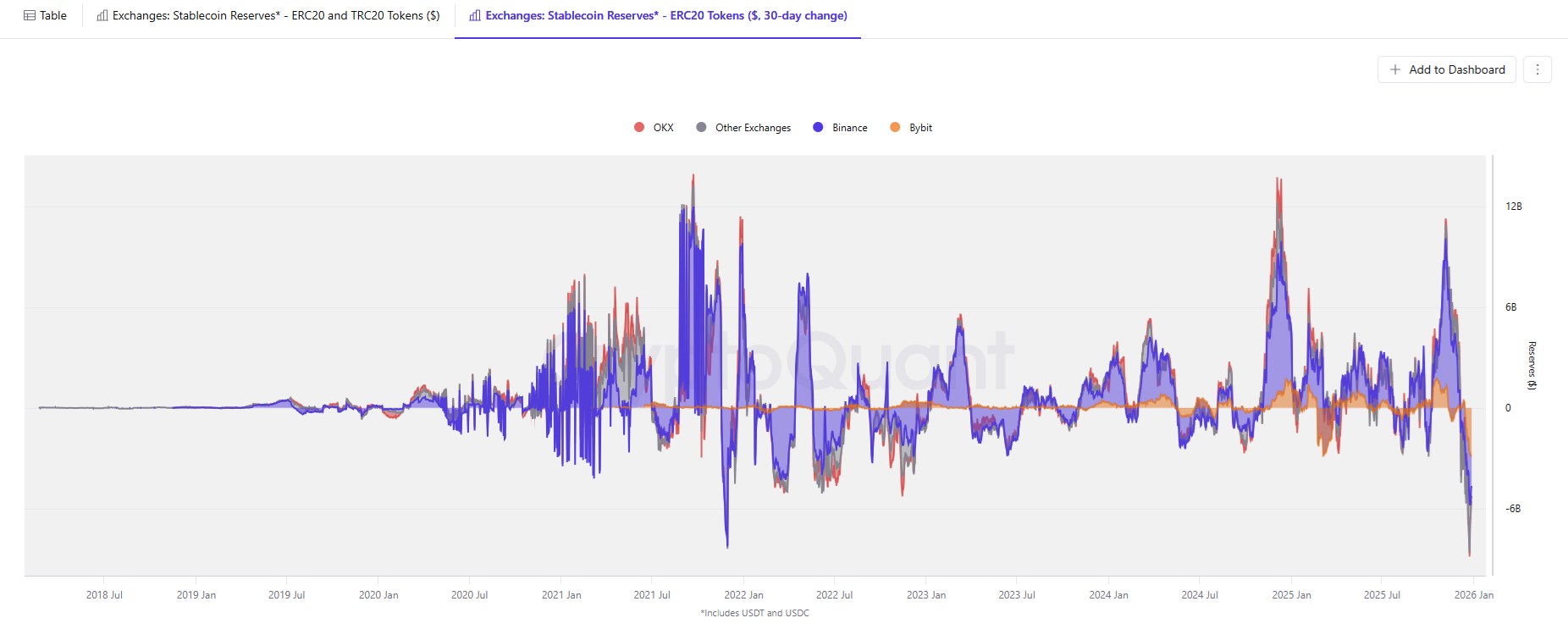
Despite the stablecoin outflow at the end of 2025, Binance still held near-historic stablecoin reserves. Source: Cryptocurrency
Bybit experienced the largest outflow, with $2 billion leaving the exchange, while Binance saw $2 billion.
Nevertheless, there are enough deposits in the market that can be deployed if sentiment changes. Binance may be an indicator of buying pressure.
Stablecoin accumulation still has no impact on the market, with the market trading with low holiday volume and low sentiment indicators. Trading activity also slowed down, with whales slowly accumulating BTC in the spot market. However, the available purchasing power is still not able to reignite the hype or propel BTC towards all-time highs.
Liquidity flows into derivatives markets
The overall trend in 2025 is that stablecoins will move from the spot market to the derivatives market. After deleveraging on October 10, the spot market briefly revived.
Despite this, stablecoins are primarily active in derivative trading pairs, with large amounts of capital flowing out of the spot market. Derivatives exchanges held $64 billion in stablecoins as of December 29, with a peak of over $68 billion on November 14.
Based on Cryptoquant, spot reserves had the most significant outflow, decreasing from $5.7 billion to $1.3 billion across all exchanges. data. Some of the retail market is also lost due to spot purchases, but whales are accumulating on accurate deposits.
Some traders are buying on the spurts, but liquidity in the derivatives market is waiting for momentum to create new positions. Traders remain cautious as both long and short positions accumulated are attacked and liquidated.
Additionally, stablecoin minting is no longer directly correlated to BTC price recovery as it was during previous bull markets. A record number of stablecoins will be useful for other purposes in 2025, but expanding supply does not guarantee purchases. attacked and purged.
Additionally, stablecoin minting is no longer directly correlated to BTC price recovery as it was during previous bull markets. A record number of stablecoins will be useful for other purposes in 2025, but expanding supply does not guarantee purchases. Purchased Lanty.


