

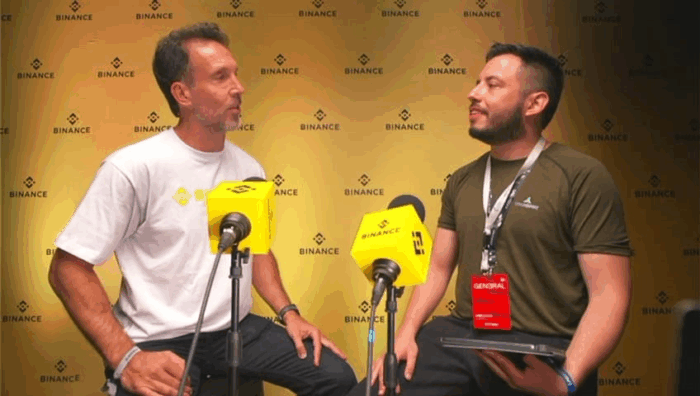
During the LABITCONF 2025 celebrations in Buenos Aires, CriptoNoticias had the opportunity to speak with Andres Ondara, General Manager of the Binance Exchange in Argentina and the Southern Cone. As the adoption of Bitcoin (BTC) and cryptocurrencies continues to grow in the region, the executive offered his views on the maturation of the ecosystem and fundamentally the intersection of decentralized technology and national regulatory frameworks.
Ondara had a nearly 20-year career in traditional banking before switching to the digital asset sector. A historical debate is unfolding regarding the complete separation of the state and the digital currency ecosystem.
When asked about how Bitcoiner’s original ethos (often associated with financial independence from the state) would combine with increased regulation, the executive bluntly pointed out that large-scale growth requires cooperation.
“I think this is part of the industry’s development process,” Ondara explained, adding:
“If the[cryptocurrency]industry wants to expand and continue to grow in terms of reaching new audiences and new users, it needs a mature and dynamic interaction with stakeholders in the financial ecosystem, both the traditional financial world and regulators and governments.”
Andres Ondara, Binance Manager for Argentina and the Southern Cone.
Under this perspectiveIn Ondara’s opinion, the dichotomy between free and regulated markets seems to be losing validity in the face of the realities of institutional adoption.. “I think the debate about regulation vs. non-regulation is starting to become a bit outdated,” the executive said. According to their analysis, this interaction has enabled “breakthrough development” through integration with more supervised sectors.
Ondara emphasizes regulation as a tool of trust
Beyond the philosophical discussion, Ondara emphasizes that: Practical usefulness of regulations for ordinary users. In identifying barriers to mass adoption, managers pointed to a combination of lack of education and perceived need for increased security.
“The maturation of the industry requires transaction processes to become more secure and reliable,” he said. In this sense, “regulation helps people understand what they are doing, feel safe, and feel protected by the regulatory framework.”
The executive said this year was important because of the entry of institutional investors that legitimized the sector. “Many sectors of the traditional financial world started getting into cryptocurrencies because there was a clearer global regulatory framework.”
Binance seeks to provide infrastructure for “living in cryptocurrencies”
Regarding Binance’s role in this scenario, Ondara emphasized: The exchange’s current mission is to develop an infrastructure that facilitates the everyday use of digital assets.it’s more than just speculation or investment. The goal is to make it practical for users to use in their daily lives.
“Platforms like Binance will allow us to enrich the entire everyday financial experience,” he asserted, elaborating that users will be able to “save,” “invest,” have “passive income products,” and have “exposure to the dollar through a stable currency.”
The executive highlighted recent products launched in Argentina, such as QR code payments and depositing funds from bank accounts, as examples of this integration. In addition to this, Pix (Brazilian payment system) was recently introduced for Argentines traveling to neighboring countries.
“What we really want to do is help people understand that they are finding in crypto a financial alternative that is probably as good or better than what they were using before,” he added.
The future of exponential growth
Looking to the future, Ondara outlined: Parallelism between the current state of virtual currency and other technological revolutions in the past. “In the medium to long term, probably within the next five years, this industry will be much larger than it is today,” he predicted, comparing the phenomenon to the advent of the Internet and smartphones.
With the company’s goal of reaching 1 billion users worldwide, Binance managers envision a world in which “the future will be much more ‘crypto’ than today,” driven by a diverse portfolio and everyday use cases that are yet to be discovered.
Finally, Ondara urged readers to maintain their “intellectual curiosity” in the face of future events. It is defined as “the moment of disruption in global finance due to this technological paradigm shift.”
(Tag translation) Argentina


