

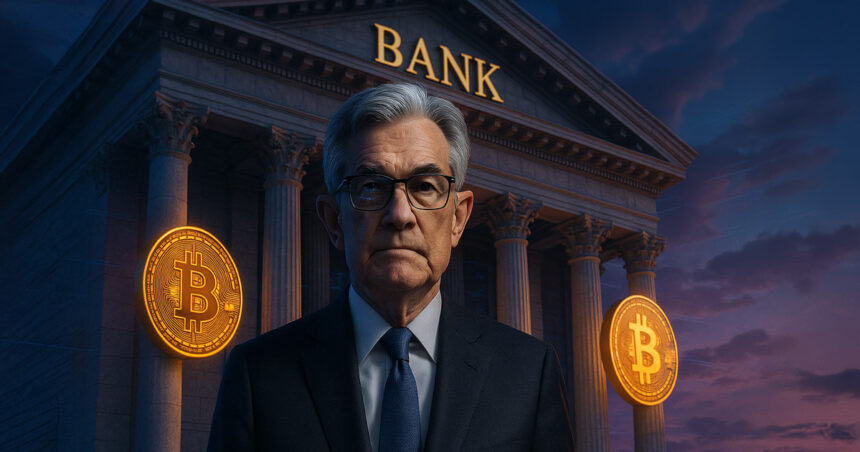
Jerome Powell stood in front of the camera on December 1st at the Hoover Institution’s George Shultz memorial event as three people watched. Bond traders are pricing in an 87% chance of a December interest rate cut, the Federal Open Market Committee is split on possible opposition, and the Bitcoin market just saw $4.3 billion in outflows from U.S. spot ETFs in November alone.
The event was billed as an academic panel on Schultz’s economic legacy. Markets treated this as the final macroeconomic checkpoint before next week’s Fed meeting, and the only potential hint that the easing cycle will continue or stall.
Bitcoin closed at $90,360 in November, down nearly 20% from its October peak of more than $126,000, with on-chain data showing trading below key cost benchmarks and options markets skewed towards downside protection.
ETF flows turned slightly positive on the last trading day of the month, with net inflows exceeding $220 million.
However, this reversal does not offset the structural damage suffered during the month when BlackRock’s IBIT alone suffered $1.6 billion in losses from late October to mid-November.
The macro settings contained in Chairman Powell’s remarks are weak. Liquidity is thin, positioning is compressed, and markets are sensitive to a reassessment of Fed policy.
What the market needs to hear
Three questions dominate the discussion at the FOMC meeting. First, will Powell examine or cool down his bet on a December rate cut? The Fed has already cut rates twice in September and October, and futures markets are almost certain to cut rates by another 25 basis points this month.
But Chairman Powell himself said in October that December’s decision was “far from a guarantee,” and recent reports suggest there could be multiple negative votes if the FOMC eases again, highlighting an unusually divided FOMC.
Markets want clarity: Is he laying the groundwork for a rate cut or setting a pause?
Second, how does he frame the trade-off between inflation and growth? Inflation remains above the Fed’s 2% target, ISM manufacturing has been contracting for months, the government shutdown has delayed the release of key data such as the PCE report, and policymakers are operating on incomplete information.
Mr. Powell could tilt toward a sweet spot where “inflation is on track and growth is slow but manageable,” justifying easy policy without triggering recession fears. Or they can emphasize persistent inflation and downplay the urgency.
The first supports risky assets and the second reprices the curve.
Third, what does he suggest about the path beyond December? The Fed halted balance sheet outflows on December 1st, effectively ending quantitative tightening.
This decision already signals a shift towards mitigation. Investors want to know whether Mr. Powell envisions another rate cut in 2026 or whether he sees December as the last move in the cycle.
Bank of America today revised its home call, predicting two more rate cuts in mid-2026 following December’s rate cut, citing weak labor data and dovish Fed rhetoric.
If Mr. Powell strengthens that view, the argument for easing will expand. If he rallies, expectations will be compressed and real yields will rise.
How Fed signals move Bitcoin
All items on the Fed’s watchlist are currently in contact with Bitcoin through different channels. The most direct is the rate path itself.
Bitcoin trades as a high-beta macro risk amid lower policy rates and lower real yields, accelerating ETF inflows, stablecoin issuance, and risk-on allocations.
A study on the response of cryptocurrencies to monetary policy shocks found that unexpected tightening, measured as a 1 basis point unexpected increase in the two-year Treasury yield on the day of the FOMC, was correlated with a statistically significant decline in the price of Bitcoin.
The reverse is also true, with short-term interest rate expectations and surprise easing that depresses real yields tend to push BTC higher.
NYDIG’s October analysis argued that real interest rates are the most important macro factor for Bitcoin.
Declines in real yields coincide with increases in prices, and increases in real yields are accompanied by sustained pressure.
The pattern since October supports that framework. After the Oct. 29 FOMC meeting in which Chairman Powell refused to pre-commit to further rate cuts, iShares’ IBIT saw outflows of $1.6 billion in three weeks, including $447 million in one-day redemptions, as Bitcoin fell more than 20% from its all-time high and investors moved to gold.
This episode clearly maps out hawkish tips, higher yields, ETF redemptions, BTC drawdowns, and more.
Determining the balance sheet is important for the second reason. Suspending quantitative tightening will ensure that dollar liquidity remains stable rather than depleted.
If Chairman Powell emphasizes that the runoff election is over and that the Fed has no problem maintaining or growing its balance sheet, it would confirm the “more liquid regime” narrative that has underpinned the Bitcoin institutionalization narrative.
Any indication that he will reinstate QT in the future would be a headwind for risk assets generally.
Divisions within the Fed, political noise, reports of unusually high potential dissent, speculation about Powell’s successor in 2026, and rumors of White House pressure are indirectly impacting Bitcoin by increasing policy uncertainty.
A visibly fragmented FOMC makes the path of interest rates less predictable, compresses risk appetite, and manifests itself in volatile price movements, dilution of liquidity, and increased sensitivity to news headlines.
If Chairman Powell sounds confident and united around a gradual easing path, that volatility will subside.
If he emphasizes independence and “data dependence” in a way that could be seen as defensive, it portends further turmoil.
Trader’s Map: Three Paths
Mr. Powell’s tone sets out three conditionals, each with a different chain of implications, from what the Fed says to real yields to ETF flows to Bitcoin’s likely next move.
The dovish surprise consisted of Powell clearly leaning into his case for a rate cut in December and sounding relaxed about the pace of inflation, opening the door to further easing in 2026.
Two-year Treasury yields and real yields are falling as markets price in higher odds for both a December rate cut and subsequent rate cuts.
The other path is based on reversing ETF flows. Dovish signals could halt redemptions and result in net inflows as macro funds return to liquidity trading after $4.3 billion in outflows in November.
In that scenario, Bitcoin’s path leans toward a rescue rally, returning to the high $80,000s to low $90,000s and potentially even higher if flows persist.
In line with pricing, a third path would open up if Powell acknowledged that a December rate cut is “on the table” but emphasized reliance on data and rejected forward guidance.
FedWatch odds don’t move much. Real yields fell significantly, but ended almost unchanged. ETF flows have been mixed, with occasional small inflow days like November’s closing price of $70 million, but no clear trend.

Bitcoin’s next move in this case has more to do with internal crypto positioning than Powell himself. With funding and open interest already compressed and on-chain indicators showing “below band” overshoot, we expect a choppy mean-reversion regime around current levels rather than a clean directional trade.
However, a hawkish tone emerges as Powell downplays the need for a December rate cut, focuses on upside risks to inflation and warns that markets are “too confident” about rapid easing. With FedWatch at 87%, even a slight rebound could cause the two-year bond yield to rise alarmingly.
This is the kind of tightening shock that research links to near-term Bitcoin weakness. The October template applies: a less dovish Fed meeting than expected, record IBIT outflows, and a 20%+ drop in BTC.
This repeat likely means another leg down from the mid-$80,000s, or at least a retest of recent lows, potentially deepening the flush if ETF redemptions accelerate and liquidity thins. This does not disrupt the long-term structure, but it does create a “sell first, revalue later” reaction.
what is the problem
The Shultz Commission is an academic falsification. What will matter for Bitcoin and the broader risk complex is whether Powell will justify the already-priced-in December interest rate cut, signal that the easing cycle will extend into 2026, and reinforce the idea that the Fed is done running out of liquidity.
These are the levers that feed directly into ETF flows, stablecoin rails, and Bitcoin tapes.
If Mr. Powell is to deliver the dovish support the market is looking for, the path of least resistance is for real yields to fall and recover from deeply oversold levels. If he punts or pushes back, it reprices the curve and keeps the ETF in redemption mode, extending the drawdown until the market finds a new macro floor.
In any case, Chairman Powell’s Dec. 2 remarks are the last major Fed signal before next week’s meeting and provide the clearest read yet on whether Bitcoin’s November pain is a capitulation or just the beginning of a deeper reset.

PR
BC.GAME named exclusive gaming partner for Crypto Fight Night 2025
Belize City, Belize, December 2, 2025 Chainwire Crypto Fight Night (CFN) confirms its partnership with BC.GAME, with BC.GAME serving as the exclusive gaming partner for the event.
14 hours ago

PR
Mono Protocol Releases Update on Stage 19 Presale Participation
New York, USA, December 1, 2025, Chainwire Mono Protocol issued a new participation update for stage 19 of the ongoing presale round, reporting stable results.
1 day ago
(Tag translation) Bitcoin


