


The majority of tokens launched on centralized exchanges (CEX) in 2025 were unable to sustain their listed price levels in a year that is likely to end in a bear market.
According to a study by market aggregator Cryptorank, 83% of newly listed tokens are currently trading below their initial price, and no coins on top centralized exchanges had a positive return on investment of more than 20%.
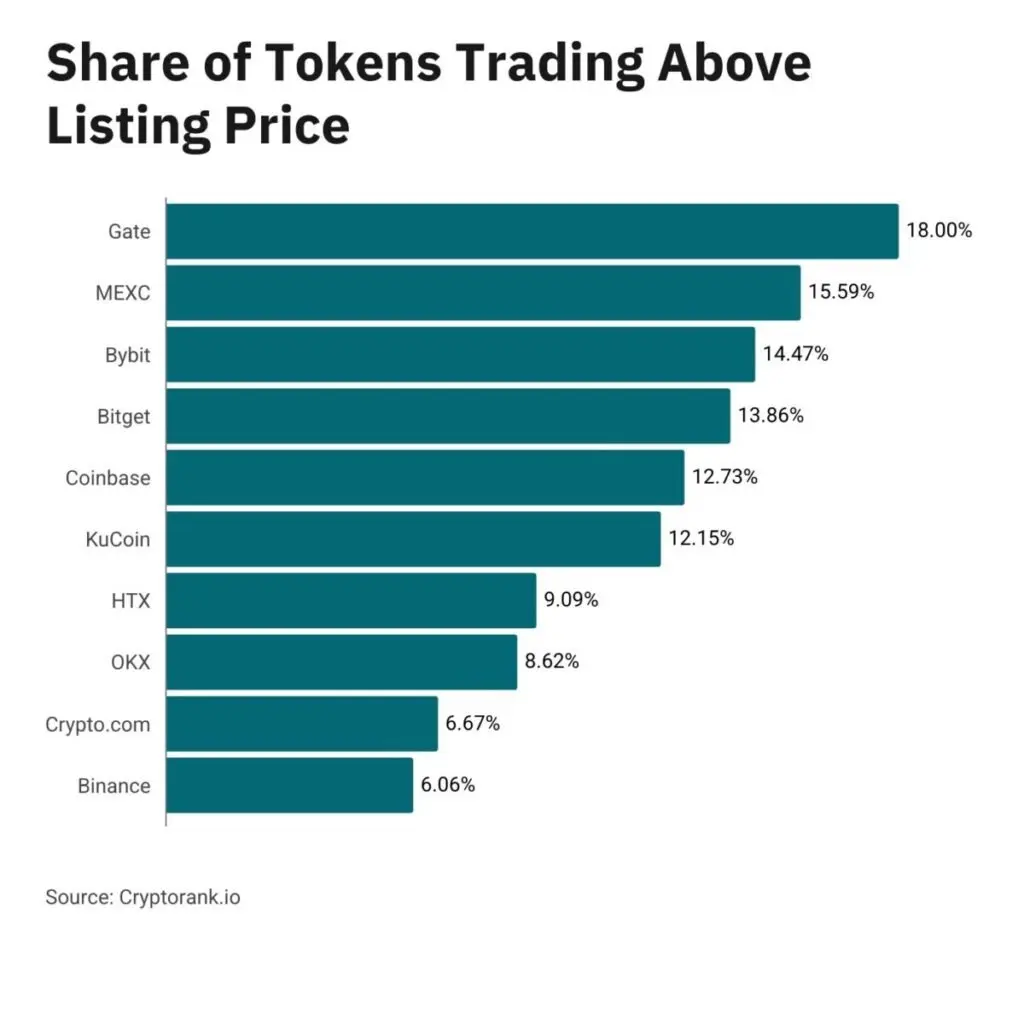
Tokens traded above the listed price chart. Source: Cryptrank.
Cayman Islands-based Gate.io is in ‘pole position’ in terms of relative token performance this year, with 18% of its tokens trading above their listed price. MEXC ranks second with 15.59%, followed by Bybit and Bitget with 14.47% and 13.86% respectively.
US-listed Coinbase and Seychelles’ KuCoin are concentrated in the middle, with 12.73% and 12.15% of their listed tokens trading above their debut price level. At the bottom, HTX recorded 9.09%, OKX 8.62%, Crypto.com 6.67%, and Binance rounded out the class with just 6.06%.
CEX is heavily traded, but the token’s performance is bleak
Looking at the positive vs. negative token launch chart shared by Cryptorank, performance leader MEXC has the most underperforming assets, with 800 tokens, and less than 200 tokens trading above the price they entered the market.
First in line in the previous category is Gate.io’s loss column with around 500 tokens traded, and above that just over 100 tokens. KuCoin also has a notable imbalance in ROI balance, with around 300 tokens with unforgettable performance versus a small number in positive territory.
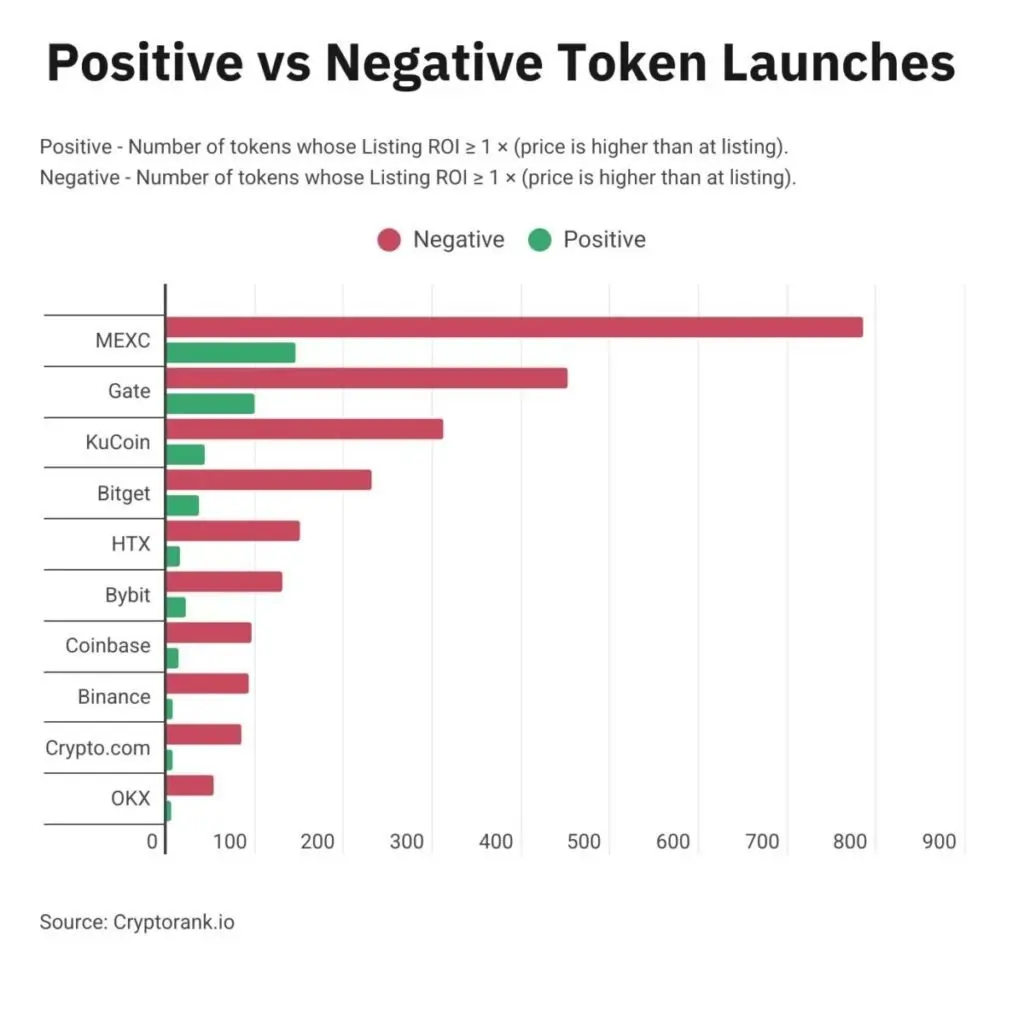
Positive Token ROI and Negative Token ROI. Source: Cryptrank.
Mid-sized exchange Bitget counts 250 tokens trading below their listing price and only a few dozen above it. HTX and Bybit have each recorded over 100 tokens under the surface. Finally, Coinbase and Binance still show a clear bias towards negative performance despite having fewer tokens listed overall.
Crypto market doom clouds come from Bitcoin’s volatile year
The crypto market this year was once again dominated by Bitcoin’s poor performance, sharing the spoils with altcoins. The largest coin by market capitalization is down almost 8% year-to-date, which is why the majority of traders believe we are in a bear market. The only times BTC ended the year in the red were in 2014, 2018, and 2022, all of which are considered bear years.
Bitcoin prices plummeted by 10% following the end of liquidation on October 10th, losing more than $14,000 in one session. “Gold is acting like Bitcoin. Bitcoin is acting like Boomer stocks. Boomer stocks are acting like meme coins. This is the worst possible timeline,” joked trader CryptoUB on X.
According to CryptoQuant contributor Wu Mingyu, the Bitcoin cycle momentum BCMI index fell to the 0.5 zone on October 21st, but market watchers did not consider this a cycle top.
Since then, Bitcoin price and BCMI have fallen further as the market resets its price levels and sellers return their coins to the market. Umingyu explained that at the bottom of meaningful cycles, such as in 2019 and 2023, the BCMI reached a range of 0.25 to 0.35. This could mean that BTC may not be able to maintain its upward momentum until at least the first quarter of 2026.
As of this update, Bitcoin was trading around $86,881, down just under 1% on the day. A recovery attempt in early trading briefly pushed the price towards the $87,000-$89,000 range, but the bulls were unable to sustain the momentum.
A consolidation below the psychologically important $90,000 level is not what Maxis was looking for over Christmas, and if downward pressure resumes, Bitcoin could test $84,000 or fall to the $82,000-$83,000 support level.
In other news, the US Spot Bitcoin ETF recorded net outflows of $188.64 million on Tuesday, according to data from SoSoValue. Cumulative net inflows into this investment vehicle currently stand at $57.08 billion, with total assets held in BTC funds at $114.29 billion, just over 6% of Bitcoin’s market capitalization.


