

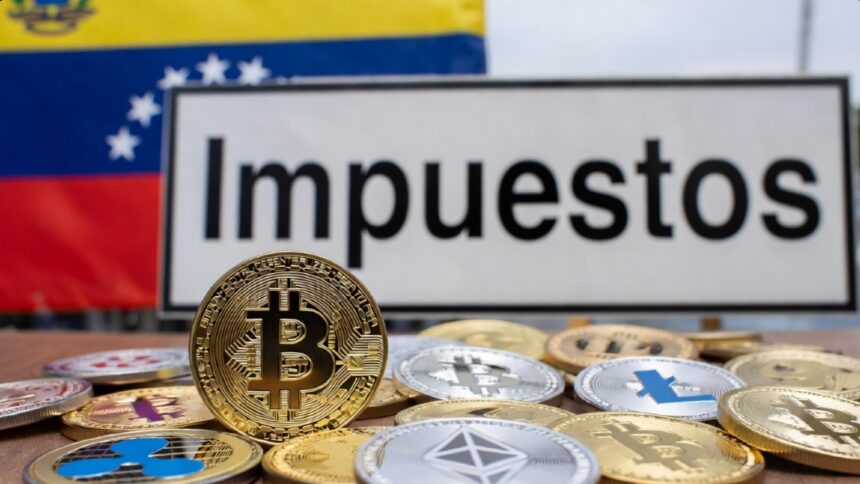
This year, as in previous years, Bitcoin (BTC) and the crypto ecosystem are facing financial pressure from the United States. Venezuela cannot escape from this.
In Caribbean countries, Individuals and companies using crypto assets must declare their holdings and commercial activities. Unless you intend to face sanctions, you will appeal to the tax authorities, in this case the State General Customs and Tax Administration (Seniat).
According to a report from CriptoNoticias, there are two weeks left until the end of the income tax (ISLR) filing period in Venezuela, where cryptocurrencies are prominent.
As established, profits earned through cryptocurrencies must also be reported, as well as stock holdings. Rules that apply to people staying in the country for more than 5 months It generates income of over 40 USD Tether (USDT).
Beyond these statements, there is a whole regulatory framework in place in Venezuela that grants government permission. The collection of taxes on the use of cryptocurrencies dates back more than six years.
For this reason, CriptoNoticias offers 5 keys to understanding the whole cryptocurrency tax in Venezuela. Let’s take a look.
1. Tax collection using virtual currency
The first piece of information to understand the nature of taxes in Venezuela is that the country has issued an ordinance that allows taxes to be collected in virtual currencies as well.
For example, Decree No. 3,719 stands out and became a milestone in Venezuelan tax policy by providing for taxpayers who conduct business in foreign currencies or “virtual currencies.” They must pay duty in the same denomination.
The measure, published in Extraordinary Official Gazette No. 6,420 of 28 December 2018, requires states to directly recover assets with international reserves; Avoid the loss of tax value due to bolivar inflation.
Not only the main tax, but also incidentals (interest) and penalties for violations must be settled in this way.
However, in daily practice, Seniat Do not receive cryptocurrencies directly in your account. Although the Decree is still in effect and has not been repealed, the collection system prevents official wallets from receiving payments from ordinary users.
Instead of transferring crypto assets directly to tax organizations, a forced conversion will take place. At declaration time, the system or form must express the operation in bolivars.
To do this, equality is used. That is, the value of the cryptocurrency is taken in dollars and converted to bolivars. Uses the official rate of the Central Bank of Venezuela (BCV) Date of surgery.
In this way, even if the profits are in Ether, Bitcoin or other crypto assets, the final payment made through the National Bank (by transfer or box office) will be in Bolívars.
Although the spirit of this statute is met by requiring the actual value of assets to be declared, Payments are still anchored to the traditional banking system in local currencies.
This dynamic was reaffirmed in Decree 4,025 of 2019, which directed the presentation of financial statements in crypto assets “without prejudice to their registration in bolivars.” In accounting terms, this means that a company can maintain its books to reflect that it holds 2 ETH, but for the purpose of paying taxes on the Seniat, that holding will be converted into a bolivar equivalent according to the official market.
Therefore, the form requesting “0.02 ETH” will not be displayed. However, it is the amount in bolivars that represents the value of that ETH, and the country can receive taxes that have not been depreciated during the fiscal year.
2. IGTF and strategic exemptions
The large financial transaction tax (IGTF) stands out as the second key piece of information for understanding Venezuelan tax developments. This might be This is the most current tribute to the daily lives of Venezuelans who use cryptocurrencies. By Decree No. 4,647, the government established that payments made in crypto assets are subject to tax.
However, the key for the average user is the exemption. Payments to individuals or businesses that are not Specially Exempted Subjects (SPE) are exempt. This facilitates retail transactions and the use of crypto assets between individuals. The claim amount has not reached the amount to be classified as a special taxpayer. by Seniat.
Another important exemption route is conversion to bolivars through the financial system. If a user sells BTC on a Bolivar authorized exchange and uses the Bolivar to send money or pay with a debit card; This operation does not generate an IGTF taxable event at final consumption.
According to tax experts consulted by CriptoNoticias, such as Alberto Barboza, this “currency settlement” to obtain bolivars in the national accounts will Mobilizing digital assets into the real economy You do not have to pay the 3% or higher tax that applies to direct virtual currency payments to establishments.
It is important to understand the moment when tax liability arises. Taxes are incurred the moment your account is debited or your debt is cancelled. The regulation proposes to protect recipients from penalties when withdrawing funds if they are sent from abroad through a licensed institution.
However, the wording of these exemptions is often technical and sometimes vague, requiring crypto holders to: Keep detailed records of each transaction To distinguish which operations are taxable and which benefit from exemptions.
3. Accounting Regulations BA VEN-NIF 12
Third, we have the approval of the VEN-NIF 12 bulletin by the Venezuelan Federation of Certified Public Accountants (FCCPV). This document provided countries with professional standards for the accounting records of cryptoassets. This standard focuses on “owning it” and applies to individuals or businesses that have complete control over their private keys within a wallet or software.
Measuring value is one of the pillars of this newsletter. Assets must initially be recorded in bolivars at historical cost, but must be constantly updated based on market value.
If the price of Bitcoin increases, the difference must be recorded in the “Crypto Asset Gain/Loss” section. This strict accounting treatment allows Venezuelan companies to prevent devaluation of assetsThe final report must be consolidated based on local regulations, as the accounting reflects the actual market value of the digital reserves.
Finally, presentation in financial statements depends on the intended use. If a crypto asset is used for current operations within a period of less than one year, it is classified as a current asset. Otherwise, it is non-current.
This distinction is critical to a company’s financial health and transparency to third parties. Furthermore, the breaking news is that Disclose certain details in the notes to the financial statementsThings like cryptocurrency types, price measurement sources, and change adjustments that account for whether your balances have changed due to new purchases, sales, or simple market fluctuations.
4. ISLR Declaration for Natural Persons and P2P
The fourth important piece of information is your Income Tax Return (ISLR). This is the largest annual commitment amount for the average cryptocurrency user in the country.
According to current regulations for fiscal year 2025, anyone who has resided in the country for more than 183 days and earns more than the minimum threshold (estimated at 30-40 USDT per month) must declare. Furthermore, profits derived from the disposal (sale or exchange) of digital assets constitute territorial income. You must report using form DPN 25 on the electronic portal.
To comply with this obligation, taxpayers must strive to be transparent, something many omit due to ignorance. You need to calculate net income, which is the difference between the sales amount and the documented acquisition cost. This requires users to save screenshots, exchange receipts, and submit reports through the P2P platform.
At the time of filling out the form, these incomes will be consolidated and the system will give you the option to pay the resulting tax in up to three installments. This will ease cash flow for the public in the face of high amounts.
Compliance with ISLR is not only a legal obligation, but also an economic safeguard. In an environment where national banks are increasingly seeking additional support for financial sources to avoid account blockades, tax returns containing income from crypto assets serve as legal proof of income.
As accounting technology experts such as Jan Domínguez, CEO and founder of the Cointable app, have pointed out, it changed the history of digital trading by declaring that BTC profits could be legally “banked.” In accounting documents with institutional validity.
5. Sanctions for inaction
The last important fact to understand taxes in Venezuela is the existence of sanctions for ignoring tax obligations. In general, the economic risks far outweigh the savings from avoidance.
The Organic Taxation Act (COT) imposes severe penalties for failure to declare income and tax evasion. Fines range from 100% to 300% of the leaked tax and if fraud or an organized intention to conceal information is detected. The legal framework also contemplates penalties that limit freedoms.
The seriousness of the system is reflected in the figure of the sentient agent and the special passive subject. Because penalties for not withholding or paying taxes can reach up to 500% of the amount, companies and agencies rarely accept excuses for not enforcing the law.
For individual users, omitted income in the final ISLR return may trigger alerts in the Seniat cross-information system, which may result in tax disputes and interest arrears. And his record was left with a stain that would complicate future administrative procedures.
Beyond fines, there is a significant operational risk of loss of access to the financial system. The lack of traceability and the inability to justify the increase in assets before Sudevan and the bank may result in the bank account being closed due to anti-money laundering compliance.
Venezuela’s cryptocurrency tax ecosystem represents a compliance challenge that should not be underestimated by any user, natural or legal.
Declaring profits or holdings and understanding the tax implications is more than just an administrative procedure. Necessary financial risk management measures to avoid sanctions.
In an environment where banks tighten their control over the origin of funds, maintaining up-to-date tax returns could serve as a key legal support for legitimizing crypto operations in the country.
(Tag translation) Bitcoin (BTC)


